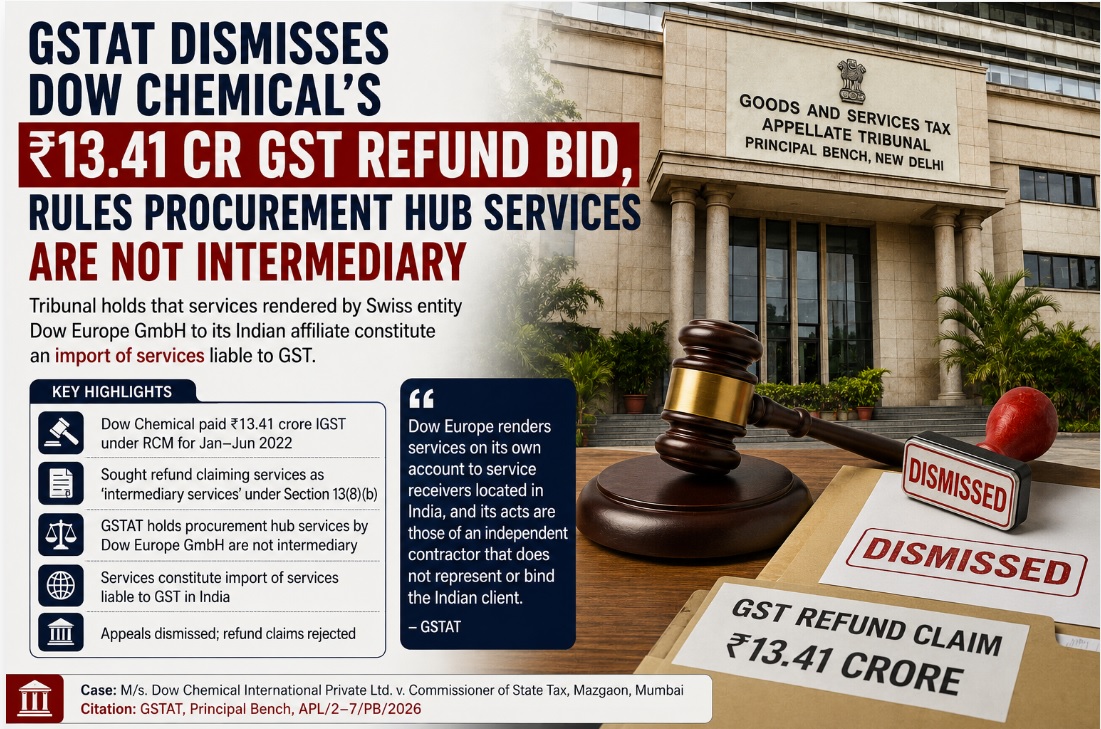
Tribunal holds that services rendered by Swiss entity Dow Europe GmbH to its Indian affiliate constitute an import of services liable to GST, rejecting the reclassification as exempt intermediary services.
GST Appellate Tribunal, Principal Bench | NEW DELHI
The GST Appellate Tribunal (GSTAT), Principal Bench, has dismissed a batch of six appeals filed by M/s Dow Chemical International Private Limited, declining to grant refunds aggregating approximately ₹13.41 crore in Integrated GST paid under the Reverse Charge Mechanism (RCM) for the period January to June 2022.
The Bench comprising Hon’ble Justice (Retd.) Dr. Sanjaya Kumar Mishra, President, and Hon’ble Shri Anil Kumar Gupta, Member (Technical), upheld the orders passed by the Joint Commissioner of State Tax (Appeals), Raigad Division, and held that the procurement services provided by Dow Europe GmbH, the Switzerland-based group entity, constitute an import of services taxable in India and do not qualify as “intermediary services” under Section 2(13) of the IGST Act.
Background
Dow Chemical India entered into a Procurement Agreement dated 1 July 2021 with Dow Europe GmbH, which functions as the centralised procurement hub for the global Dow Group.
Under the agreement, Dow Europe undertook a wide range of procurement-related activities, including identification and approval of foreign suppliers, negotiation of procurement terms, development of sourcing strategies, and execution of contracts and purchase orders on behalf of the group.
During the period in dispute, Dow India treated these services as an “import of services” under Section 2(11) of the IGST Act and discharged IGST under the Reverse Charge Mechanism on payments made to Dow Europe. The tax paid ranged from ₹38.56 lakh for June 2022 to ₹7.81 crore for January 2022, aggregating approximately ₹13.41 crore.
Subsequently, the company revised its position and contended that the services were in the nature of “intermediary services” as defined under Section 2(13) of the IGST Act. According to the company, the place of supply would therefore be outside India, namely Switzerland, by virtue of Section 13(8)(b) of the IGST Act.
Based on this position, Dow India reversed the input tax credit and filed refund claims for the IGST paid under RCM. The refund applications were rejected by both the Adjudicating Authority and the First Appellate Authority, leading to the present appeals before the Tribunal.
Appellant’s Arguments
Appearing for the appellant, counsel submitted that Dow Europe squarely satisfied the statutory definition of an “intermediary” as it arranged and facilitated the supply of goods between Dow India and independent foreign suppliers without supplying the goods on its own account.
It was argued that the service fee, fixed at 3.5% of the procurement value, was commission-based and dependent upon actual procurement transactions, which is a characteristic feature of intermediary arrangements. It was further submitted that no consideration was payable in periods when no procurement activity took place.
Reliance was placed on the Advance Ruling decisions in Airbus Group India Pvt. Ltd. and Global Reach Education Services Pvt. Ltd., where similar facilitation activities were held to qualify as intermediary services.
The appellant also relied upon CBIC Circular No. 159/15/2021-GST dated 20 September 2021 and argued that all three conditions prescribed therein for intermediary classification were fulfilled, namely:
- Existence of three parties;
- Presence of two distinct supplies; and
- Performance of a facilitative role rather than acting as a principal supplier.
The appellant submitted:
“The role of Dow Europe is not limited to a single transaction but extends to the entire procurement lifecycle—from strategy to contract negotiation to final sign-off.”
Revenue’s Contentions
The Revenue, represented by Ms. Shwetal Shepal, contended that Dow Europe was independently providing substantive procurement services, including procurement strategy, supplier relationship management, supplier risk management, quality audits, and spend analytics.
According to the Revenue, the arrangement amounted to procurement outsourcing on a principal-to-principal basis and therefore fell within the exclusionary portion of the intermediary definition contained in Section 2(13) of the IGST Act.
Reliance was placed on the Karnataka High Court’s decision in Columbia Sportswear India Sourcing Pvt. Ltd. (26 April 2025), where buying support services rendered as an independent contractor were held not to constitute intermediary services.
The Revenue further pointed out that Clause 6 of the Procurement Agreement expressly provided that Dow Europe was not authorised to bind Dow India, thereby reinforcing its status as an independent service provider.
Tribunal’s Findings
The Tribunal noted that there exist divergent judicial authorities on the scope of intermediary services.
Reference was made to the decisions of the Delhi High Court in Blackberry India Private Limited and the Punjab and Haryana High Court in Genpact India Pvt. Ltd., both of which held that services rendered by Indian entities to foreign affiliates constituted exports rather than intermediary services.
However, the Tribunal observed that the present matter involved the reverse factual situation, namely a foreign entity rendering services to an Indian company.
Applying the three-part test contained in CBIC Circular No. 159/15/2021-GST, the Tribunal accepted that three parties were involved in the broader transaction. However, it held that the requirement of two distinct supplies was not satisfied.
The Tribunal observed that Dow Europe and Dow India are both subsidiaries of Dow Inc. and that the services rendered by Dow Europe as the group’s centralised procurement hub constituted a substantive group-level procurement function rather than a mere facilitation of supplies between independent principals.
The Tribunal observed:
“Dow Europe renders services on its own account to service receivers located in India, and its acts are those of an independent contractor that does not represent or bind the Indian client.”
The Tribunal also disagreed with the First Appellate Authority’s observation that the refund claims were liable to be rejected merely because the tax had initially been paid voluntarily.
It observed that Section 54 of the CGST Act permits refund claims even where tax has been paid under a mistaken understanding of law, and such claims cannot be rejected solely on that ground.
Nevertheless, on the substantive issues relating to classification of services, intermediary status, place of supply, and entitlement to refund, the Tribunal decided all issues against the appellant.
Accordingly, all six appeals were dismissed and the orders of the First Appellate Authority were affirmed.
Key Takeaway
The ruling highlights the importance of the exclusionary limb of Section 2(13) of the IGST Act. Where a foreign group entity independently performs substantive services on a principal-to-principal basis, the transaction may be treated as an import of services liable to GST in India even if multiple parties are involved in the broader commercial arrangement.
Businesses relying upon intermediary classification for inbound group services may need to closely examine whether the overseas entity is merely facilitating supplies between independent parties or is itself providing substantive services on its own account.
Citation: M/s Dow Chemical International Private Ltd. v. Commissioner of State Tax, Mazgaon, Mumbai — GSTAT, Principal Bench, APL/2–7/PB/2026.
Leave a Reply