Tag: tax litigation india

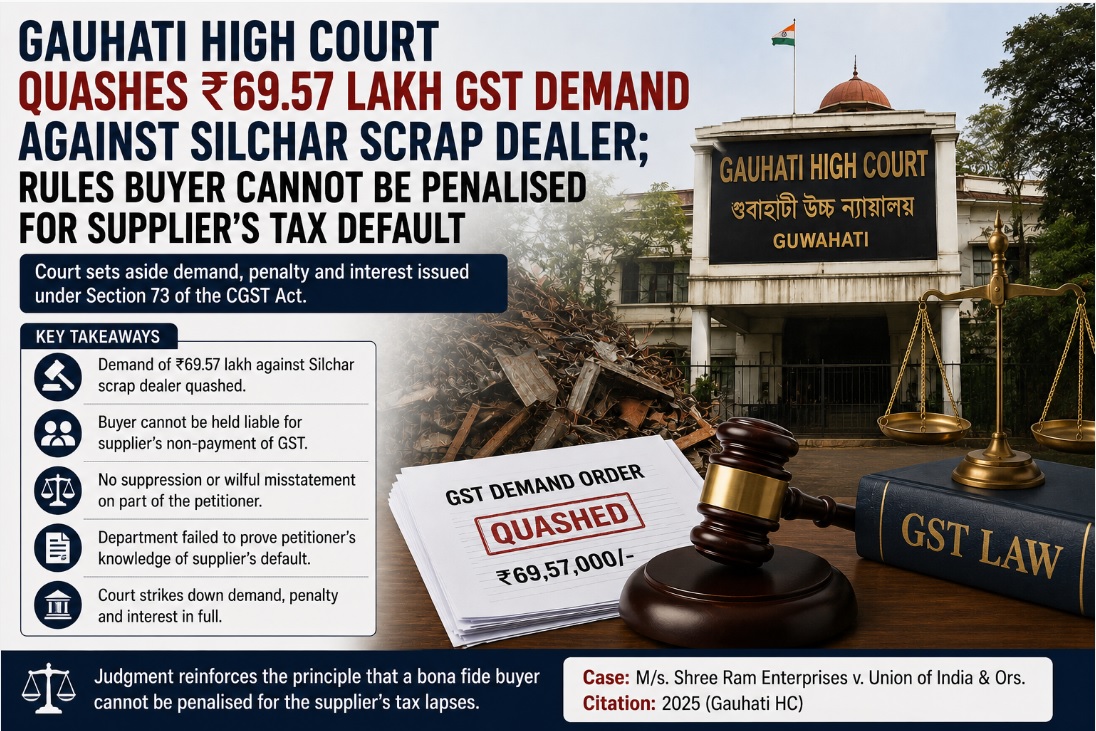
  • Gauhati High Court Quashes ₹69.57 Lakh GST Demand Against Silchar Scrap Dealer; Rules Buyer Cannot Be Penalised for Supplier’s Tax Default

    Gauhati High Court Quashes ₹69.57 Lakh GST Demand Against Silchar Scrap Dealer; Rules Buyer Cannot Be Penalised for Supplier’s Tax Default

    Court reaffirms that a bona fide purchasing dealer who has duly paid GST to a registered seller cannot be denied input tax credit merely because the seller failed to remit the tax to the government.

    Gauhati High Court | GUWAHATI

    In a significant ruling for trading and manufacturing businesses, the Gauhati High Court has set aside a demand order of ₹69,56,794 raised against Sri Gurucharan Kangsa Banik, proprietor of M/s Sree Guru Metals, Silchar. The demand comprised IGST of ₹50.19 lakh, CGST of ₹9.69 lakh, and SGST of ₹9.69 lakh, along with an equivalent penalty.

    Hon’ble Mr. Justice Kardak Ete held that a purchasing dealer who acts in good faith and pays GST to a registered supplier cannot be penalised if the supplier subsequently fails to deposit the tax with the government.

    The Court followed the Division Bench judgment in National Plasto Moulding v. State of Assam & Ors. [2024] 129 GSTR 544 (Gauhati), which in turn relied upon the Delhi High Court’s decision in On Quest Merchandising India Pvt. Ltd. v. Government of NCT of Delhi [2018] 56 GSTR 177 (Delhi). Counsel appearing for both the petitioner and the Revenue accepted that the issue was covered by these decisions.

    Facts of the Case

    M/s Sree Guru Metals is engaged in the business of procurement and sale of scrap and waste batteries.

    During the financial years 2017-18 and 2018-19, the proprietorship purchased goods from suppliers located in Kolkata and paid the applicable GST along with the purchase consideration through banking channels. The transactions were supported by valid tax invoices.

    Following the introduction of the GST regime in July 2017, the business encountered certain compliance-related issues, including discrepancies between GSTR-1 and GSTR-3B arising from data-entry errors relating to reporting of output tax liability and input tax credit.

    Pursuant to a summons issued by the Directorate General of GST Intelligence (DGGI), Guwahati Zonal Unit, the petitioner appeared before the authorities on 5 April 2019 and furnished all relevant records, including GST returns and purchase invoices.

    A search conducted at the business premises on 9 July 2019 did not result in recovery of any incriminating material.

    The Demand and the Challenge

    Despite the petitioner’s cooperation, a Show Cause Notice dated 26 August 2022 was issued alleging wrongful availment of ITC amounting to ₹69.56 lakh under Section 16(2)(a) and Section 16(2)(b) of the CGST Act on the ground that the underlying goods had not actually been received.

    Thereafter, an Order-in-Original dated 28 March 2024 was passed confirming the demand together with interest under Section 50 and an equivalent penalty under Section 74(1) read with Section 122 of the CGST Act.

    The petitioner challenged the order on several grounds.

    It was contended that no effective opportunity of hearing had been granted, as notices were manually served after the dates fixed for hearing and were not uploaded on the GST portal. It was also argued that Form GST DRC-07 had not been issued prior to passing the order.

    On merits, the petitioner submitted that all statutory conditions prescribed under Section 16(2) had been fulfilled. The goods had been received, genuine tax invoices had been issued, and payment including GST had been made through banking channels.

    According to the petitioner, the sole basis for denial of ITC was the alleged failure of the suppliers to deposit the tax collected from the petitioner, a circumstance entirely beyond the purchaser’s control.

    The petitioner further raised a limitation challenge, contending that a part of the disputed period was governed by Section 73 of the CGST Act and that the statutory limitation for proceedings under that provision had already expired. Consequently, invocation of Section 74 was stated to be impermissible.

    An additional objection was raised against the clubbing of multiple assessment years into a single adjudication order.

    Court’s Reasoning

    The Court held that the controversy stood squarely covered by the Division Bench judgment in National Plasto Moulding, which had adopted the reasoning of the Delhi High Court in On Quest Merchandising.

    The Division Bench had held that where a purchasing dealer bona fide enters into transactions with a validly registered supplier, pays the tax component, and otherwise complies with the statutory requirements, denial of ITC merely because the selling dealer fails to deposit the tax with the government is impermissible.

    The Court referred to the following observation in National Plasto Moulding:

    “A purchasing dealer cannot be punished for the act of a selling dealer who has failed to deposit the tax collected by it.”

    The Court also noted that the Delhi High Court in On Quest Merchandising had read down Section 9(2)(g) of the Delhi VAT Act—the provision analogous to Sections 16(2)(c) and 16(2)(d) of the CGST Act—to exclude bona fide purchasing dealers from its scope.

    The Delhi High Court had reasoned that a literal interpretation would impose an impossible burden on a purchaser and could render the provision vulnerable to challenge under Article 14 of the Constitution.

    The Court further noted that the Special Leave Petition filed against the Delhi High Court’s judgment had been dismissed by the Supreme Court, while preserving liberty for the authorities to proceed in cases where the transactions were not bona fide.

    Accepting that the legal position stood settled, the Gauhati High Court set aside the impugned Order-in-Original.

    At the same time, the Court preserved the department’s right to proceed against the petitioner if material subsequently emerges showing that the transactions were not genuine or were entered into in collusion with the suppliers.

    Significance

    The decision adds to the growing body of judicial authority protecting bona fide purchasers from adverse consequences arising solely from a supplier’s failure to discharge tax liability.

    The ruling reiterates that where a purchaser has acted in good faith, obtained valid tax invoices, received the goods, and paid the consideration including GST, denial of ITC cannot be justified merely because the supplier defaults in remitting tax to the government.

    The Court, however, recognised the distinction between genuine transactions and collusive arrangements. Where the department is able to establish that transactions were not bona fide or lacked commercial substance, it remains open to the authorities to invoke the statutory provisions and deny the benefit of ITC.

    Citation: Sri Gurucharan Kangsa Banik v. Union of India & Ors. — Gauhati High Court, Writ Petition (arising from Order-in-Original No. 37/GST/AC/SIL/2023-24 dated 28.03.2024).
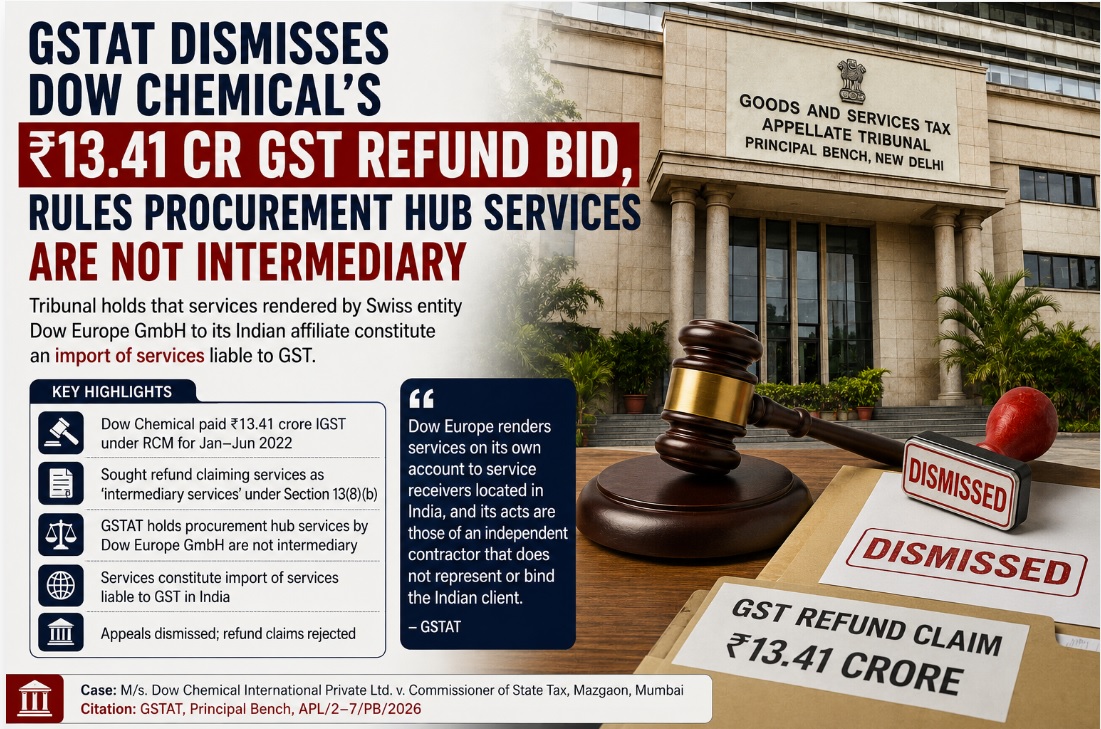
  • GSTAT Dismisses Dow Chemical’s ₹13.41 Cr GST Refund Bid, Rules Procurement Hub Services Are Not Intermediary

    GSTAT Dismisses Dow Chemical’s ₹13.41 Cr GST Refund Bid, Rules Procurement Hub Services Are Not Intermediary

    Tribunal holds that services rendered by Swiss entity Dow Europe GmbH to its Indian affiliate constitute an import of services liable to GST, rejecting the reclassification as exempt intermediary services.

    GST Appellate Tribunal, Principal Bench | NEW DELHI

    The GST Appellate Tribunal (GSTAT), Principal Bench, has dismissed a batch of six appeals filed by M/s Dow Chemical International Private Limited, declining to grant refunds aggregating approximately ₹13.41 crore in Integrated GST paid under the Reverse Charge Mechanism (RCM) for the period January to June 2022.

    The Bench comprising Hon’ble Justice (Retd.) Dr. Sanjaya Kumar Mishra, President, and Hon’ble Shri Anil Kumar Gupta, Member (Technical), upheld the orders passed by the Joint Commissioner of State Tax (Appeals), Raigad Division, and held that the procurement services provided by Dow Europe GmbH, the Switzerland-based group entity, constitute an import of services taxable in India and do not qualify as “intermediary services” under Section 2(13) of the IGST Act.

    Background

    Dow Chemical India entered into a Procurement Agreement dated 1 July 2021 with Dow Europe GmbH, which functions as the centralised procurement hub for the global Dow Group.

    Under the agreement, Dow Europe undertook a wide range of procurement-related activities, including identification and approval of foreign suppliers, negotiation of procurement terms, development of sourcing strategies, and execution of contracts and purchase orders on behalf of the group.

    During the period in dispute, Dow India treated these services as an “import of services” under Section 2(11) of the IGST Act and discharged IGST under the Reverse Charge Mechanism on payments made to Dow Europe. The tax paid ranged from ₹38.56 lakh for June 2022 to ₹7.81 crore for January 2022, aggregating approximately ₹13.41 crore.

    Subsequently, the company revised its position and contended that the services were in the nature of “intermediary services” as defined under Section 2(13) of the IGST Act. According to the company, the place of supply would therefore be outside India, namely Switzerland, by virtue of Section 13(8)(b) of the IGST Act.

    Based on this position, Dow India reversed the input tax credit and filed refund claims for the IGST paid under RCM. The refund applications were rejected by both the Adjudicating Authority and the First Appellate Authority, leading to the present appeals before the Tribunal.

    Appellant’s Arguments

    Appearing for the appellant, counsel submitted that Dow Europe squarely satisfied the statutory definition of an “intermediary” as it arranged and facilitated the supply of goods between Dow India and independent foreign suppliers without supplying the goods on its own account.

    It was argued that the service fee, fixed at 3.5% of the procurement value, was commission-based and dependent upon actual procurement transactions, which is a characteristic feature of intermediary arrangements. It was further submitted that no consideration was payable in periods when no procurement activity took place.

    Reliance was placed on the Advance Ruling decisions in Airbus Group India Pvt. Ltd. and Global Reach Education Services Pvt. Ltd., where similar facilitation activities were held to qualify as intermediary services.

    The appellant also relied upon CBIC Circular No. 159/15/2021-GST dated 20 September 2021 and argued that all three conditions prescribed therein for intermediary classification were fulfilled, namely:

    • Existence of three parties;
    • Presence of two distinct supplies; and
    • Performance of a facilitative role rather than acting as a principal supplier.

    The appellant submitted:

    “The role of Dow Europe is not limited to a single transaction but extends to the entire procurement lifecycle—from strategy to contract negotiation to final sign-off.”

    Revenue’s Contentions

    The Revenue, represented by Ms. Shwetal Shepal, contended that Dow Europe was independently providing substantive procurement services, including procurement strategy, supplier relationship management, supplier risk management, quality audits, and spend analytics.

    According to the Revenue, the arrangement amounted to procurement outsourcing on a principal-to-principal basis and therefore fell within the exclusionary portion of the intermediary definition contained in Section 2(13) of the IGST Act.

    Reliance was placed on the Karnataka High Court’s decision in Columbia Sportswear India Sourcing Pvt. Ltd. (26 April 2025), where buying support services rendered as an independent contractor were held not to constitute intermediary services.

    The Revenue further pointed out that Clause 6 of the Procurement Agreement expressly provided that Dow Europe was not authorised to bind Dow India, thereby reinforcing its status as an independent service provider.

    Tribunal’s Findings

    The Tribunal noted that there exist divergent judicial authorities on the scope of intermediary services.

    Reference was made to the decisions of the Delhi High Court in Blackberry India Private Limited and the Punjab and Haryana High Court in Genpact India Pvt. Ltd., both of which held that services rendered by Indian entities to foreign affiliates constituted exports rather than intermediary services.

    However, the Tribunal observed that the present matter involved the reverse factual situation, namely a foreign entity rendering services to an Indian company.

    Applying the three-part test contained in CBIC Circular No. 159/15/2021-GST, the Tribunal accepted that three parties were involved in the broader transaction. However, it held that the requirement of two distinct supplies was not satisfied.

    The Tribunal observed that Dow Europe and Dow India are both subsidiaries of Dow Inc. and that the services rendered by Dow Europe as the group’s centralised procurement hub constituted a substantive group-level procurement function rather than a mere facilitation of supplies between independent principals.

    The Tribunal observed:

    “Dow Europe renders services on its own account to service receivers located in India, and its acts are those of an independent contractor that does not represent or bind the Indian client.”

    The Tribunal also disagreed with the First Appellate Authority’s observation that the refund claims were liable to be rejected merely because the tax had initially been paid voluntarily.

    It observed that Section 54 of the CGST Act permits refund claims even where tax has been paid under a mistaken understanding of law, and such claims cannot be rejected solely on that ground.

    Nevertheless, on the substantive issues relating to classification of services, intermediary status, place of supply, and entitlement to refund, the Tribunal decided all issues against the appellant.

    Accordingly, all six appeals were dismissed and the orders of the First Appellate Authority were affirmed.

    Key Takeaway

    The ruling highlights the importance of the exclusionary limb of Section 2(13) of the IGST Act. Where a foreign group entity independently performs substantive services on a principal-to-principal basis, the transaction may be treated as an import of services liable to GST in India even if multiple parties are involved in the broader commercial arrangement.

    Businesses relying upon intermediary classification for inbound group services may need to closely examine whether the overseas entity is merely facilitating supplies between independent parties or is itself providing substantive services on its own account.

    Citation: M/s Dow Chemical International Private Ltd. v. Commissioner of State Tax, Mazgaon, Mumbai — GSTAT, Principal Bench, APL/2–7/PB/2026.