Tag: GST Refund

  • GSTAT Dismisses Dow Chemical’s ₹13.41 Cr GST Refund Bid, Rules Procurement Hub Services Are Not Intermediary

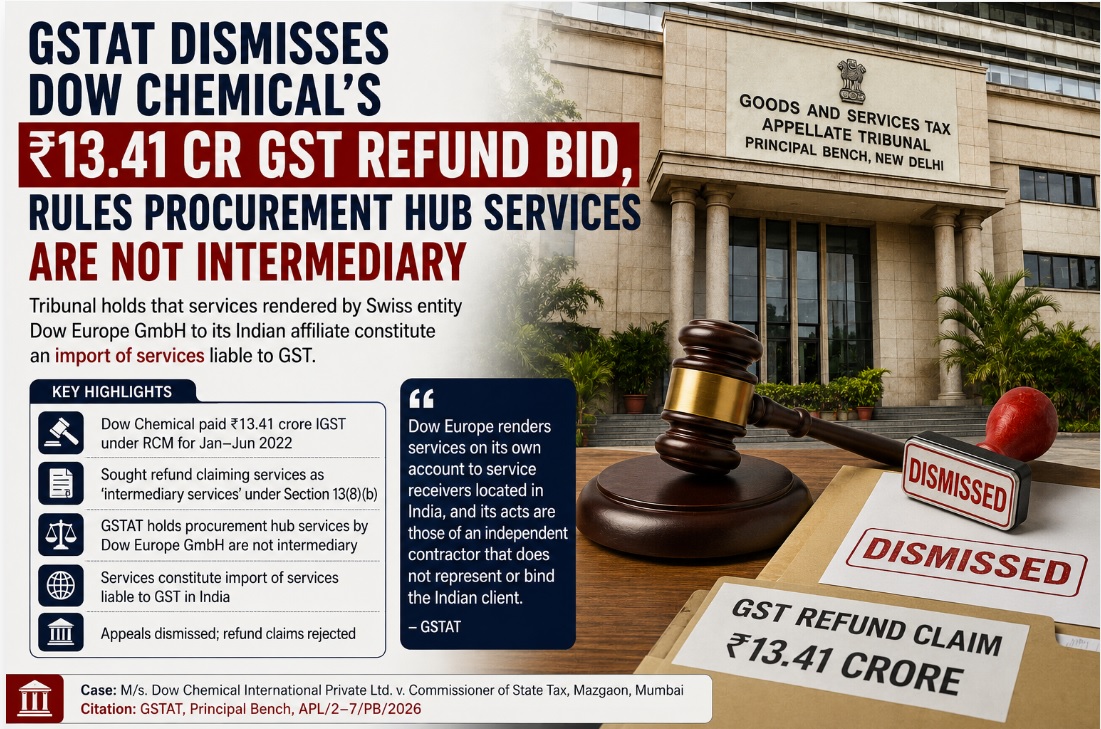
    GSTAT Dismisses Dow Chemical’s ₹13.41 Cr GST Refund Bid, Rules Procurement Hub Services Are Not Intermediary

    Tribunal holds that services rendered by Swiss entity Dow Europe GmbH to its Indian affiliate constitute an import of services liable to GST, rejecting the reclassification as exempt intermediary services.

    GST Appellate Tribunal, Principal Bench | NEW DELHI

    The GST Appellate Tribunal (GSTAT), Principal Bench, has dismissed a batch of six appeals filed by M/s Dow Chemical International Private Limited, declining to grant refunds aggregating approximately ₹13.41 crore in Integrated GST paid under the Reverse Charge Mechanism (RCM) for the period January to June 2022.

    The Bench comprising Hon’ble Justice (Retd.) Dr. Sanjaya Kumar Mishra, President, and Hon’ble Shri Anil Kumar Gupta, Member (Technical), upheld the orders passed by the Joint Commissioner of State Tax (Appeals), Raigad Division, and held that the procurement services provided by Dow Europe GmbH, the Switzerland-based group entity, constitute an import of services taxable in India and do not qualify as “intermediary services” under Section 2(13) of the IGST Act.

    Background

    Dow Chemical India entered into a Procurement Agreement dated 1 July 2021 with Dow Europe GmbH, which functions as the centralised procurement hub for the global Dow Group.

    Under the agreement, Dow Europe undertook a wide range of procurement-related activities, including identification and approval of foreign suppliers, negotiation of procurement terms, development of sourcing strategies, and execution of contracts and purchase orders on behalf of the group.

    During the period in dispute, Dow India treated these services as an “import of services” under Section 2(11) of the IGST Act and discharged IGST under the Reverse Charge Mechanism on payments made to Dow Europe. The tax paid ranged from ₹38.56 lakh for June 2022 to ₹7.81 crore for January 2022, aggregating approximately ₹13.41 crore.

    Subsequently, the company revised its position and contended that the services were in the nature of “intermediary services” as defined under Section 2(13) of the IGST Act. According to the company, the place of supply would therefore be outside India, namely Switzerland, by virtue of Section 13(8)(b) of the IGST Act.

    Based on this position, Dow India reversed the input tax credit and filed refund claims for the IGST paid under RCM. The refund applications were rejected by both the Adjudicating Authority and the First Appellate Authority, leading to the present appeals before the Tribunal.

    Appellant’s Arguments

    Appearing for the appellant, counsel submitted that Dow Europe squarely satisfied the statutory definition of an “intermediary” as it arranged and facilitated the supply of goods between Dow India and independent foreign suppliers without supplying the goods on its own account.

    It was argued that the service fee, fixed at 3.5% of the procurement value, was commission-based and dependent upon actual procurement transactions, which is a characteristic feature of intermediary arrangements. It was further submitted that no consideration was payable in periods when no procurement activity took place.

    Reliance was placed on the Advance Ruling decisions in Airbus Group India Pvt. Ltd. and Global Reach Education Services Pvt. Ltd., where similar facilitation activities were held to qualify as intermediary services.

    The appellant also relied upon CBIC Circular No. 159/15/2021-GST dated 20 September 2021 and argued that all three conditions prescribed therein for intermediary classification were fulfilled, namely:

    • Existence of three parties;
    • Presence of two distinct supplies; and
    • Performance of a facilitative role rather than acting as a principal supplier.

    The appellant submitted:

    “The role of Dow Europe is not limited to a single transaction but extends to the entire procurement lifecycle—from strategy to contract negotiation to final sign-off.”

    Revenue’s Contentions

    The Revenue, represented by Ms. Shwetal Shepal, contended that Dow Europe was independently providing substantive procurement services, including procurement strategy, supplier relationship management, supplier risk management, quality audits, and spend analytics.

    According to the Revenue, the arrangement amounted to procurement outsourcing on a principal-to-principal basis and therefore fell within the exclusionary portion of the intermediary definition contained in Section 2(13) of the IGST Act.

    Reliance was placed on the Karnataka High Court’s decision in Columbia Sportswear India Sourcing Pvt. Ltd. (26 April 2025), where buying support services rendered as an independent contractor were held not to constitute intermediary services.

    The Revenue further pointed out that Clause 6 of the Procurement Agreement expressly provided that Dow Europe was not authorised to bind Dow India, thereby reinforcing its status as an independent service provider.

    Tribunal’s Findings

    The Tribunal noted that there exist divergent judicial authorities on the scope of intermediary services.

    Reference was made to the decisions of the Delhi High Court in Blackberry India Private Limited and the Punjab and Haryana High Court in Genpact India Pvt. Ltd., both of which held that services rendered by Indian entities to foreign affiliates constituted exports rather than intermediary services.

    However, the Tribunal observed that the present matter involved the reverse factual situation, namely a foreign entity rendering services to an Indian company.

    Applying the three-part test contained in CBIC Circular No. 159/15/2021-GST, the Tribunal accepted that three parties were involved in the broader transaction. However, it held that the requirement of two distinct supplies was not satisfied.

    The Tribunal observed that Dow Europe and Dow India are both subsidiaries of Dow Inc. and that the services rendered by Dow Europe as the group’s centralised procurement hub constituted a substantive group-level procurement function rather than a mere facilitation of supplies between independent principals.

    The Tribunal observed:

    “Dow Europe renders services on its own account to service receivers located in India, and its acts are those of an independent contractor that does not represent or bind the Indian client.”

    The Tribunal also disagreed with the First Appellate Authority’s observation that the refund claims were liable to be rejected merely because the tax had initially been paid voluntarily.

    It observed that Section 54 of the CGST Act permits refund claims even where tax has been paid under a mistaken understanding of law, and such claims cannot be rejected solely on that ground.

    Nevertheless, on the substantive issues relating to classification of services, intermediary status, place of supply, and entitlement to refund, the Tribunal decided all issues against the appellant.

    Accordingly, all six appeals were dismissed and the orders of the First Appellate Authority were affirmed.

    Key Takeaway

    The ruling highlights the importance of the exclusionary limb of Section 2(13) of the IGST Act. Where a foreign group entity independently performs substantive services on a principal-to-principal basis, the transaction may be treated as an import of services liable to GST in India even if multiple parties are involved in the broader commercial arrangement.

    Businesses relying upon intermediary classification for inbound group services may need to closely examine whether the overseas entity is merely facilitating supplies between independent parties or is itself providing substantive services on its own account.

    Citation: M/s Dow Chemical International Private Ltd. v. Commissioner of State Tax, Mazgaon, Mumbai — GSTAT, Principal Bench, APL/2–7/PB/2026.
  • GSTAT Dismisses Dow Chemical’s ₹13.41 Crore GST Refund Claims, Holds Swiss Affiliate’s Services Are Not “Intermediary”

    GSTAT Dismisses Dow Chemical’s ₹13.41 Crore GST Refund Claims, Holds Swiss Affiliate’s Services Are Not “Intermediary”

    India’s GST Appellate Tribunal upholds the Revenue’s position that procurement services rendered by Switzerland-based Dow Europe GmbH to its Indian affiliate constituted an import of services — rejecting six consolidated refund appeals spanning January to June 2022 and holding that a centralised group hub providing core services to a sister concern cannot be characterised as a mere facilitator.


    In a closely watched ruling, the Goods and Services Tax Appellate Tribunal’s Division Bench — comprising President Justice (Retd.) Dr. Sanjaya Kumar Mishra and Technical Member Shri Anil Kumar Gupta — on June 4, 2026 dismissed six consolidated appeals filed by M/s Dow Chemical International Private Limited, confirming the rejection of IGST refund claims totalling approximately ₹13.41 crore.

    The appeals arose after Dow India concluded — following an internal review — that it had erroneously discharged Integrated GST under the Reverse Charge Mechanism on fees paid to Dow Europe GmbH, a Switzerland-incorporated affiliate that serves as the centralised procurement hub for the global Dow Group. Dow India had initially treated the payments as imports of services. It later formed the view that Dow Europe’s activities qualified as “intermediary services” under Section 2(13) of the IGST Act, which would have placed the supply outside India’s GST net entirely.

    Background

    Under a Procurement Agreement dated July 1, 2021, Dow Europe was engaged to identify and approve foreign suppliers, negotiate procurement terms, review and sign contracts and purchase orders, develop procurement strategies, manage supplier relationships, and oversee quality and spend analytics. In return, Dow India paid a service fee equal to 3.5 per cent of total monthly purchases — with no fee payable in months where no procurement occurred.

    Under Section 13(8)(b) of the IGST Act, the place of supply for intermediary services is the location of the service supplier. Since Dow Europe is based in Switzerland, Dow India argued the transaction fell outside India’s GST net altogether. It reversed the input tax credit previously availed and filed refund applications. Both the Adjudicating Authority and the First Appellate Authority rejected the claims, finding that Dow Europe was rendering a core procurement outsourcing service — not mere ancillary facilitation.

    Arguments Before the Tribunal

    Before the GSTAT, counsel for Dow India argued that the statutory definition of “intermediary” is deliberately wide, covering brokers, agents, and “any other person, by whatever name called” who arranges or facilitates supply between two or more parties. The three-party structure — Dow India, Dow Europe, and the foreign supplier — together with the commission-linked fee and advance rulings from Karnataka and West Bengal (including Airbus Group India and Global Reach Education Services) were cited to support the intermediary classification.

    “The manner of remuneration is a key indicator of the nature of services. A commission-based structure clearly reflects a facilitative role.”

    — Shri Mihir Prashant Deshmukh, Counsel for Dow Chemical India

    The Revenue’s counsel countered by pointing to Appendix 1 of the Procurement Agreement, which detailed how Dow Europe independently conducted procurement strategy development, governance, supplier risk management, analytics, strategic sourcing, and quality audits. She characterised these as substantive, core operations rather than ancillary facilitation, and relied heavily on the Karnataka High Court’s April 2025 ruling in Columbia Sportswear India Sourcing Pvt. Ltd. — which held that a group entity providing buying-support services was an independent service provider, not an intermediary.

    The Tribunal’s Reasoning

    The GSTAT acknowledged a genuine tension in the existing case law. Two competing streams have emerged: one treating intra-group facilitation as intermediary services; the other — endorsed by the Karnataka and Delhi High Courts — treating substantive support rendered on a principal-to-principal basis as independent services. The Tribunal noted that Revenue has applied these standards inconsistently depending on the direction of cross-border supply, observing that “both views cannot be taken — one view is to be taken.”

    Applying the four prerequisites for intermediary classification laid down in CBIC Circular No. 159/15/2021-GST, the Bench found that while the first requirement — a minimum of three parties — was satisfied, the second was not. The services provided by Dow Europe could not be characterised as an ancillary supply facilitating a main supply between two independent principals because Dow Europe is itself a dedicated procurement hub whose very existence and purpose is to serve the global Dow Group — including Dow India — as a core, structural function of the group’s operations.

    The Tribunal aligned with the reasoning in Columbia Sportswear and the Delhi High Court’s Blackberry India ruling, holding that Dow Europe renders services on its own account as an independent contractor without authority to bind Dow India. The place of supply was therefore confirmed to be India, and the transaction held to constitute an import of services outside the scope of Section 13(8)(b) — which was itself omitted by the Finance Act, 2026 with effect from March 30, 2026.

    The Final Holding — Para 26 : Operative finding of the Tribunal

    The Tribunal expressly held that Dow Europe’s services cannot be termed “intermediary services” and are not in the nature of ancillary services. Rather, they constitute a core service rendered by Dow Europe to a sister concern — Dow India — both being subsidiaries operating within the same global group, Dow Inc. The intra-group, global-hub character of the arrangement was itself a decisive ground for rejecting the intermediary classification, independent of the principal-to-principal analysis.

    This framing is significant for practitioners. The Tribunal did not merely apply the Columbia Sportswear/Blackberry line of reasoning about independent contractors. It went a step further: where a foreign entity exists specifically as a centralised service hub for an entire global group, the very nature of that entity’s role makes it structurally incapable of being a “facilitator” between two other principals — it is itself the principal service provider to each group company it serves.

    On the Refund Claim

    The Tribunal did take issue with one finding of the First Appellate Authority. The lower authority had partly dismissed the refund claims on the ground that Dow India had originally paid tax voluntarily and was raising the intermediary argument as an afterthought. The GSTAT rejected this characterisation, noting that Section 54 of the CGST Act expressly provides for refund of taxes paid within a prescribed limitation period, and that a bona fide change of legal interpretation cannot disentitle a taxpayer from seeking a statutory refund. That observation, however, carried no practical weight given the Tribunal’s conclusion on the substantive issue.

    All six appeals were dismissed and the orders of the First Appellate Authority confirmed.

    Significance

    The ruling carries two practical lessons. First, where a foreign group entity functions as a dedicated centralised hub — for procurement, treasury, IT, HR, or any other shared function — serving the entire group worldwide, courts and tribunals are likely to treat its services to Indian affiliates as core imports rather than intermediary facilitation, regardless of the fee structure or three-party appearance of individual transactions. Second, the Tribunal’s pointed observation that Revenue has applied contradictory standards to outbound versus inbound intra-group services may give future litigants a basis to press for parity in cases where the flow runs the other way. The omission of Section 13(8)(b) by the Finance Act, 2026 will, going forward, significantly narrow the practical scope of such disputes.

    Dow Chemical International Private Limited was represented by Shri Mihir Prashant Deshmukh and Shri Shamik Gupte. The Commissioner of State Tax, Mazgaon, Mumbai was represented by Ms Shwetal Shepal.

  • Calcutta HC Quashes ₹6.28 Crore GST Demand: Omission of Rule 96(10) Wipes Out Pending IGST Refund Proceedings

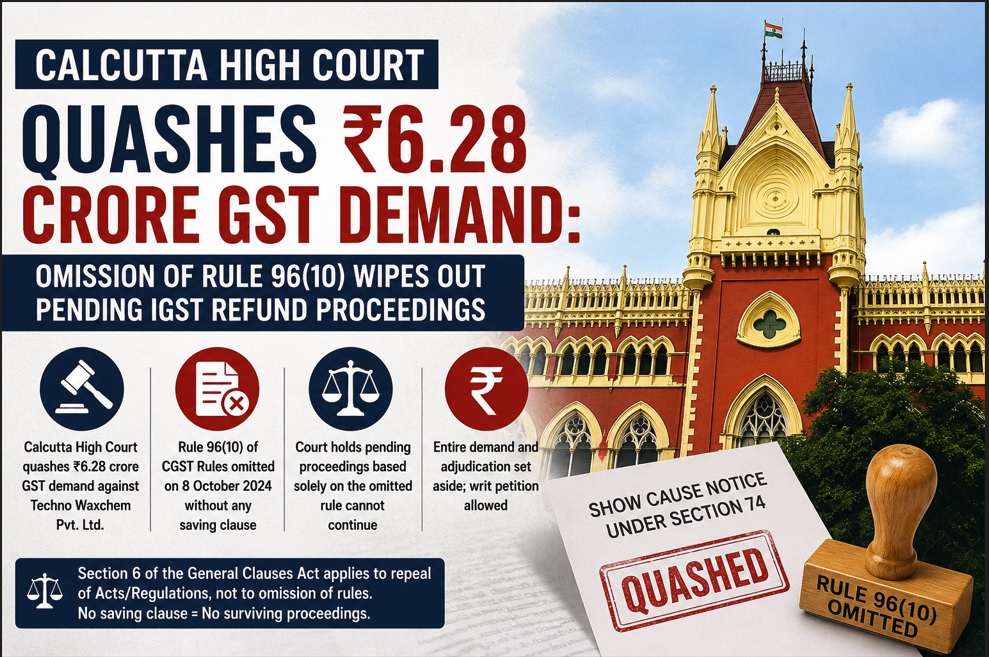
    Calcutta HC Quashes ₹6.28 Crore GST Demand: Omission of Rule 96(10) Wipes Out Pending IGST Refund Proceedings

    Kolkata, June 2026 – The Calcutta High Court has quashed a ₹6.28 crore tax demand against Techno Waxchem Private Limited, holding that the Government’s October 2024 decision to omit Rule 96(10) of the CGST Rules leaves no legal basis for continuing any pending enforcement proceedings under that provision. The ruling by Justice Raja Basu Chowdhury adds to a growing body of High Court jurisprudence that has effectively sounded the death knell for all outstanding show-cause notices, adjudication orders, and appeals rooted in the now-deleted anti-double-benefit restriction.


    The Dispute

    Techno Waxchem, a manufacturer and exporter of chemical products primarily used in the rubber industry — including modified formaldehyde resins, resorcinol blends, and related compounds — had, between October 2017 and March 2022, claimed and received IGST refunds totalling ₹6,28,27,407 on goods exported under the Advance Authorisation Scheme.

    Under the Advance Authorisation framework, exporters are permitted duty-free import of inputs. The rub, according to the revenue authorities, was Rule 96(10) of the CGST Rules, 2017. That provision barred an exporter who had availed duty-free imports under specified Customs notifications from simultaneously claiming a refund of IGST paid on the exported finished goods. The logic was to prevent “encashment” of input tax credit accumulated on domestically procured goods against exports manufactured using duty-free imported inputs — a species of double benefit that the rule was designed to foreclose.

    The Director General of GST Intelligence (DGGI) alleged that Techno Waxchem had done exactly that. A show-cause notice dated 27 September 2023 was issued under Section 74 of the CGST Act for the periods 2017–18 through 2021–22. The adjudicating authority confirmed the demand in an order-in-original dated 4 February 2025, directing recovery along with interest under Section 50 and penalty under Section 122(2)(b).


    The Rule That Vanished

    Between the issuance of the show-cause notice and the adjudication order, however, the legal landscape shifted fundamentally. In its 54th meeting, the GST Council accepted the Law Committee’s recommendation to do away with Rule 96(10), observing that the restriction had caused unnecessary complications without yielding any commensurate benefit. On 8 October 2024, the Central Government issued Notification No. 20/2024-Central Tax, which — at Serial No. 10 — simply stated: “In the said rules, in rule 96, sub-rule (10) shall be omitted.”

    No saving clause was inserted. No transitional provision was made. No language preserved pending proceedings. The rule was simply taken off the statute book.

    Techno Waxchem, during the personal hearing before the adjudicating authority, specifically drew attention to this development and argued that the demand could no longer survive. The Proper Officer, however, took the view that the omission was prospective — effective only from 8 October 2024 — and that since the refund was availed and the show-cause notice issued during the rule’s subsistence, the demand remained valid.


    The High Court’s Reasoning

    Justice Raja Basu Chowdhury disagreed. Drawing on two seminal Supreme Court decisions — Rayala Corporation (P) Ltd. v. Director of Enforcement (1969) and Kolhapur Canesugar Works Ltd. v. Union of India (2000) — the Court reaffirmed a proposition that, while well-settled in criminal and excise jurisprudence, is only now being tested in the GST context: Section 6 of the General Clauses Act, 1897, which saves proceedings initiated under a repealed enactment, applies only to the repeal of a Central Act or Regulation. It has no application to the omission of a rule.

    The distinction is not merely semantic. As the Supreme Court held in Rayala Corporation:

    “Section 6 only applies to repeals and not to omissions, and applies when the repeal is of a Central Act or Regulation and not of a rule.”

    And in Kolhapur Canesugar Works, the Constitution Bench reaffirmed the principle, rejecting the Gujarat High Court’s attempt to distinguish Rayala Corporation. The rule, the Court held, takes its colour from the definition in the General Clauses Act — it is not a “statute,” and equating the two is impermissible.

    The consequence is stark: when a rule is omitted without a saving clause, the rule is treated as having never existed. All pending proceedings — show-cause notices awaiting adjudication, orders under challenge before appellate authorities, even writ petitions contesting demands — stand ipso facto terminated.


    A National Consensus Emerges

    Justice Chowdhury’s ruling does not stand alone. The Calcutta High Court drew express support from three other High Courts that have addressed identical questions in recent months.

    The Bombay High Court, in Hikal Limited v. Union of India (2025), held that following the omission of Rules 89(4B) and 96(10), and in the absence of saving clauses, “all pending proceedings — such as undisposed show cause notices, orders disposing of show cause notices issued after 08 October 2024, or even orders made before 08 October 2024 but not yet finalised due to appeals … are not preserved and will stand lapsed.”

    The Gujarat High Court in Addwrap Packaging (P.) Ltd. v. Union of India (2025) arrived at the same conclusion.

    Most recently, the Delhi High Court in Vinayak International Housewares Pvt. Ltd. undertook a comprehensive survey of the precedents and crystallised the position into four clear propositions: the GST Council itself acknowledged that Rule 96(10) caused unnecessary complications; the omission applies to all pending proceedings; anything short of a “transaction past and closed” is caught by the omission; and appeals, pending adjudications, and even show-cause notices all fall within the protective sweep of the deletion.


    “Transactions Past and Closed”

    The operative distinction, as the Bombay High Court framed it, is between proceedings that are alive and those that have attained finality. A demand confirmed by an order that has not been appealed — a “transaction past and closed” — may well stand. But a show-cause notice awaiting adjudication, an order under appeal, or a writ petition against an order — none of these constitutes a concluded transaction. For these, the omission of the underlying rule pulls the rug from under the entire proceeding.

    Since Techno Waxchem’s writ petition was filed against the order-in-original dated 4 February 2025, the matter was very much alive. The Court had little difficulty concluding that “on the omission of Rule 96(10), the order dated 4th February, 2025 no longer survives.”


    Implications for the Field

    The judgment is significant beyond its immediate facts. Rule 96(10) had been one of the most heavily litigated provisions in the GST refund universe. Exporters across sectors — pharmaceuticals, chemicals, engineering goods, textiles — had been hit with demands running into hundreds of crores on the allegation that they had availed the IGST refund route while also holding Advance Authorisation licences or having procured inputs under specified exemption notifications.

    The 54th GST Council meeting may have been motivated by administrative pragmatism — the rule, as the Council observed, created enormous compliance friction without meaningful revenue protection — but the legal effect of a simple omission, unaccompanied by a saving clause, appears to have been more far-reaching than perhaps anticipated. By operation of the principle laid down in Rayala Corporation and Kolhapur Canesugar, the omission has effectively wiped the slate clean.

    Unless the revenue authorities persuade the Supreme Court to take a different view — and the consistent, multi-jurisdictional weight of High Court authority makes that an uphill task — thousands of pending IGST refund demands premised on Rule 96(10) now stand on legally unsustainable ground.


    The Road Ahead

    With four High Courts now speaking in one voice — Bombay, Gujarat, Delhi, and Calcutta — the question is whether the revenue will accept the settled position or attempt to carry the issue to the Supreme Court. The adjudicating authority, in its order, had noted pointedly that “the instant issue has not yet attained finality and the department has opportunity to appeal before Hon’ble Supreme Court against the aforementioned order of Hon’ble Kerala High Court.” That observation, however, concerned the constitutional validity of Rule 96(10) — a question rendered academic by the rule’s omission. The surviving question — the effect of omission without a saving clause — rests on Supreme Court decisions that are over five decades old and have never been doubted.

    For exporters who have been fighting Rule 96(10) demands, the Calcutta High Court’s judgment is the latest — and one of the most lucidly reasoned — endorsements of a position that increasingly looks unassailable.