Tag: Tax Disputes

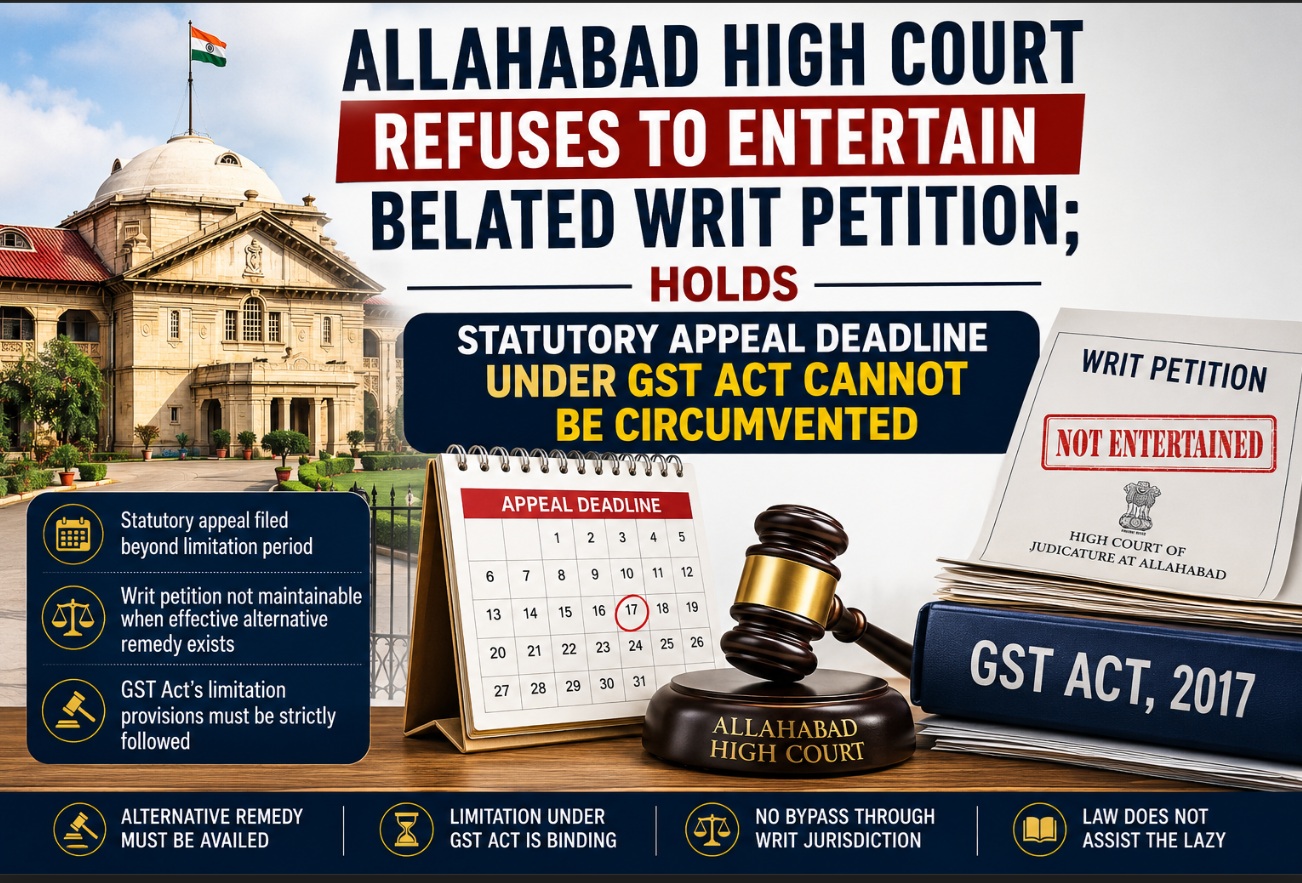
  • Allahabad High Court Refuses to Entertain Belated Writ Petition; Holds Statutory Appeal Deadline Under GST Act Cannot Be Circumvented

    Allahabad High Court Refuses to Entertain Belated Writ Petition; Holds Statutory Appeal Deadline Under GST Act Cannot Be Circumvented

    PRAYAGRAJ, May 26, 2026 — In a judgment that reinforces the principle that writ jurisdiction cannot be used as a backdoor to bypass statutory limitation periods, the Allahabad High Court has dismissed a writ petition challenging an assessment order that was nearly a year old, holding that the petitioner’s failure to file a timely statutory appeal under the GST Act was fatal to his case.

    A division bench of Justice Shekhar B. Saraf and Justice Abdhesh Kumar Chaudhary was hearing a petition filed by M/s Mishra Security Services, whose proprietor Smt. Sunita Mishra had sought to quash an assessment order dated June 4, 2025, and the preceding show-cause notice dated March 17, 2025.

    The petitioner had earlier filed a writ petition in January 2026 — itself beyond the limitation period — which was dismissed as withdrawn with liberty to file afresh with better particulars. The present petition was the second attempt.

    The court expressed its inability to countenance how the petitioner could file a writ petition at such a belated stage “merely to bypass the limitation prescribed for filing a statutory appeal under Section 107(1) of the GST Act.”

    Section 107(1) provides for filing an appeal within three months from the date of communication of the order, with a further condonable period of one month under Section 107(4). The court noted that the outer limit had long since expired.

    Relying on the Supreme Court’s authoritative pronouncements in Singh Enterprises vs. C.C.E., Jamshedpur (2008) and Commissioner of Customs and Central Excise vs. Hongo India Private Limited (2009), the bench held that the appellate authority under the GST Act has no power to condone delay beyond the statutorily prescribed period. The court also drew from the coordinate bench ruling in Atlantis Intelligence Ltd. vs. Union of India (2025), where Justice Saraf himself had distilled the principles governing maintainability of writ petitions after expiry of the statutory appeal period.

    The Atlantis Intelligence ruling had established, among other things, that when a statute prescribes a maximum condonable delay (here, one additional month), Section 29(2) read with Section 3 of the Limitation Act applies, and courts have no power to condone any further delay — even in writ jurisdiction under Article 226 of the Constitution.

    “We are rather surprised,” the bench observed, noting that the petitioner had been “a fence sitter” who had not been diligent in pursuing his rights. The court underscored the Latin maxim quando aliquid prohibetur ex directo, prohibetur et per obliquum — what cannot be done directly cannot be done indirectly.

    The court, however, clarified that if the petitioner files an appeal, the observations made in the order shall not affect the decision of the appellate forum.

    The judgment serves as a cautionary reminder to litigants that the extraordinary writ jurisdiction of the High Court is not a substitute for statutory remedies, and that courts will not readily assist those who sleep over their rights.
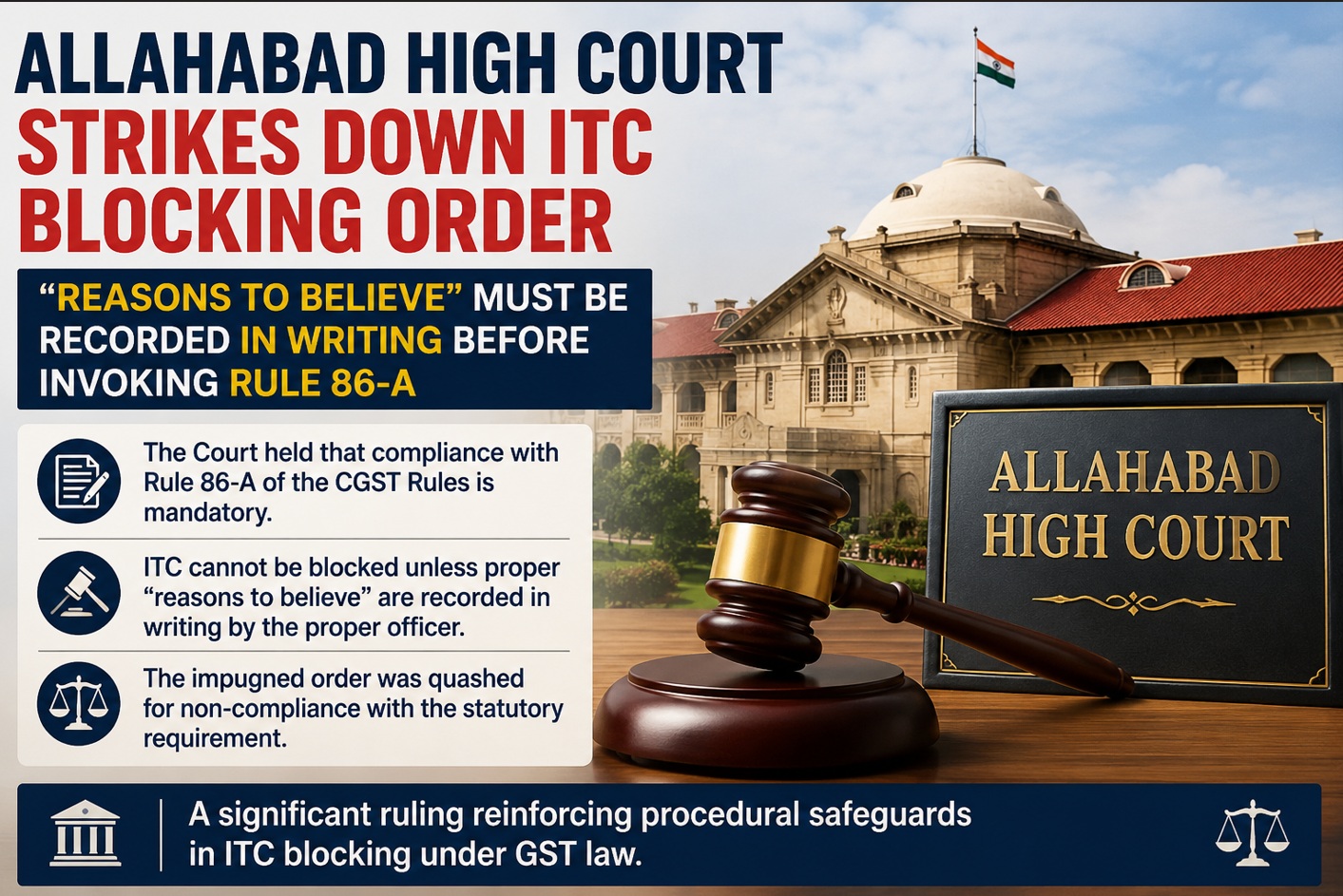
  • Allahabad High Court Strikes Down ITC Blocking Order: “Reasons to Believe” Must Be Recorded in Writing Before Invoking Rule 86-A

    Allahabad High Court Strikes Down ITC Blocking Order: “Reasons to Believe” Must Be Recorded in Writing Before Invoking Rule 86-A

    PRAYAGRAJ, May 26, 2026 — In a significant ruling reaffirming procedural safeguards for taxpayers, the Allahabad High Court has set aside an order blocking the Input Tax Credit (ITC) of a private dairy company after finding that the tax authorities failed to record “reasons to believe” in writing — a mandatory precondition under the GST framework.

    A division bench comprising Justice Saumitra Dayal Singh and Justice Vivek Saran quashed the order dated April 9, 2026, passed by the Joint Commissioner (Corporate-2), State Tax, which had blocked the ITC of M/s Mohan Milkfoods Private Limited in its Electronic Credit Ledger under Rule 86-A of the Uttar Pradesh Goods and Services Tax Rules, 2017.

    The petitioner, represented by Senior Advocate Rakesh Ranjan Agarwal along with counsel Nitin Kumar Kesarwani and Suyash Agarwal, contended that the essential precondition for exercising jurisdiction under Rule 86-A had not been fulfilled, as no “reason to believe” was recorded in writing before the extreme action of blocking ITC was taken.

    During the proceedings, the court directed the Standing Counsel for the revenue to produce clear written instructions confirming the existence of such recorded reasons. When the written instructions dated May 25, 2026, were produced, the court found that while several paragraphs offered reasoning to support the blocking order, the impugned order itself contained no recital of such reasons — it merely stated the conclusion that the petitioner had fraudulently availed ITC.

    Drawing on established constitutional jurisprudence, the court cited the Supreme Court’s landmark decision in Mohinder Singh Gill & Anr. vs. The Chief Election Commissioner, New Delhi & Ors. (1978), famously holding that “orders are not like old wine becoming better as they grow older” — an order must stand on its own strength and cannot be supplemented by subsequent affidavits or reasoning.

    The bench also placed strong reliance on a coordinate bench ruling in M/s Pilcon Infrastructure Pvt. Ltd. vs. State of U.P. & Anr. (2025), which had elaborated extensively on what constitutes a valid “reason to believe.” That ruling emphasised that there must be a rational basis for the belief, that the grounds must be germane to the formation of the belief, and that the belief must be held in good faith and not as a mere pretence.

    “It may not be forgotten, granting ITC and maintaining its chain is the soul of a successful GST regime,” the court had observed in Pilcon Infrastructure, a sentiment echoed by the present bench. “Any doubt or suspicion alone may not lead an action by the authorities to block the ITC of the assessee and disrupt the entire value addition chain.”

    The court declared the impugned order “jurisdictionally deficient” and set it aside, while granting liberty to the revenue to pass a fresh order strictly in accordance with law.

    The ruling underscores the judiciary’s consistent position that the requirement to record “reasons to believe” in writing is a non-negotiable, mandatory condition — even when the power is exercised ex-parte against the assessee.