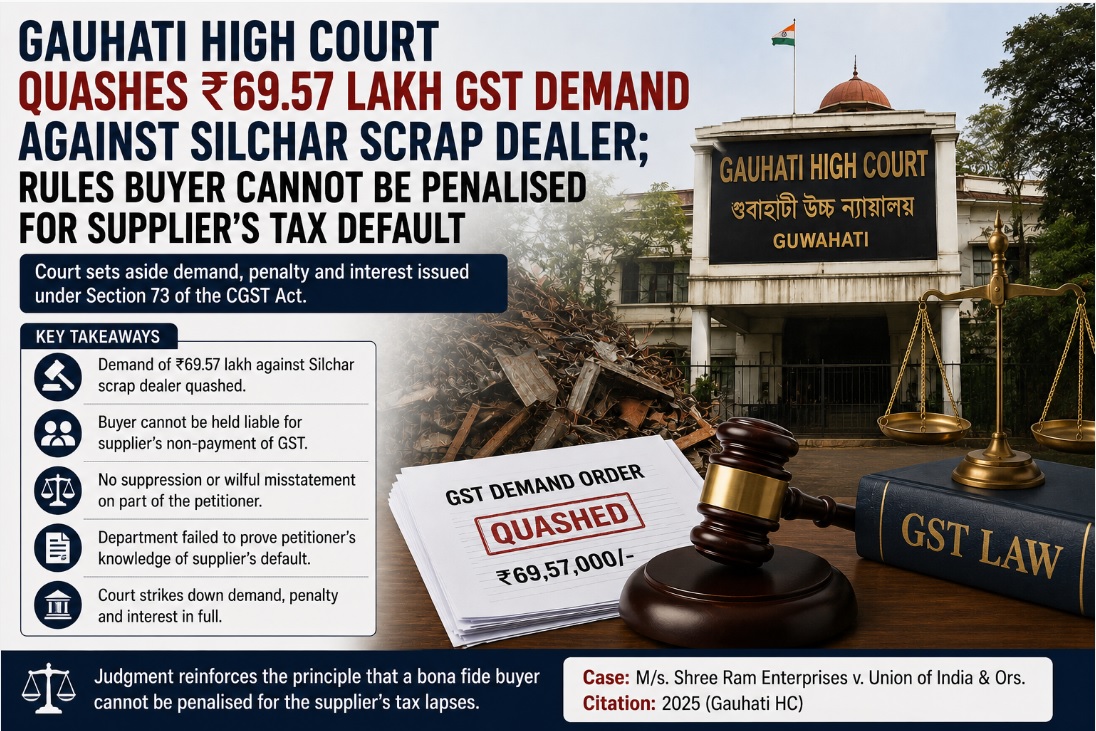
Court reaffirms that a bona fide purchasing dealer who has duly paid GST to a registered seller cannot be denied input tax credit merely because the seller failed to remit the tax to the government.
Gauhati High Court | GUWAHATI
In a significant ruling for trading and manufacturing businesses, the Gauhati High Court has set aside a demand order of ₹69,56,794 raised against Sri Gurucharan Kangsa Banik, proprietor of M/s Sree Guru Metals, Silchar. The demand comprised IGST of ₹50.19 lakh, CGST of ₹9.69 lakh, and SGST of ₹9.69 lakh, along with an equivalent penalty.
Hon’ble Mr. Justice Kardak Ete held that a purchasing dealer who acts in good faith and pays GST to a registered supplier cannot be penalised if the supplier subsequently fails to deposit the tax with the government.
The Court followed the Division Bench judgment in National Plasto Moulding v. State of Assam & Ors. [2024] 129 GSTR 544 (Gauhati), which in turn relied upon the Delhi High Court’s decision in On Quest Merchandising India Pvt. Ltd. v. Government of NCT of Delhi [2018] 56 GSTR 177 (Delhi). Counsel appearing for both the petitioner and the Revenue accepted that the issue was covered by these decisions.
Facts of the Case
M/s Sree Guru Metals is engaged in the business of procurement and sale of scrap and waste batteries.
During the financial years 2017-18 and 2018-19, the proprietorship purchased goods from suppliers located in Kolkata and paid the applicable GST along with the purchase consideration through banking channels. The transactions were supported by valid tax invoices.
Following the introduction of the GST regime in July 2017, the business encountered certain compliance-related issues, including discrepancies between GSTR-1 and GSTR-3B arising from data-entry errors relating to reporting of output tax liability and input tax credit.
Pursuant to a summons issued by the Directorate General of GST Intelligence (DGGI), Guwahati Zonal Unit, the petitioner appeared before the authorities on 5 April 2019 and furnished all relevant records, including GST returns and purchase invoices.
A search conducted at the business premises on 9 July 2019 did not result in recovery of any incriminating material.
The Demand and the Challenge
Despite the petitioner’s cooperation, a Show Cause Notice dated 26 August 2022 was issued alleging wrongful availment of ITC amounting to ₹69.56 lakh under Section 16(2)(a) and Section 16(2)(b) of the CGST Act on the ground that the underlying goods had not actually been received.
Thereafter, an Order-in-Original dated 28 March 2024 was passed confirming the demand together with interest under Section 50 and an equivalent penalty under Section 74(1) read with Section 122 of the CGST Act.
The petitioner challenged the order on several grounds.
It was contended that no effective opportunity of hearing had been granted, as notices were manually served after the dates fixed for hearing and were not uploaded on the GST portal. It was also argued that Form GST DRC-07 had not been issued prior to passing the order.
On merits, the petitioner submitted that all statutory conditions prescribed under Section 16(2) had been fulfilled. The goods had been received, genuine tax invoices had been issued, and payment including GST had been made through banking channels.
According to the petitioner, the sole basis for denial of ITC was the alleged failure of the suppliers to deposit the tax collected from the petitioner, a circumstance entirely beyond the purchaser’s control.
The petitioner further raised a limitation challenge, contending that a part of the disputed period was governed by Section 73 of the CGST Act and that the statutory limitation for proceedings under that provision had already expired. Consequently, invocation of Section 74 was stated to be impermissible.
An additional objection was raised against the clubbing of multiple assessment years into a single adjudication order.
Court’s Reasoning
The Court held that the controversy stood squarely covered by the Division Bench judgment in National Plasto Moulding, which had adopted the reasoning of the Delhi High Court in On Quest Merchandising.
The Division Bench had held that where a purchasing dealer bona fide enters into transactions with a validly registered supplier, pays the tax component, and otherwise complies with the statutory requirements, denial of ITC merely because the selling dealer fails to deposit the tax with the government is impermissible.
The Court referred to the following observation in National Plasto Moulding:
“A purchasing dealer cannot be punished for the act of a selling dealer who has failed to deposit the tax collected by it.”
The Court also noted that the Delhi High Court in On Quest Merchandising had read down Section 9(2)(g) of the Delhi VAT Act—the provision analogous to Sections 16(2)(c) and 16(2)(d) of the CGST Act—to exclude bona fide purchasing dealers from its scope.
The Delhi High Court had reasoned that a literal interpretation would impose an impossible burden on a purchaser and could render the provision vulnerable to challenge under Article 14 of the Constitution.
The Court further noted that the Special Leave Petition filed against the Delhi High Court’s judgment had been dismissed by the Supreme Court, while preserving liberty for the authorities to proceed in cases where the transactions were not bona fide.
Accepting that the legal position stood settled, the Gauhati High Court set aside the impugned Order-in-Original.
At the same time, the Court preserved the department’s right to proceed against the petitioner if material subsequently emerges showing that the transactions were not genuine or were entered into in collusion with the suppliers.
Significance
The decision adds to the growing body of judicial authority protecting bona fide purchasers from adverse consequences arising solely from a supplier’s failure to discharge tax liability.
The ruling reiterates that where a purchaser has acted in good faith, obtained valid tax invoices, received the goods, and paid the consideration including GST, denial of ITC cannot be justified merely because the supplier defaults in remitting tax to the government.
The Court, however, recognised the distinction between genuine transactions and collusive arrangements. Where the department is able to establish that transactions were not bona fide or lacked commercial substance, it remains open to the authorities to invoke the statutory provisions and deny the benefit of ITC.
Citation: Sri Gurucharan Kangsa Banik v. Union of India & Ors. — Gauhati High Court, Writ Petition (arising from Order-in-Original No. 37/GST/AC/SIL/2023-24 dated 28.03.2024).