Tag: Indian Tax Law

  • Gauhati High Court Upholds Consolidated Show Cause Notices Under Sections 73 and 74 of the CGST Act: Tata Projects Limited v. Union of India

    Gauhati High Court Upholds Consolidated Show Cause Notices Under Sections 73 and 74 of the CGST Act: Tata Projects Limited v. Union of India

    Gauhati High Court Upholds Consolidated Show Cause Notices Under Sections 73 and 74 of the CGST Act: Tata Projects Limited v. Union of India

    Court: Gauhati High Court | Bench: Justice Devashis Baruah | Case No.: WP(C)/2922/2025 (with WP(C)/20/2026 and WP(C)/1113/2026) | Date: June 8, 2026 | Citation: 2026:GAU-AS:8028


    Key Takeaways

    • There is no statutory bar under the CGST Act, 2017 against issuing a consolidated show cause notice under Section 73(1) or Section 74(1) covering multiple financial years, provided limitation under Sections 73(2)/74(2) is independently satisfied for each year.
    • Proceedings under Sections 73 and 74 are adversarial and adjudicatory in character, falling under Chapter XV (“Demand and Recovery”) — they are structurally distinct from “Assessment” under Chapter XII, and the financial-year-specific architecture of Chapter XII does not control or restrict the demand machinery.
    • Where a consolidated notice covers some financial years that are within limitation and others that are time-barred, the doctrine of severability applies: the notice survives for the years within time and fails only for those that are not.
    • The Court expressly disagreed with the Kerala High Court (Tharayil Medicals, Dhanlaxmi Bank) and the Madras High Court (Oriental Lotus, Titan Company), and aligned with the Delhi High Court (Ambika Traders, Mathur Polymers), the Allahabad High Court (S.A. Aromatics), and the Karnataka High Court Division Bench (Chimney Hills Education Society).

    What the Case Was About

    Three unrelated writ petitions — filed by Tata Projects Limited (a works contract services provider), Quantum Infratech (a residential construction firm), and Bitchem Asphalt Technologies Limited (a road-building materials supplier) — were heard together because they raised a single, common jurisdictional challenge. Each petitioner had been served a show cause notice under Section 74 (or Section 73, in Tata Projects’ case for one year) of the CGST Act that clubbed together demands pertaining to multiple financial years — ranging from 2017-18 through 2022-23 in the most expansive case. Each petitioner contended that the entire proceeding was without jurisdiction because the CGST Act requires year-specific show cause notices and does not permit consolidation.

    The stakes were significant. Tata Projects had already exhausted its first appeal, with the Commissioner (Appeals) confirming the demand. Quantum Infratech’s case originated in DGGI search operations, involved allegations of fraud under Section 74 read with Section 122(1A), and had penalties imposed on individual partners. Bitchem faced a demand of over ₹12.34 crore. In each case, if the jurisdictional challenge succeeded, the entire demand edifice would collapse without any adjudication on merits.

    What the Court Decided — and Why

    Justice Devashis Baruah, in a reserved judgment, ruled squarely against the petitioners on the jurisdictional question: there is no bar, explicit or implicit, in the CGST Act against issuance of a consolidated show cause notice or a consolidated adjudication order covering multiple financial years (para 70).

    The reasoning proceeds through several distinct analytical steps.

    The text of Sections 73(1) and 74(1) imposes no financial-year restriction. The Court observed that Sub-Section (1) of both provisions confers jurisdiction on the Proper Officer upon satisfaction of certain material facts — tax not paid, short paid, erroneously refunded, or ITC wrongly availed. Nothing in the language limits the notice to a single financial year. The only temporal constraint appears in Sub-Section (2), which requires the notice to be issued a specified period before the limitation deadline — but that constraint is about timing, not about the scope of years that can be covered (paras 48–49).

    Limitation runs independently per financial year, but that does not mandate separate notices. This is the heart of the judgment. The Court acknowledged that Sections 73(10) and 74(10) compute limitation by reference to the due date for filing annual returns “for the financial year to which” the default relates. But the Court drew a critical distinction: limitation governs whether a particular year’s demand can validly be raised at all, not whether it must be raised in a standalone proceeding. If a consolidated notice is issued on a date when limitation is still open for all the covered years, there is no infirmity (paras 53–55). The Court illustrated this with detailed worked examples and tabular computations for both three-year (Section 73) and five-year (Section 74) timelines.

    The doctrine of severability rescues partially time-barred consolidated notices. In an important practical holding, the Court addressed the scenario where a consolidated notice covers some years within limitation and some that are time-barred. Drawing an analogy to civil suits involving recurring causes of action (such as arrears of rent, where each rental period generates an independent cause of action), the Court held that the time-barred years can simply be severed — the notice and order survive for the years that are within time (para 59).

    Sections 73 and 74 are not “assessment” provisions — they are demand and adjudication provisions. The petitioners had argued that since the entire GST architecture (returns, annual returns, self-assessment) is financial-year-specific, Sections 73 and 74, being part of the “assessment” mechanism under Section 2(11), must also be year-specific. The Court rejected this by drawing a sharp structural distinction between Chapter XII (Assessment) and Chapter XV (Demand and Recovery). Assessment provisions — self-assessment under Section 59, scrutiny under Section 61, best judgment under Section 62 — are largely non-adversarial. Sections 73 and 74, by contrast, are adversarial and adjudicatory, requiring notice, reply, hearing, and a reasoned order. They also uniquely involve penalty and, in Section 74’s case, findings on fraud — matters that do not arise in assessment proceedings proper (paras 60–61).

    Sub-Sections (3) and (4) of both Sections 73 and 74 confirm the legislative design. The Court noted that these provisions allow the Proper Officer, after issuing a notice under Sub-Section (1) for “any period,” to serve a supplementary statement (Form DRC-02) covering “such periods other than those covered under Sub-Section (1).” The phrase “those covered under Sub-Section (1)” is deliberately pluralistic — it contemplates that the original notice itself may have covered multiple periods (paras 62–64).

    The insertion of Section 74A and Sub-Section (12) in Sections 73 and 74 does not help the petitioners. The petitioners pointed to the Finance Act, 2024 amendments (effective November 1, 2024) introducing Section 74A — which applies from FY 2024-25 onward and is expressly year-specific — as proof that the pre-amendment regime was also intended to be year-specific. The Court implicitly rejected this by treating the amendment as a prospective structural change, not a clarification of pre-existing law.

    How This Changes Practice

    This judgment is the most analytically detailed single-judge pronouncement on the consolidated-SCN question to date, and it lands on the side of a growing judicial consensus. With Delhi, Allahabad, Karnataka (Division Bench), and now Gauhati aligned on permissibility, and with the Bombay High Court’s contrary line (Milroc, Marfani Steel, Aasawa Brother) already referred to a larger bench in Rollmet LLP (2026 SCC OnLine Bom 2613), the practical balance has shifted decisively in the department’s favour.

    For practitioners, several operational implications follow. First, jurisdictional challenges to consolidated notices are now a diminishing-returns strategy in most High Courts. Counsel should assess whether the stronger defence lies on merits — limitation for specific years, factual defences on fraud or suppression, computation disputes — rather than on the consolidation point. Second, the severability holding at para 59 is a double-edged sword: it means that even if some years in a consolidated notice are demonstrably time-barred, the notice will not be quashed in its entirety. Counsel must raise limitation year-by-year during adjudication and cannot rely on a wholesale jurisdictional knock-out. Third, for assessees who have already received consolidated notices, the Court’s direction granting 30 days to file statutory appeals (with limitation condoned) provides a narrow but real window to get before the Tribunal or the Appellate Authority on merits.

    Relevant Provisions

    • Sections 73 and 74, CGST Act, 2017 — Determination of tax not paid or short paid (non-fraud and fraud cases respectively); Sub-Sections (1), (2), (3), (4), (9), (10) extensively analyzed
    • Section 74A, CGST Act — Determination of tax for FY 2024-25 onward (inserted by Finance Act, 2024 w.e.f. 01.11.2024)
    • Section 2(11), CGST Act — Definition of “assessment”
    • Sections 59–64, CGST Act — Chapter XII assessment provisions (self-assessment, provisional, scrutiny, best judgment, summary)
    • Section 75, CGST Act — General provisions relating to determination of tax
    • Rule 142(1)(a) and (b), CGST Rules, 2017 — Issuance of notice (DRC-01) and statement (DRC-02)
    • Sections 107, 108, 112, CGST Act — Appellate remedies
    • Article 14 and Article 141, Constitution of India

    What to Watch

    The consolidated-SCN question is now squarely headed for definitive resolution at two levels. The Bombay High Court’s larger bench reference in Rollmet LLP will be the most closely watched proceeding — if the larger bench disagrees with Delhi, Allahabad, Karnataka, and Gauhati, a genuine inter-High Court conflict crystallizes and a Supreme Court reference becomes almost inevitable. The SLP against Mathur Polymers was dismissed with the observation that the Supreme Court found “no good ground” to interfere, which the department treats as tantamount to approval under Kunhayammed principles — but whether that truly constitutes a declaration of law under Article 141, as the respondents argued here (para 31), remains contestable and will likely be tested. Practitioners should also monitor whether CBIC issues any clarificatory circular endorsing consolidated proceedings, which would give field formations explicit administrative cover. Finally, the interaction between this line of authority and the new Section 74A regime (which is expressly year-specific for FY 2024-25 onward) may itself generate fresh litigation on transitional cases straddling the old and new frameworks.
  • Gauhati High Court Reaffirms: GST Registration Cancelled for Non-Filing Can Be Restored If Assessee Clears All Dues

    Gauhati High Court Reaffirms: GST Registration Cancelled for Non-Filing Can Be Restored If Assessee Clears All Dues

    Gauhati High Court Reaffirms: GST Registration Cancelled for Non-Filing Can Be Restored If Assessee Clears All Dues

    Court: Gauhati High Court | Bench: Justice Kardak Ete | Case No.: WP(C)/3000/2026 | Date: June 10, 2026


    Key Takeaways

    • Where GST registration is cancelled under Section 29(2)(c) of the CGST Act for non-filing of returns for six continuous months, the assessee can seek restoration by filing all pending returns and paying full tax dues with interest and late fee, as contemplated by the proviso to Rule 22(4) of the CGST Rules, 2017.
    • The Court permitted the petitioner to approach the jurisdictional officer within 60 days for restoration, even though the statutory time limit for filing a revocation application had lapsed.
    • The limitation period under Section 73(10) for issuing demand notices was directed to run from the date of this order (except for FY 2024-25, governed by Section 44), giving the department a fresh window to raise demands.
    • The decision follows and applies the coordinate bench ruling in Dhirghat Hardware Stores v. Union of India, WP(C) No. 5944/2025 (decided 17.10.2025), reinforcing a consistent line of authority from the Gauhati High Court on this issue.

    The Facts: A Familiar Story of Missed Returns and a Lapsed Remedy

    The petitioner, Sri Chongtham Manabandra Singh, is a proprietor operating a light motor vehicle hiring business in Duliajan, Dibrugarh, registered under both the CGST Act and the Assam GST Act. His trouble began when he failed to file GST returns for a continuous stretch of six months — a default he attributed to a breakdown in communication with his tax consultant.

    The department followed the prescribed procedure. A show-cause notice dated August 13, 2024 was issued in Form GST REG-17, calling upon the petitioner to explain within 30 days why his registration should not be cancelled. His registration was simultaneously suspended. When no satisfactory response came, the Superintendent, CGST, Duliajan Range cancelled the registration by order dated July 28, 2025 — notably, without recording any reasons in the cancellation order itself (para 5).

    By the time the petitioner attempted to apply for revocation of cancellation, the statutory window had already closed. He was, in effect, locked out of the GST system with no administrative remedy available. He had, however, filed all pending returns up to June 2025 and expressed willingness to pay all outstanding dues. Left with no other option, he moved the High Court under Article 226.

    What the Court Decided — and Why

    Justice Kardak Ete disposed of the petition at the motion stage itself, with the consent of both sides, on the strength of an earlier coordinate bench decision in Dhirghat Hardware Stores & Anr. v. Union of India & 3 Ors., WP(C) No. 5944/2025 (order dated October 17, 2025). The Standing Counsel for CGST fairly conceded that the earlier ruling covered the present facts (para 9).

    The legal reasoning, drawn from the Dhirghat Hardware Stores order and adopted in full by this bench, rests on two pillars.

    First, the proviso to Rule 22(4) of the CGST Rules expressly contemplates a situation where an assessee served with a show-cause notice for non-filing under Section 29(2)(b) or (c) furnishes all pending returns and clears all tax dues along with interest and late fee. In such a case, the proper officer is empowered — indeed, directed — to drop the proceedings and pass an order in Form GST REG-20 (paras 10 and 12 of the Dhirghat Hardware Stores extract). The proviso, in other words, builds a statutory escape hatch for assessees willing to come into compliance.

    Second, the Court underscored that cancellation of GST registration entails “serious civil consequences” (para 12 of Dhirghat Hardware Stores). This framing matters. It signals that the High Court views cancellation not as a routine administrative act but as a measure that effectively shuts a person out of legitimate commerce — an outcome disproportionate to the default where the assessee demonstrates willingness to regularize.

    The operative directions are precise. The petitioner must approach the jurisdictional authority within 60 days seeking restoration. If he files the application and complies with every requirement under the proviso to Rule 22(4) — meaning all returns filed, all tax paid with interest and late fee — the authority is bound to consider restoration “in accordance with law” and act “as expeditiously as possible” (para 13). There is no discretion to refuse on the ground that the statutory revocation period has lapsed; the Court’s writ jurisdiction effectively overrides that procedural bar.

    An important ancillary direction concerns limitation for departmental demands. The Court ordered that the period under Section 73(10) of the CGST Act (and the corresponding State Act provision) shall be computed from the date of this order, except for FY 2024-25, which remains governed by Section 44. This protects the revenue’s interest by ensuring that the time spent in litigation does not erode the department’s ability to raise demands for the period during which registration was cancelled.

    How This Shapes Practice

    This judgment does not break new ground in doctrinal terms — it follows Dhirghat Hardware Stores, which in turn followed Sanjoy Nath v. Union of India, WP(C) No. 6366/2023 (order dated October 11, 2023). What it does is consolidate a now-settled line of authority from the Gauhati High Court. Three coordinate bench orders over three years, all reaching the same result on materially identical facts, create a body of precedent that the department will find difficult to resist in future cases.

    For practitioners advising small businesses and proprietors in the Northeast — many of whom rely heavily on tax consultants and are vulnerable to precisely this kind of procedural default — the practical takeaway is clear. A lapsed revocation window is not the end of the road. The writ remedy remains available, provided the assessee demonstrates genuine willingness to comply: file all pending returns, pay all dues, and move promptly.

    Counsel should note, however, the conditions that made this petition succeed. The petitioner had already filed returns up to June 2025 before approaching the Court (para 6). He did not seek a waiver of dues or interest. He offered unconditional compliance. Petitions that seek restoration without having first cleared the backlog are unlikely to receive the same treatment.

    From the department’s perspective, the Court’s direction on Section 73(10) limitation is a meaningful safeguard. Officers processing restoration applications under these orders should note the recalibrated limitation timeline and initiate assessment proceedings accordingly.

    Relevant Provisions

    • Section 29(2)(c), CGST Act, 2017 — Power to cancel registration for non-filing of returns for six continuous months
    • Rule 22, CGST Rules, 2017 — Procedure for cancellation; proviso to sub-rule (4) permitting dropping of proceedings on compliance
    • Section 73(10), CGST Act / State GST Act — Time limit for issuance of demand orders
    • Section 44, CGST Act — Annual return provisions (applicable to FY 2024-25 limitation computation)
    • Article 226, Constitution of India — Writ jurisdiction of the High Court

    What to Watch

    An appeal to a Division Bench or the Supreme Court appears unlikely here — the Standing Counsel conceded the point and the department has not resisted this line of cases. The more interesting question is legislative. The GST Council and the CBIC have periodically introduced amnesty schemes and deadline extensions for revocation applications (most recently through various notifications relaxing the time limits under Section 30). If the pattern of writ petitions on this issue continues to grow, it may prompt a more permanent procedural fix — perhaps an expanded revocation window or a standardized late-compliance mechanism that removes the need for High Court intervention altogether. Practitioners should watch for any upcoming GST Council recommendations on this front.

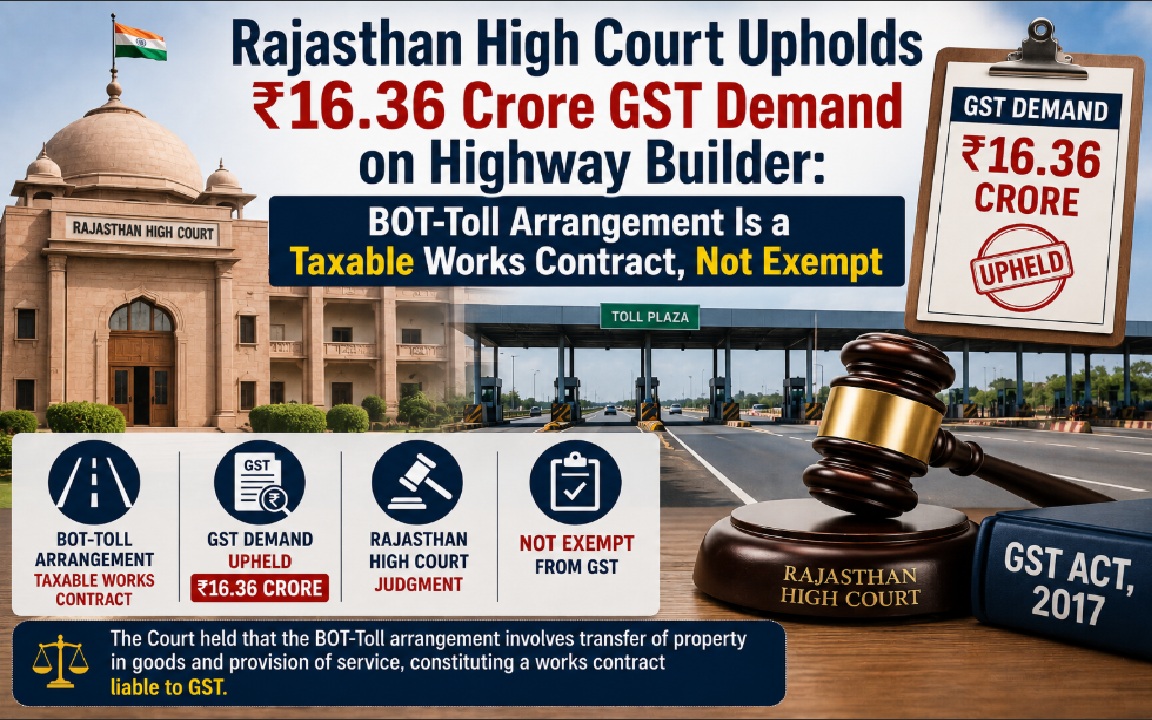
  • Rajasthan High Court Upholds ₹16.36 Crore GST Demand on Highway Builder: BOT-Toll Arrangement Is a Taxable Works Contract, Not Exempt

    Rajasthan High Court Upholds ₹16.36 Crore GST Demand on Highway Builder: BOT-Toll Arrangement Is a Taxable Works Contract, Not Exempt

    JODHPUR, May 22, 2026 — In a ruling of significant consequence for the infrastructure sector, the Rajasthan High Court has upheld a GST demand of ₹16.36 crore against a highway concessionaire, holding that the construction and maintenance of a national highway on a Build-Operate-Transfer (BOT-Toll) basis constitutes a taxable “works contract” and that the right to collect toll in return for such construction is a form of “barter” falling squarely within the definition of “supply” under the GST framework.

    A division bench comprising Justice Arun Monga and Justice Sandeep Shah dismissed the writ petition filed by CG Tollway Ltd., which had challenged an order dated December 14, 2023, passed by the Deputy Commissioner, State Tax, Bhilwara, as well as the appellate order dated May 9, 2025, that affirmed the demand.

    The Factual Background

    CG Tollway Ltd. entered into a concession agreement with the National Highways Authority of India (NHAI) on December 9, 2016, for the six-laning of the Kishangarh-Udaipur-Ahmedabad section of NH-79 on a Design, Build, Finance, Operate, and Transfer (DBFOT) basis. The construction work was sub-contracted to IRB Infrastructure Developers Limited, while the petitioner retained the right to collect toll from road users.

    An internal audit flagged that the petitioner had not paid GST amounting to Rs. 16,36,20,418/-. Despite the petitioner’s objections, the Deputy Commissioner confirmed the demand along with penalty at 10% and interest. The Appellate Authority, Ajmer, dismissed the statutory appeal on May 9, 2025.

    The Petitioner’s Case

    Senior counsel appearing for CG Tollway, led by Mr. Bharat Raichandani, advanced a multi-pronged challenge. The principal contention was that no “service” was provided to NHAI and therefore there was no “supply” attracting GST. The petitioner argued that the only consideration it received — the right to collect toll — was exempt from GST under Entry 23 of Notification No. 12/2017-Central Tax (Rate) dated June 28, 2017, which exempts “service by way of access to a road or a bridge on payment of toll charges.”

    The petitioner also contended that the sub-contractor (IRB Infrastructure Developers Limited) had already paid GST on the same construction activity, making the demand an impermissible instance of double taxation. Reliance was placed on the Supreme Court’s decision in State of Andhra Pradesh vs. Larsen & Toubro Ltd. (2008), which had held under the VAT regime that the State cannot collect tax from both the contractor and the sub-contractor for the same transaction. In addition, the petitioner pointed out that identical audit objections had been dropped by GST authorities in Karnataka and Gujarat in the case of its sister concerns, and that parity demanded the same outcome in Rajasthan.

    The Revenue’s Stand

    The State, represented by Additional Advocate General Mahaveer Bishnoi and counsel Harshvardhan Singh, raised a preliminary objection regarding the availability of an alternative remedy before the GST Appellate Tribunal under Section 112 of the CGST Act. However, the revenue candidly admitted that the Tribunal was not yet functional — a concession the Court accepted in deciding to hear the matter on merits rather than leaving the petitioner remediless.

    On substance, the revenue argued that the arrangement between NHAI and the concessionaire was a classic case of “barter”: the petitioner constructed and maintained the road and, in return, received the exclusive right to collect toll for the duration of the concession period—plus leave and licence rights over the site. The definition of “supply” under Section 7 of the CGST Act expressly includes “barter,” and “consideration” under Section 2(31) includes payment “in money or otherwise.”

    Crucially, the revenue submitted that the construction of roads falls under Heading 9954 (general construction services of highways) and not under Heading 9967 (supporting services in transport), which is the heading under which the toll exemption operates. The revenue relied on Circular No. 150/06/2021-GST dated June 17, 2021, issued pursuant to the 43rd GST Council meeting, which clarified that “Entry 23A does not cover construction of road services (falling under heading 9954), even if deferred payment is made by way of instalments (annuities).”

    The Court’s Analysis

    Delivering the judgment, the bench undertook an exhaustive examination of the statutory provisions and the concession agreement.

    On “Supply” and “Barter.” The Court found that the terms of the concession agreement — particularly the grant of exclusive leave and licence rights, the right to collect toll, and the obligation to pay a substantial premium (Rs. 228.60 crore, escalating annually by 3%) — made it clear that the transaction was a works contract falling within Section 2(119) and amounted to “supply” under Section 7. “In barter for undertaking the construction and maintenance of the road, the concessionaire has been conferred certain exclusive rights,” the Court held, “thus all the ingredients of ‘barter’ are clearly available.”

    On the Exemption Claim. The Court rejected the petitioner’s argument that toll collection was exempt. A comparative analysis of the notification and the 2021 circular revealed that construction of roads falls under Heading 9954, not Heading 9967. The exemption under Entry 23 is confined to services by way of access to a road or bridge on payment of toll — not to the construction of the road itself. “The toll is being collected as a barter for the work contract undertaken by the petitioner,” the Court observed, adding that besides toll collection, the petitioner was also paying a significant premium to NHAI under the agreement.

    Citing the Supreme Court’s Constitution Bench decision in Commissioner of Customs vs. Dilip Kumar & Co. (2018) and the recent ruling in Commissioner (CGST) vs. Safari Retreats Pvt. Ltd. (2025), the bench reiterated that exemption notifications must be interpreted strictly and any ambiguity must be resolved in favour of the Revenue — not the assessee.

    On Double Taxation. The Court distinguished the Larsen & Toubro case, noting that it was decided under the VAT regime, which taxed goods at the point of incorporation into works. GST, by contrast, is a destination-based tax levied on the supply of both goods and services. Further, there were two distinct contracts — one between NHAI and the petitioner, and another between the petitioner and the sub-contractor — with no privity of contract between NHAI and the sub-contractor. “Both contracts are distinct and cannot be treated as overlapping,” the Court held.

    On Parity with Karnataka and Gujarat. The Court examined the audit reports from the two States and found that the issues involved were entirely different. The Karnataka proceedings concerned ineligible ITC disclosures in Form GSTR-9, while the Gujarat matter pertained to VAT liability under the composition scheme. Neither addressed the question of whether a BOT-Toll arrangement constitutes a taxable works contract under GST. “There can be no concept of negative equality,” the Court stated.

    On the Telangana High Court Precedent. The bench expressly agreed with the reasoning of the Telangana High Court in GMR Pochanpalli Expressways Limited vs. Additional Director, DGGI (2024), which had upheld the validity of the very same 2021 circular in an identical BOT context.

    Conclusion

    Finding that both the Deputy Commissioner’s order and the Appellate Authority’s decision were “well-reasoned” and fully consistent with the statutory framework and the terms of the concession agreement, the Court dismissed the writ petition and affirmed the demand of Rs. 16,36,20,418/- along with penalty and interest. No order as to costs was made.

    The judgment is likely to have wide ramifications for infrastructure developers operating under BOT-Toll models across the country, clarifying that the consideration flowing from such arrangements — whether in the form of toll collection rights or deferred annuity payments — constitutes a taxable supply of works contract services and is not shielded by the toll exemption under Entry 23 of the GST rate notification.

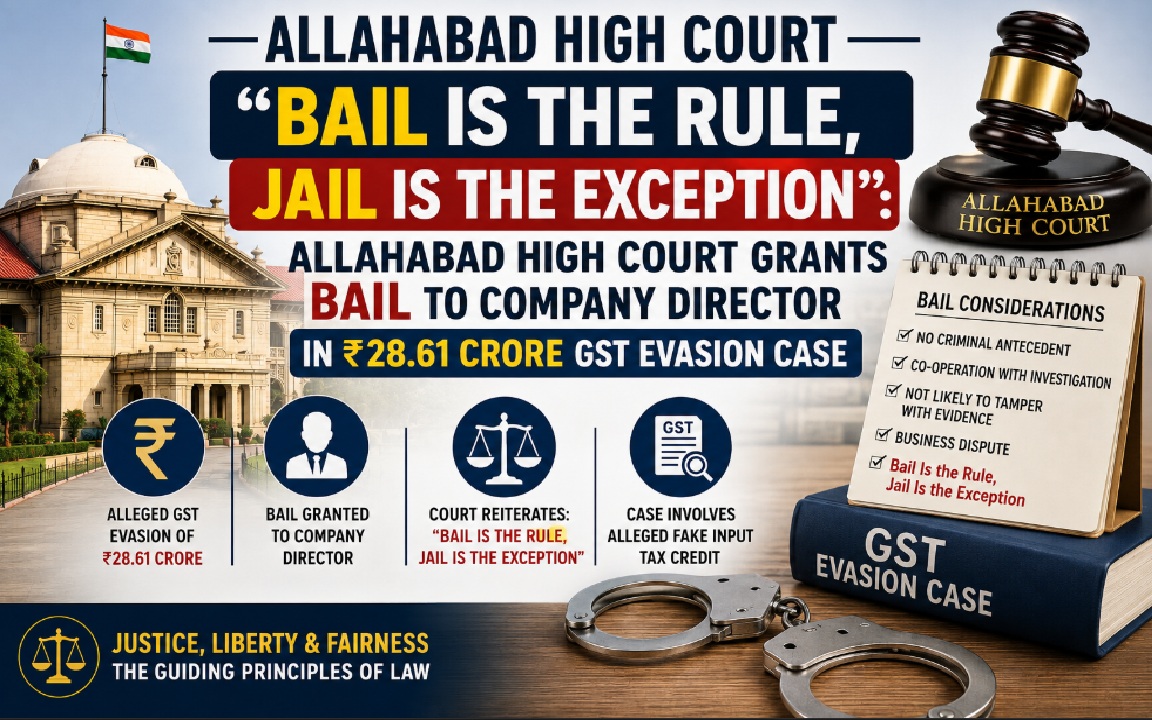
  • “Bail Is the Rule, Jail Is the Exception”: Allahabad High Court Grants Bail to Company Director in ₹28.61 Crore GST Evasion Case

    “Bail Is the Rule, Jail Is the Exception”: Allahabad High Court Grants Bail to Company Director in ₹28.61 Crore GST Evasion Case

    PRAYAGRAJ, May 25, 2026 — Reaffirming the well-settled principle that pre-conviction detention is not meant to be punitive, the Allahabad High Court has granted bail to Dhruv Seth, a director of an online gaming company accused of evading GST to the tune of ₹28.61 crore, holding that the prosecution had failed to demonstrate any exceptional circumstances warranting continued incarceration.

    Justice Vikram D. Chauhan, sitting singly, allowed the bail application (No. 14325 of 2026) filed by Seth, who had been in custody since March 15, 2026, in connection with Case Crime No. GEXCOM/AE/INV/GST/1555/2026-AE-P/o-COOMR-CGST-AGRA-A under Sections 132(1)(A), 132(1)(F), and 132(1)(i) of the Central Goods and Services Tax Act, 2017.

    The prosecution’s case alleged that the company, M/s Pymplay Advance Gaming Tech (OPC) Pvt. Ltd., was involved in online money gaming and had failed to issue invoices, resulting in a tax evasion of ₹28,61,45,695. The payments received by the aggregator were allegedly transferred into different accounts to facilitate the evasion.

    However, the applicant’s counsel, Mahima Singh and Sudhanshu Kumar, argued that the co-accused Sachet Goyal had, in his statement recorded during investigation, specifically stated that Seth had merely provided his documents for the establishment of the company and directorship as a friend, and that the directors were not in direct contact with the handlers — all work was handled by Goyal himself.

    The court noted that the maximum punishment under Section 132 of the CGST Act is five years, that the offences are triable by a Magistrate, that the investigation was complete and a complaint had already been filed, and that even if trial were to commence in the near future, it would not conclude within a year.

    Citing a string of Supreme Court authorities, including Sanjay Chandra vs. CBI (2012), Satyendra Kumar Antil vs. CBI (2022), Ratnambar Kaushik vs. Union of India (2023), and Manish Sisodia vs. Enforcement Directorate (2024), the court observed that “bail is a rule and jail is an exception” — a principle that has been repeatedly emphasised by the apex court.

    The court also placed significant reliance on two recent Supreme Court orders in GST-related bail matters: Atul Mehra vs. Union of India (January 2026), where bail was granted after eight months of detention, and Vineet Jain vs. Union of India (April 2025), where the Supreme Court had expressed surprise that the accused had been denied bail at all levels in a case where the maximum sentence was five years and the prosecution was based on documentary evidence.

    “We are surprised to note that in a case like this, the appellant has been denied the benefit of bail at all levels, including the High Court and ultimately, he was forced to approach this Court,” the Supreme Court had remarked in Vineet Jain, adding that “these are the cases where in normal course, before the Trial Courts, the accused should get bail unless there are some extraordinary circumstances.”

    The court imposed standard conditions on Seth’s release, including that he shall not tamper with evidence, shall appear before the trial court on all dates, shall not leave India without prior permission, and shall not commit a similar offence while on bail.

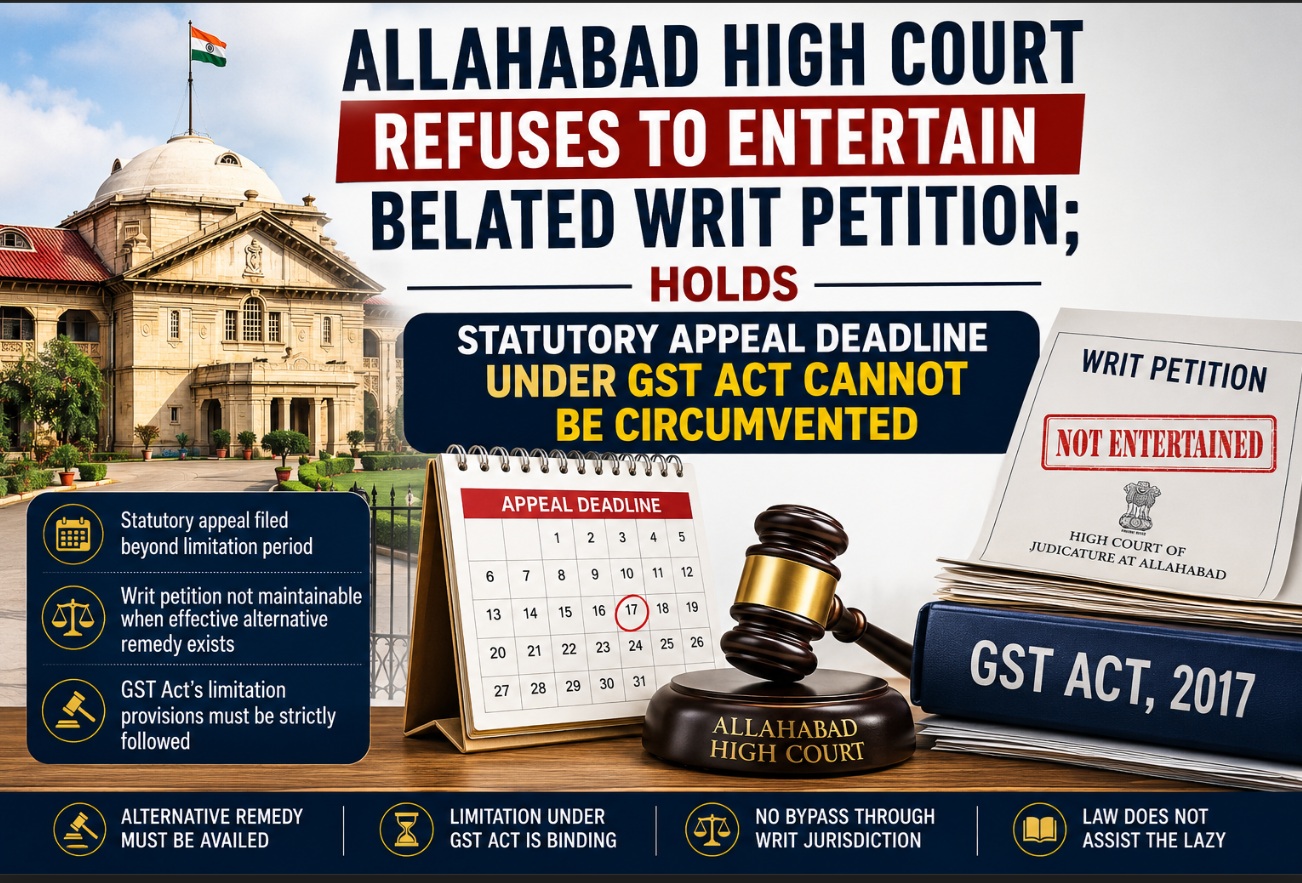
  • Allahabad High Court Refuses to Entertain Belated Writ Petition; Holds Statutory Appeal Deadline Under GST Act Cannot Be Circumvented

    Allahabad High Court Refuses to Entertain Belated Writ Petition; Holds Statutory Appeal Deadline Under GST Act Cannot Be Circumvented

    PRAYAGRAJ, May 26, 2026 — In a judgment that reinforces the principle that writ jurisdiction cannot be used as a backdoor to bypass statutory limitation periods, the Allahabad High Court has dismissed a writ petition challenging an assessment order that was nearly a year old, holding that the petitioner’s failure to file a timely statutory appeal under the GST Act was fatal to his case.

    A division bench of Justice Shekhar B. Saraf and Justice Abdhesh Kumar Chaudhary was hearing a petition filed by M/s Mishra Security Services, whose proprietor Smt. Sunita Mishra had sought to quash an assessment order dated June 4, 2025, and the preceding show-cause notice dated March 17, 2025.

    The petitioner had earlier filed a writ petition in January 2026 — itself beyond the limitation period — which was dismissed as withdrawn with liberty to file afresh with better particulars. The present petition was the second attempt.

    The court expressed its inability to countenance how the petitioner could file a writ petition at such a belated stage “merely to bypass the limitation prescribed for filing a statutory appeal under Section 107(1) of the GST Act.”

    Section 107(1) provides for filing an appeal within three months from the date of communication of the order, with a further condonable period of one month under Section 107(4). The court noted that the outer limit had long since expired.

    Relying on the Supreme Court’s authoritative pronouncements in Singh Enterprises vs. C.C.E., Jamshedpur (2008) and Commissioner of Customs and Central Excise vs. Hongo India Private Limited (2009), the bench held that the appellate authority under the GST Act has no power to condone delay beyond the statutorily prescribed period. The court also drew from the coordinate bench ruling in Atlantis Intelligence Ltd. vs. Union of India (2025), where Justice Saraf himself had distilled the principles governing maintainability of writ petitions after expiry of the statutory appeal period.

    The Atlantis Intelligence ruling had established, among other things, that when a statute prescribes a maximum condonable delay (here, one additional month), Section 29(2) read with Section 3 of the Limitation Act applies, and courts have no power to condone any further delay — even in writ jurisdiction under Article 226 of the Constitution.

    “We are rather surprised,” the bench observed, noting that the petitioner had been “a fence sitter” who had not been diligent in pursuing his rights. The court underscored the Latin maxim quando aliquid prohibetur ex directo, prohibetur et per obliquum — what cannot be done directly cannot be done indirectly.

    The court, however, clarified that if the petitioner files an appeal, the observations made in the order shall not affect the decision of the appellate forum.

    The judgment serves as a cautionary reminder to litigants that the extraordinary writ jurisdiction of the High Court is not a substitute for statutory remedies, and that courts will not readily assist those who sleep over their rights.

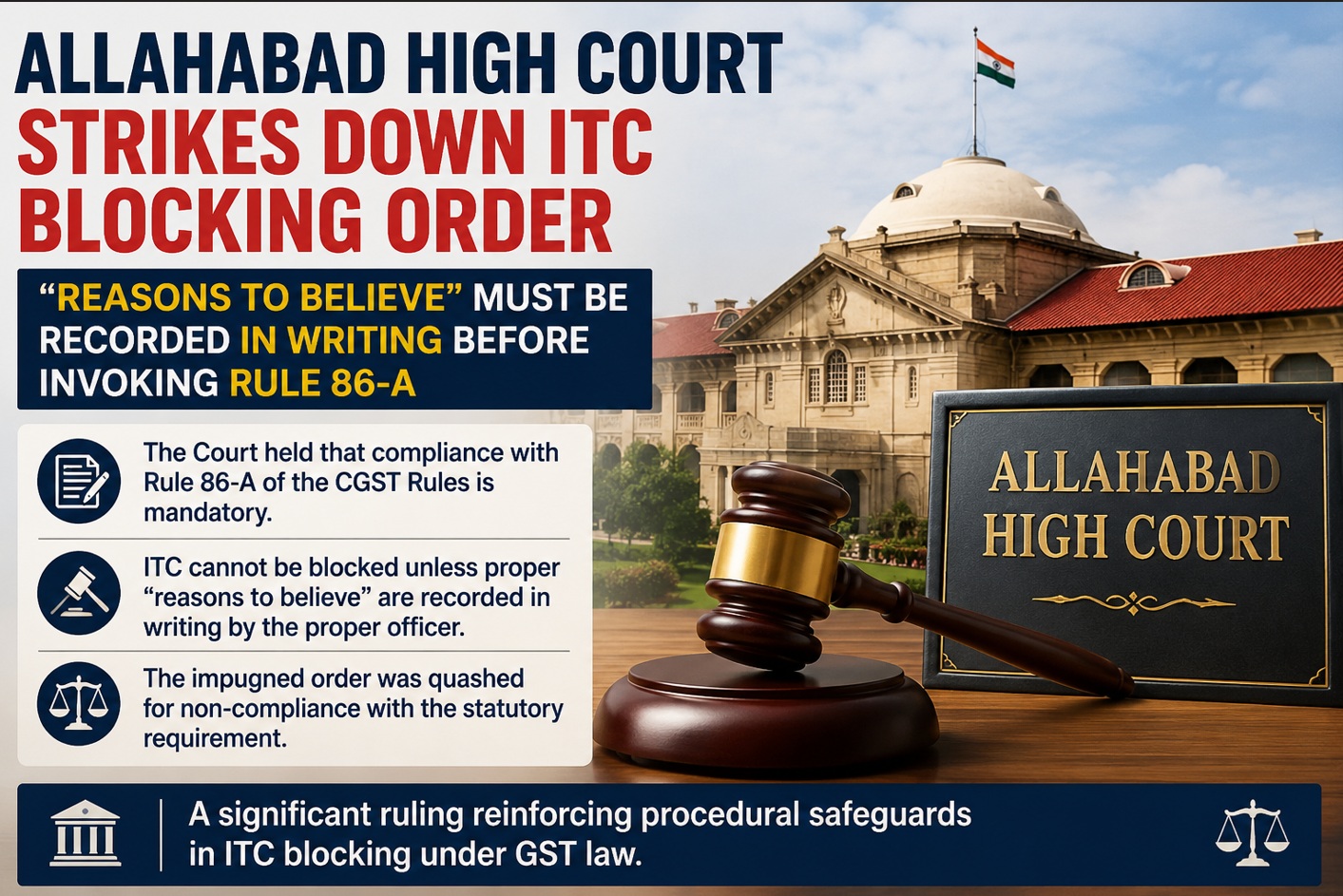
  • Allahabad High Court Strikes Down ITC Blocking Order: “Reasons to Believe” Must Be Recorded in Writing Before Invoking Rule 86-A

    Allahabad High Court Strikes Down ITC Blocking Order: “Reasons to Believe” Must Be Recorded in Writing Before Invoking Rule 86-A

    PRAYAGRAJ, May 26, 2026 — In a significant ruling reaffirming procedural safeguards for taxpayers, the Allahabad High Court has set aside an order blocking the Input Tax Credit (ITC) of a private dairy company after finding that the tax authorities failed to record “reasons to believe” in writing — a mandatory precondition under the GST framework.

    A division bench comprising Justice Saumitra Dayal Singh and Justice Vivek Saran quashed the order dated April 9, 2026, passed by the Joint Commissioner (Corporate-2), State Tax, which had blocked the ITC of M/s Mohan Milkfoods Private Limited in its Electronic Credit Ledger under Rule 86-A of the Uttar Pradesh Goods and Services Tax Rules, 2017.

    The petitioner, represented by Senior Advocate Rakesh Ranjan Agarwal along with counsel Nitin Kumar Kesarwani and Suyash Agarwal, contended that the essential precondition for exercising jurisdiction under Rule 86-A had not been fulfilled, as no “reason to believe” was recorded in writing before the extreme action of blocking ITC was taken.

    During the proceedings, the court directed the Standing Counsel for the revenue to produce clear written instructions confirming the existence of such recorded reasons. When the written instructions dated May 25, 2026, were produced, the court found that while several paragraphs offered reasoning to support the blocking order, the impugned order itself contained no recital of such reasons — it merely stated the conclusion that the petitioner had fraudulently availed ITC.

    Drawing on established constitutional jurisprudence, the court cited the Supreme Court’s landmark decision in Mohinder Singh Gill & Anr. vs. The Chief Election Commissioner, New Delhi & Ors. (1978), famously holding that “orders are not like old wine becoming better as they grow older” — an order must stand on its own strength and cannot be supplemented by subsequent affidavits or reasoning.

    The bench also placed strong reliance on a coordinate bench ruling in M/s Pilcon Infrastructure Pvt. Ltd. vs. State of U.P. & Anr. (2025), which had elaborated extensively on what constitutes a valid “reason to believe.” That ruling emphasised that there must be a rational basis for the belief, that the grounds must be germane to the formation of the belief, and that the belief must be held in good faith and not as a mere pretence.

    “It may not be forgotten, granting ITC and maintaining its chain is the soul of a successful GST regime,” the court had observed in Pilcon Infrastructure, a sentiment echoed by the present bench. “Any doubt or suspicion alone may not lead an action by the authorities to block the ITC of the assessee and disrupt the entire value addition chain.”

    The court declared the impugned order “jurisdictionally deficient” and set it aside, while granting liberty to the revenue to pass a fresh order strictly in accordance with law.

    The ruling underscores the judiciary’s consistent position that the requirement to record “reasons to believe” in writing is a non-negotiable, mandatory condition — even when the power is exercised ex-parte against the assessee.