Tag: GST Proceedings

  • Gauhati High Court Reaffirms: GST Registration Cancelled for Non-Filing Can Be Restored If Assessee Clears All Dues

    Gauhati High Court Reaffirms: GST Registration Cancelled for Non-Filing Can Be Restored If Assessee Clears All Dues

    Gauhati High Court Reaffirms: GST Registration Cancelled for Non-Filing Can Be Restored If Assessee Clears All Dues

    Court: Gauhati High Court | Bench: Justice Kardak Ete | Case No.: WP(C)/3000/2026 | Date: June 10, 2026


    Key Takeaways

    • Where GST registration is cancelled under Section 29(2)(c) of the CGST Act for non-filing of returns for six continuous months, the assessee can seek restoration by filing all pending returns and paying full tax dues with interest and late fee, as contemplated by the proviso to Rule 22(4) of the CGST Rules, 2017.
    • The Court permitted the petitioner to approach the jurisdictional officer within 60 days for restoration, even though the statutory time limit for filing a revocation application had lapsed.
    • The limitation period under Section 73(10) for issuing demand notices was directed to run from the date of this order (except for FY 2024-25, governed by Section 44), giving the department a fresh window to raise demands.
    • The decision follows and applies the coordinate bench ruling in Dhirghat Hardware Stores v. Union of India, WP(C) No. 5944/2025 (decided 17.10.2025), reinforcing a consistent line of authority from the Gauhati High Court on this issue.

    The Facts: A Familiar Story of Missed Returns and a Lapsed Remedy

    The petitioner, Sri Chongtham Manabandra Singh, is a proprietor operating a light motor vehicle hiring business in Duliajan, Dibrugarh, registered under both the CGST Act and the Assam GST Act. His trouble began when he failed to file GST returns for a continuous stretch of six months — a default he attributed to a breakdown in communication with his tax consultant.

    The department followed the prescribed procedure. A show-cause notice dated August 13, 2024 was issued in Form GST REG-17, calling upon the petitioner to explain within 30 days why his registration should not be cancelled. His registration was simultaneously suspended. When no satisfactory response came, the Superintendent, CGST, Duliajan Range cancelled the registration by order dated July 28, 2025 — notably, without recording any reasons in the cancellation order itself (para 5).

    By the time the petitioner attempted to apply for revocation of cancellation, the statutory window had already closed. He was, in effect, locked out of the GST system with no administrative remedy available. He had, however, filed all pending returns up to June 2025 and expressed willingness to pay all outstanding dues. Left with no other option, he moved the High Court under Article 226.

    What the Court Decided — and Why

    Justice Kardak Ete disposed of the petition at the motion stage itself, with the consent of both sides, on the strength of an earlier coordinate bench decision in Dhirghat Hardware Stores & Anr. v. Union of India & 3 Ors., WP(C) No. 5944/2025 (order dated October 17, 2025). The Standing Counsel for CGST fairly conceded that the earlier ruling covered the present facts (para 9).

    The legal reasoning, drawn from the Dhirghat Hardware Stores order and adopted in full by this bench, rests on two pillars.

    First, the proviso to Rule 22(4) of the CGST Rules expressly contemplates a situation where an assessee served with a show-cause notice for non-filing under Section 29(2)(b) or (c) furnishes all pending returns and clears all tax dues along with interest and late fee. In such a case, the proper officer is empowered — indeed, directed — to drop the proceedings and pass an order in Form GST REG-20 (paras 10 and 12 of the Dhirghat Hardware Stores extract). The proviso, in other words, builds a statutory escape hatch for assessees willing to come into compliance.

    Second, the Court underscored that cancellation of GST registration entails “serious civil consequences” (para 12 of Dhirghat Hardware Stores). This framing matters. It signals that the High Court views cancellation not as a routine administrative act but as a measure that effectively shuts a person out of legitimate commerce — an outcome disproportionate to the default where the assessee demonstrates willingness to regularize.

    The operative directions are precise. The petitioner must approach the jurisdictional authority within 60 days seeking restoration. If he files the application and complies with every requirement under the proviso to Rule 22(4) — meaning all returns filed, all tax paid with interest and late fee — the authority is bound to consider restoration “in accordance with law” and act “as expeditiously as possible” (para 13). There is no discretion to refuse on the ground that the statutory revocation period has lapsed; the Court’s writ jurisdiction effectively overrides that procedural bar.

    An important ancillary direction concerns limitation for departmental demands. The Court ordered that the period under Section 73(10) of the CGST Act (and the corresponding State Act provision) shall be computed from the date of this order, except for FY 2024-25, which remains governed by Section 44. This protects the revenue’s interest by ensuring that the time spent in litigation does not erode the department’s ability to raise demands for the period during which registration was cancelled.

    How This Shapes Practice

    This judgment does not break new ground in doctrinal terms — it follows Dhirghat Hardware Stores, which in turn followed Sanjoy Nath v. Union of India, WP(C) No. 6366/2023 (order dated October 11, 2023). What it does is consolidate a now-settled line of authority from the Gauhati High Court. Three coordinate bench orders over three years, all reaching the same result on materially identical facts, create a body of precedent that the department will find difficult to resist in future cases.

    For practitioners advising small businesses and proprietors in the Northeast — many of whom rely heavily on tax consultants and are vulnerable to precisely this kind of procedural default — the practical takeaway is clear. A lapsed revocation window is not the end of the road. The writ remedy remains available, provided the assessee demonstrates genuine willingness to comply: file all pending returns, pay all dues, and move promptly.

    Counsel should note, however, the conditions that made this petition succeed. The petitioner had already filed returns up to June 2025 before approaching the Court (para 6). He did not seek a waiver of dues or interest. He offered unconditional compliance. Petitions that seek restoration without having first cleared the backlog are unlikely to receive the same treatment.

    From the department’s perspective, the Court’s direction on Section 73(10) limitation is a meaningful safeguard. Officers processing restoration applications under these orders should note the recalibrated limitation timeline and initiate assessment proceedings accordingly.

    Relevant Provisions

    • Section 29(2)(c), CGST Act, 2017 — Power to cancel registration for non-filing of returns for six continuous months
    • Rule 22, CGST Rules, 2017 — Procedure for cancellation; proviso to sub-rule (4) permitting dropping of proceedings on compliance
    • Section 73(10), CGST Act / State GST Act — Time limit for issuance of demand orders
    • Section 44, CGST Act — Annual return provisions (applicable to FY 2024-25 limitation computation)
    • Article 226, Constitution of India — Writ jurisdiction of the High Court

    What to Watch

    An appeal to a Division Bench or the Supreme Court appears unlikely here — the Standing Counsel conceded the point and the department has not resisted this line of cases. The more interesting question is legislative. The GST Council and the CBIC have periodically introduced amnesty schemes and deadline extensions for revocation applications (most recently through various notifications relaxing the time limits under Section 30). If the pattern of writ petitions on this issue continues to grow, it may prompt a more permanent procedural fix — perhaps an expanded revocation window or a standardized late-compliance mechanism that removes the need for High Court intervention altogether. Practitioners should watch for any upcoming GST Council recommendations on this front.
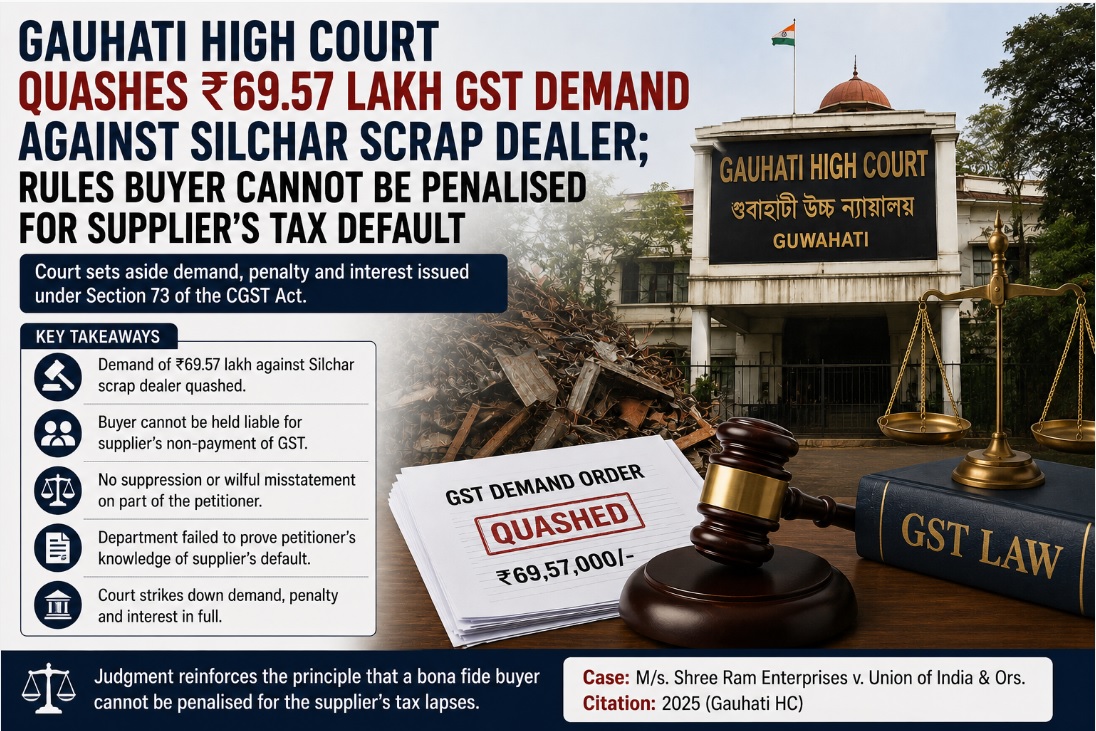
  • Gauhati High Court Quashes ₹69.57 Lakh GST Demand Against Silchar Scrap Dealer; Rules Buyer Cannot Be Penalised for Supplier’s Tax Default

    Gauhati High Court Quashes ₹69.57 Lakh GST Demand Against Silchar Scrap Dealer; Rules Buyer Cannot Be Penalised for Supplier’s Tax Default

    Court reaffirms that a bona fide purchasing dealer who has duly paid GST to a registered seller cannot be denied input tax credit merely because the seller failed to remit the tax to the government.

    Gauhati High Court | GUWAHATI

    In a significant ruling for trading and manufacturing businesses, the Gauhati High Court has set aside a demand order of ₹69,56,794 raised against Sri Gurucharan Kangsa Banik, proprietor of M/s Sree Guru Metals, Silchar. The demand comprised IGST of ₹50.19 lakh, CGST of ₹9.69 lakh, and SGST of ₹9.69 lakh, along with an equivalent penalty.

    Hon’ble Mr. Justice Kardak Ete held that a purchasing dealer who acts in good faith and pays GST to a registered supplier cannot be penalised if the supplier subsequently fails to deposit the tax with the government.

    The Court followed the Division Bench judgment in National Plasto Moulding v. State of Assam & Ors. [2024] 129 GSTR 544 (Gauhati), which in turn relied upon the Delhi High Court’s decision in On Quest Merchandising India Pvt. Ltd. v. Government of NCT of Delhi [2018] 56 GSTR 177 (Delhi). Counsel appearing for both the petitioner and the Revenue accepted that the issue was covered by these decisions.

    Facts of the Case

    M/s Sree Guru Metals is engaged in the business of procurement and sale of scrap and waste batteries.

    During the financial years 2017-18 and 2018-19, the proprietorship purchased goods from suppliers located in Kolkata and paid the applicable GST along with the purchase consideration through banking channels. The transactions were supported by valid tax invoices.

    Following the introduction of the GST regime in July 2017, the business encountered certain compliance-related issues, including discrepancies between GSTR-1 and GSTR-3B arising from data-entry errors relating to reporting of output tax liability and input tax credit.

    Pursuant to a summons issued by the Directorate General of GST Intelligence (DGGI), Guwahati Zonal Unit, the petitioner appeared before the authorities on 5 April 2019 and furnished all relevant records, including GST returns and purchase invoices.

    A search conducted at the business premises on 9 July 2019 did not result in recovery of any incriminating material.

    The Demand and the Challenge

    Despite the petitioner’s cooperation, a Show Cause Notice dated 26 August 2022 was issued alleging wrongful availment of ITC amounting to ₹69.56 lakh under Section 16(2)(a) and Section 16(2)(b) of the CGST Act on the ground that the underlying goods had not actually been received.

    Thereafter, an Order-in-Original dated 28 March 2024 was passed confirming the demand together with interest under Section 50 and an equivalent penalty under Section 74(1) read with Section 122 of the CGST Act.

    The petitioner challenged the order on several grounds.

    It was contended that no effective opportunity of hearing had been granted, as notices were manually served after the dates fixed for hearing and were not uploaded on the GST portal. It was also argued that Form GST DRC-07 had not been issued prior to passing the order.

    On merits, the petitioner submitted that all statutory conditions prescribed under Section 16(2) had been fulfilled. The goods had been received, genuine tax invoices had been issued, and payment including GST had been made through banking channels.

    According to the petitioner, the sole basis for denial of ITC was the alleged failure of the suppliers to deposit the tax collected from the petitioner, a circumstance entirely beyond the purchaser’s control.

    The petitioner further raised a limitation challenge, contending that a part of the disputed period was governed by Section 73 of the CGST Act and that the statutory limitation for proceedings under that provision had already expired. Consequently, invocation of Section 74 was stated to be impermissible.

    An additional objection was raised against the clubbing of multiple assessment years into a single adjudication order.

    Court’s Reasoning

    The Court held that the controversy stood squarely covered by the Division Bench judgment in National Plasto Moulding, which had adopted the reasoning of the Delhi High Court in On Quest Merchandising.

    The Division Bench had held that where a purchasing dealer bona fide enters into transactions with a validly registered supplier, pays the tax component, and otherwise complies with the statutory requirements, denial of ITC merely because the selling dealer fails to deposit the tax with the government is impermissible.

    The Court referred to the following observation in National Plasto Moulding:

    “A purchasing dealer cannot be punished for the act of a selling dealer who has failed to deposit the tax collected by it.”

    The Court also noted that the Delhi High Court in On Quest Merchandising had read down Section 9(2)(g) of the Delhi VAT Act—the provision analogous to Sections 16(2)(c) and 16(2)(d) of the CGST Act—to exclude bona fide purchasing dealers from its scope.

    The Delhi High Court had reasoned that a literal interpretation would impose an impossible burden on a purchaser and could render the provision vulnerable to challenge under Article 14 of the Constitution.

    The Court further noted that the Special Leave Petition filed against the Delhi High Court’s judgment had been dismissed by the Supreme Court, while preserving liberty for the authorities to proceed in cases where the transactions were not bona fide.

    Accepting that the legal position stood settled, the Gauhati High Court set aside the impugned Order-in-Original.

    At the same time, the Court preserved the department’s right to proceed against the petitioner if material subsequently emerges showing that the transactions were not genuine or were entered into in collusion with the suppliers.

    Significance

    The decision adds to the growing body of judicial authority protecting bona fide purchasers from adverse consequences arising solely from a supplier’s failure to discharge tax liability.

    The ruling reiterates that where a purchaser has acted in good faith, obtained valid tax invoices, received the goods, and paid the consideration including GST, denial of ITC cannot be justified merely because the supplier defaults in remitting tax to the government.

    The Court, however, recognised the distinction between genuine transactions and collusive arrangements. Where the department is able to establish that transactions were not bona fide or lacked commercial substance, it remains open to the authorities to invoke the statutory provisions and deny the benefit of ITC.

    Citation: Sri Gurucharan Kangsa Banik v. Union of India & Ors. — Gauhati High Court, Writ Petition (arising from Order-in-Original No. 37/GST/AC/SIL/2023-24 dated 28.03.2024).

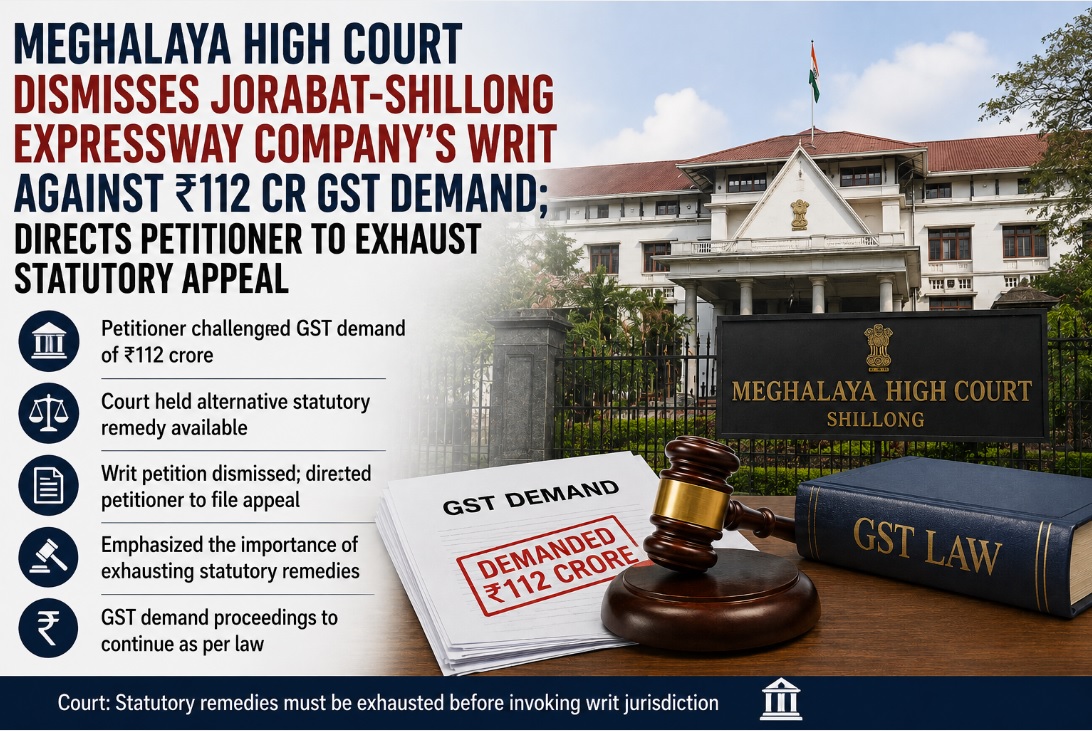
  • Meghalaya High Court Dismisses Jorabat-Shillong Expressway Company’s Writ Against ₹112 Cr GST Demand; Directs Petitioner to Exhaust Statutory Appeal

    Meghalaya High Court Dismisses Jorabat-Shillong Expressway Company’s Writ Against ₹112 Cr GST Demand; Directs Petitioner to Exhaust Statutory Appeal

    Division Bench holds that classification of BOT annuity receipts—whether taxable construction services or exempt road-access services—raises mixed questions of law and fact unsuitable for writ adjudication, and finds no patent jurisdictional defect or violation of natural justice that would warrant bypassing the appellate remedy under Section 107 of the CGST Act.

    Gauhati High Court, Shillong Bench (Meghalaya) | SHILLONG, June 2, 2026

    The Meghalaya Bench of the Gauhati High Court has dismissed a writ petition filed by M/s Jorabat Shillong Expressway Limited (JSEL) challenging a GST demand of ₹112,39,64,394 (comprising CGST and SGST) raised on annuity receipts of ₹864,12,69,958 received from the National Highways Authority of India (NHAI) for the period July 2017 to December 2022.

    The Division Bench of Hon’ble Mr. Justice H.S. Thangkhiew and Hon’ble Mr. Justice B. Bhattacharjee declined to exercise writ jurisdiction under Article 226 of the Constitution, holding that the petitioner had an efficacious alternate remedy by way of a statutory appeal before the appellate authority under Section 107 of the CGST Act, 2017.

    The Court, however, granted liberty to the petitioner to file the appeal within four weeks and directed the appellate authority to consider the same on its own merits, uninfluenced by any observations made in the judgment.

    Background: The BOT Annuity Project

    JSEL was incorporated as a Special Purpose Vehicle (SPV) by a consortium of IL&FS Transportation Networks Limited and Ramky Infrastructure pursuant to a Letter of Acceptance issued by NHAI on 20 May 2010.

    The company entered into a Concession Agreement dated 16 July 2010 for a BOT (Annuity) project covering approximately 61.98 kilometres of the Jorabat–Shillong Section of National Highway No. 40 spanning the States of Assam and Meghalaya.

    Under the BOT (Annuity) model—a Public Private Partnership structure widely used in highway development—the concessionaire finances and constructs the highway, operates and maintains it for a specified concession period, and eventually transfers it back to the government.

    Importantly, the right to collect toll remains with NHAI and not with the concessionaire. Instead, the concessionaire recovers its investment through half-yearly annuity payments made by NHAI after commencement of commercial operations. Under JSEL’s concession agreement, the concession period extends until 2031.

    The Demand and Its Basis

    The dispute originated when GST Intelligence authorities issued a Show Cause Notice dated 30 September 2023 alleging that JSEL had failed to discharge GST on annuity payments received for road construction activities.

    The Department classified the services under SAC 9954 (works contract services taxable at 12% to 18%) rather than SAC 9967 (services by way of access to a road or bridge exempt under Entry 23A of the relevant exemption notification).

    An initial demand of approximately ₹130.57 crore, along with interest and penalty, was proposed.

    JSEL initially challenged the Show Cause Notice before the High Court on the ground that the proceedings were premature. That writ petition was dismissed. Thereafter, a Special Leave Petition filed before the Supreme Court was disposed of on 5 February 2024 with directions requiring the authorities to properly consider the petitioner’s submissions.

    Following a personal hearing held on 19 March 2024, the Additional Commissioner, CGST, Shillong passed an Order-in-Original dated 18 April 2024 confirming a reduced demand of ₹112.39 crore together with applicable interest and penalty.

    The present writ petition challenged both the Show Cause Notice and the Order-in-Original.

    Petitioner’s Grounds of Challenge

    Senior Advocate Mr. S. Ghosh advanced multiple grounds of challenge on behalf of JSEL.

    The central contention was that the entire consideration, including annuity receipts received under the BOT arrangement, was exempt under Entry 23A of the exemption notification dated 28 June 2017, as amended on 13 October 2017, which exempts:

    “Service by way of access to a road or a bridge on payment of annuity.”

    According to the petitioner, the Department had artificially bifurcated an integrated BOT service into separate construction and access components when, in substance, the concessionaire was providing a composite and indivisible service.

    The petitioner also mounted a constitutional challenge to CBIC Circular No. 150/06/2021-GST dated 17 June 2021, which clarified that Entry 23A does not exempt GST on annuity paid for construction of roads.

    It was argued that the Circular effectively overrides a statutory exemption notification, contrary to Section 11(3) of the CGST Act.

    Reliance was placed upon the decision of the Karnataka High Court in M/s DPJ Bidar-Chincholi (Annuity) Road Project Pvt. Ltd. v. Union of India, reported in (2024) 122 GSTR 48, wherein the same Circular was struck down and annuity receipts were held exempt.

    Jurisdictional objections were also raised against:

    • The Additional Director, DGGI, who issued the Show Cause Notice; and
    • The Additional Commissioner, CGST, Shillong, who passed the adjudication order.

    The petitioner contended that neither officer qualified as a “Proper Officer” under Section 2(91) of the CGST Act for initiating and adjudicating proceedings under Section 74.

    Further, it was argued that Section 74, which applies to cases involving fraud, suppression, or wilful misstatement, was inapplicable because the dispute involved only interpretation of law and not any attempt to evade tax.

    Additional grounds included:

    • Taxability of services rendered under pre-GST contracts;
    • Incorrect inclusion of certain exempt receipts;
    • Alleged computational errors in the demand; and
    • Inclusion of interest earned on term deposits, which was claimed to be exempt.

    The petitioner submitted:

    “The case hinges on a pure question of law—whether annuity receipts under BOT road projects are exempt—supported by statutory notifications, judicial precedent, and settled principles on interpretation of exemptions.”

    Revenue’s Defence

    The Union respondents, represented by learned DSGI Dr. N. Mozika, defended both the Show Cause Notice and the Order-in-Original.

    According to the Revenue, JSEL was engaged in a composite supply consisting of:

    • Design;
    • Financing;
    • Construction;
    • Operation; and
    • Maintenance.

    The principal supply, according to the Department, was construction of roads, which is taxable as a works contract service.

    Since the right to collect toll never vested in JSEL, the concessionaire could not claim that it was providing road-access services falling under Entry 23A.

    On jurisdiction, the Revenue relied on Notification No. 14/2017-Central Tax dated 1 July 2017, which conferred powers upon DGGI officers as Central Tax officers.

    The Revenue also relied upon Notification No. 2/2022-Central Tax dated 11 March 2022, which inserted Paragraph 3A and vested Additional Commissioners with adjudication powers in respect of Show Cause Notices issued by DGGI.

    On the issue of pre-GST contracts, reliance was placed on Section 142(10) of the CGST Act and Section 13 dealing with time of supply of continuous services.

    The Revenue further contended that the Karnataka High Court’s decision in DPJ Bidar-Chincholi had not attained finality as appeals were pending.

    The State of Meghalaya, represented by learned Government Advocate Mr. N. Syngkon, argued that Entry 23A was intended to apply only where a concessionaire provides access to a road in lieu of toll collection and receives annuity as compensation.

    Since JSEL never possessed toll collection rights, the principal supply remained construction, making the entire composite supply taxable under Section 8 of the CGST Act.

    Court’s Analysis

    The Division Bench first noted that the legal position concerning GST liability on BOT annuity receipts remains unsettled and is presently the subject of divergent judicial views and pending appeals.

    Against that background, the Court examined the maintainability of the writ petition.

    Challenge to Jurisdiction Rejected

    The Court rejected the petitioner’s challenge regarding the competence of the officers involved.

    It held that the Additional Director, DGGI was a valid Proper Officer by virtue of Notification No. 14/2017, which conferred powers on DGGI officers corresponding to their rank.

    Similarly, the Additional Commissioner, CGST, Shillong possessed adjudicatory authority under Notification No. 2/2022.

    The Court observed:

    “Mere disagreement regarding the interpretation of the scope of powers conferred under statutory notifications cannot by itself convert an issue into a jurisdictional defect warranting interference under Article 226.”

    The Court relied upon the decision of the Allahabad High Court in RC Infra Digital Solution v. Union of India as well as the Supreme Court’s decision in Union of India v. Azadi Bachao Andolan (2004) 10 SCC 1.

    Mixed Questions of Law and Fact

    The Court further held that the controversy involved several intertwined issues requiring detailed factual examination, including:

    • Classification under SAC 9954 or SAC 9967;
    • Applicability of Entry 23A;
    • Characterisation of BOT annuity payments;
    • Interpretation of concession agreements; and
    • Determination of principal supply under the composite supply provisions.

    These issues, according to the Court, constituted mixed questions of law and fact and were therefore unsuitable for adjudication in writ jurisdiction at the first instance.

    Alternate Remedy Cannot Be Bypassed

    The petitioner argued that the appellate remedy under Section 107 would be illusory because appellate authorities are bound by CBIC Circulars issued under Section 168 of the CGST Act.

    The Court rejected this contention.

    It held that while circulars may bind departmental officers, they do not constitute law and do not bind courts.

    The Court observed that acceptance of the petitioner’s argument would effectively permit taxpayers to bypass the statutory appellate framework whenever a departmental circular is involved.

    Approving the principle laid down by the Allahabad High Court, the Bench noted:

    “Though orders or instructions issued by the Board may be binding upon departmental authorities, they do not bind courts and it is needless to cite cases on the point.”

    The Court also noted that the petitioner had fully participated in the adjudication proceedings pursuant to the directions of the Supreme Court, filed detailed replies, attended personal hearings, and presented extensive submissions.

    Whether the conclusions reached by the adjudicating authority were correct or incorrect was a matter appropriately falling within the domain of the appellate authority.

    Outcome

    Finding no exceptional circumstance warranting interference under Article 226, the Court dismissed the writ petition.

    The Court held that none of the recognised exceptions to the rule of alternate remedy were attracted, namely:

    • Lack of jurisdiction;
    • Violation of principles of natural justice; or
    • Infringement of fundamental rights incapable of redress through the statutory mechanism.

    However, the Court granted JSEL liberty to file an appeal under Section 107 of the CGST Act within four weeks from the date of the judgment.

    The appellate authority was directed to decide the appeal independently and strictly on its own merits, without being influenced by any observations made in the writ proceedings.

    Significance

    The judgment reinforces the well-established principle that writ jurisdiction should not ordinarily be invoked where an effective statutory appellate remedy exists.

    The ruling is particularly significant for infrastructure concessionaires operating under BOT (Annuity) models because it indicates that disputes concerning the GST treatment of annuity receipts should generally be pursued through the appellate hierarchy rather than through direct writ proceedings.

    The decision also highlights that the controversy surrounding taxation of BOT annuity receipts remains unresolved. Although the Karnataka High Court in DPJ Bidar-Chincholi held such annuity receipts to be exempt, the Meghalaya Bench noted that the issue remains subject to pending appellate proceedings and cannot yet be regarded as conclusively settled.

    Case: M/s Jorabat Shillong Expressway Limited v. Union of India & Others
    Court: Meghalaya Bench of the Gauhati High Court
    Case No.: WP(C) No. 245 of 2024
    Decision Date: 2 June 2026

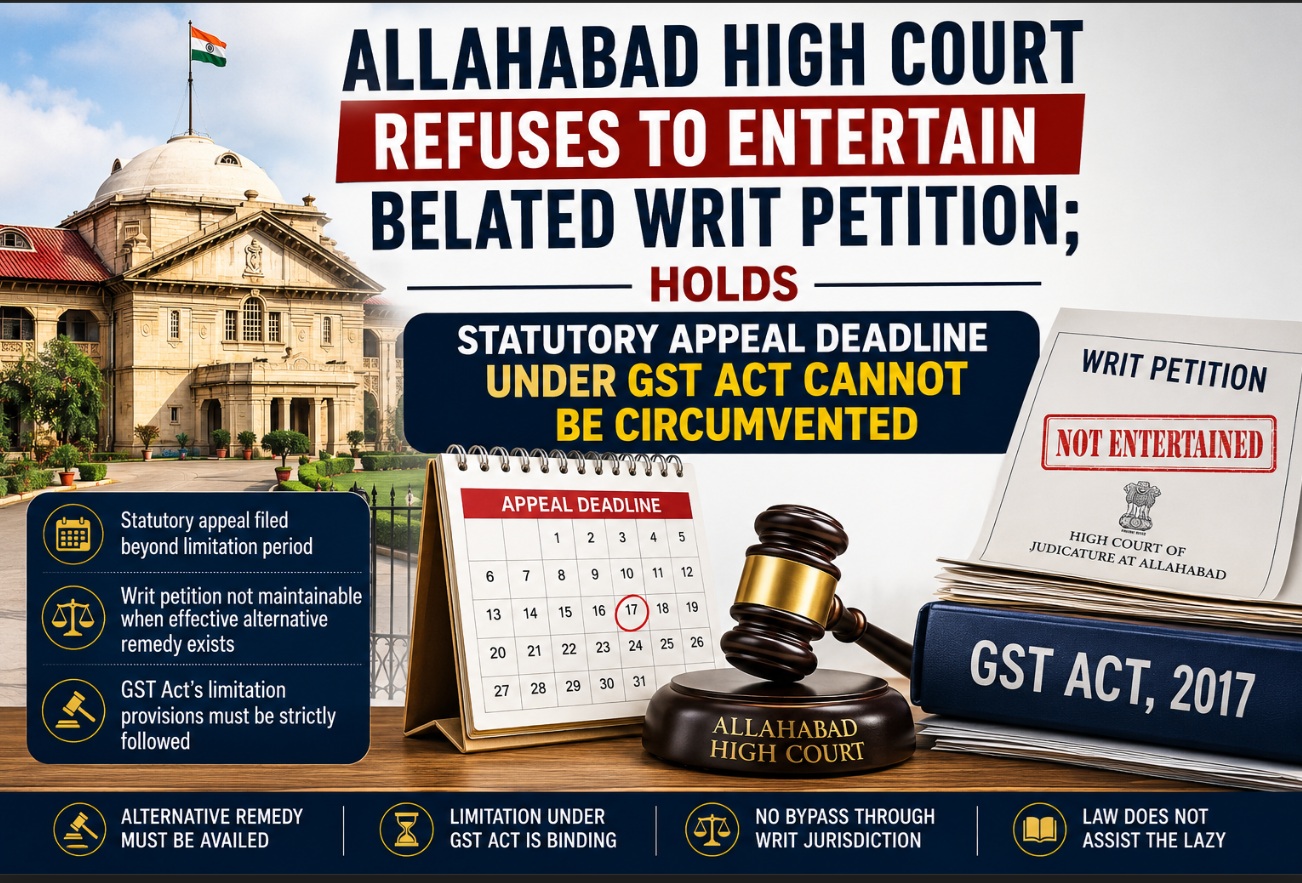
  • Allahabad High Court Refuses to Entertain Belated Writ Petition; Holds Statutory Appeal Deadline Under GST Act Cannot Be Circumvented

    Allahabad High Court Refuses to Entertain Belated Writ Petition; Holds Statutory Appeal Deadline Under GST Act Cannot Be Circumvented

    PRAYAGRAJ, May 26, 2026 — In a judgment that reinforces the principle that writ jurisdiction cannot be used as a backdoor to bypass statutory limitation periods, the Allahabad High Court has dismissed a writ petition challenging an assessment order that was nearly a year old, holding that the petitioner’s failure to file a timely statutory appeal under the GST Act was fatal to his case.

    A division bench of Justice Shekhar B. Saraf and Justice Abdhesh Kumar Chaudhary was hearing a petition filed by M/s Mishra Security Services, whose proprietor Smt. Sunita Mishra had sought to quash an assessment order dated June 4, 2025, and the preceding show-cause notice dated March 17, 2025.

    The petitioner had earlier filed a writ petition in January 2026 — itself beyond the limitation period — which was dismissed as withdrawn with liberty to file afresh with better particulars. The present petition was the second attempt.

    The court expressed its inability to countenance how the petitioner could file a writ petition at such a belated stage “merely to bypass the limitation prescribed for filing a statutory appeal under Section 107(1) of the GST Act.”

    Section 107(1) provides for filing an appeal within three months from the date of communication of the order, with a further condonable period of one month under Section 107(4). The court noted that the outer limit had long since expired.

    Relying on the Supreme Court’s authoritative pronouncements in Singh Enterprises vs. C.C.E., Jamshedpur (2008) and Commissioner of Customs and Central Excise vs. Hongo India Private Limited (2009), the bench held that the appellate authority under the GST Act has no power to condone delay beyond the statutorily prescribed period. The court also drew from the coordinate bench ruling in Atlantis Intelligence Ltd. vs. Union of India (2025), where Justice Saraf himself had distilled the principles governing maintainability of writ petitions after expiry of the statutory appeal period.

    The Atlantis Intelligence ruling had established, among other things, that when a statute prescribes a maximum condonable delay (here, one additional month), Section 29(2) read with Section 3 of the Limitation Act applies, and courts have no power to condone any further delay — even in writ jurisdiction under Article 226 of the Constitution.

    “We are rather surprised,” the bench observed, noting that the petitioner had been “a fence sitter” who had not been diligent in pursuing his rights. The court underscored the Latin maxim quando aliquid prohibetur ex directo, prohibetur et per obliquum — what cannot be done directly cannot be done indirectly.

    The court, however, clarified that if the petitioner files an appeal, the observations made in the order shall not affect the decision of the appellate forum.

    The judgment serves as a cautionary reminder to litigants that the extraordinary writ jurisdiction of the High Court is not a substitute for statutory remedies, and that courts will not readily assist those who sleep over their rights.

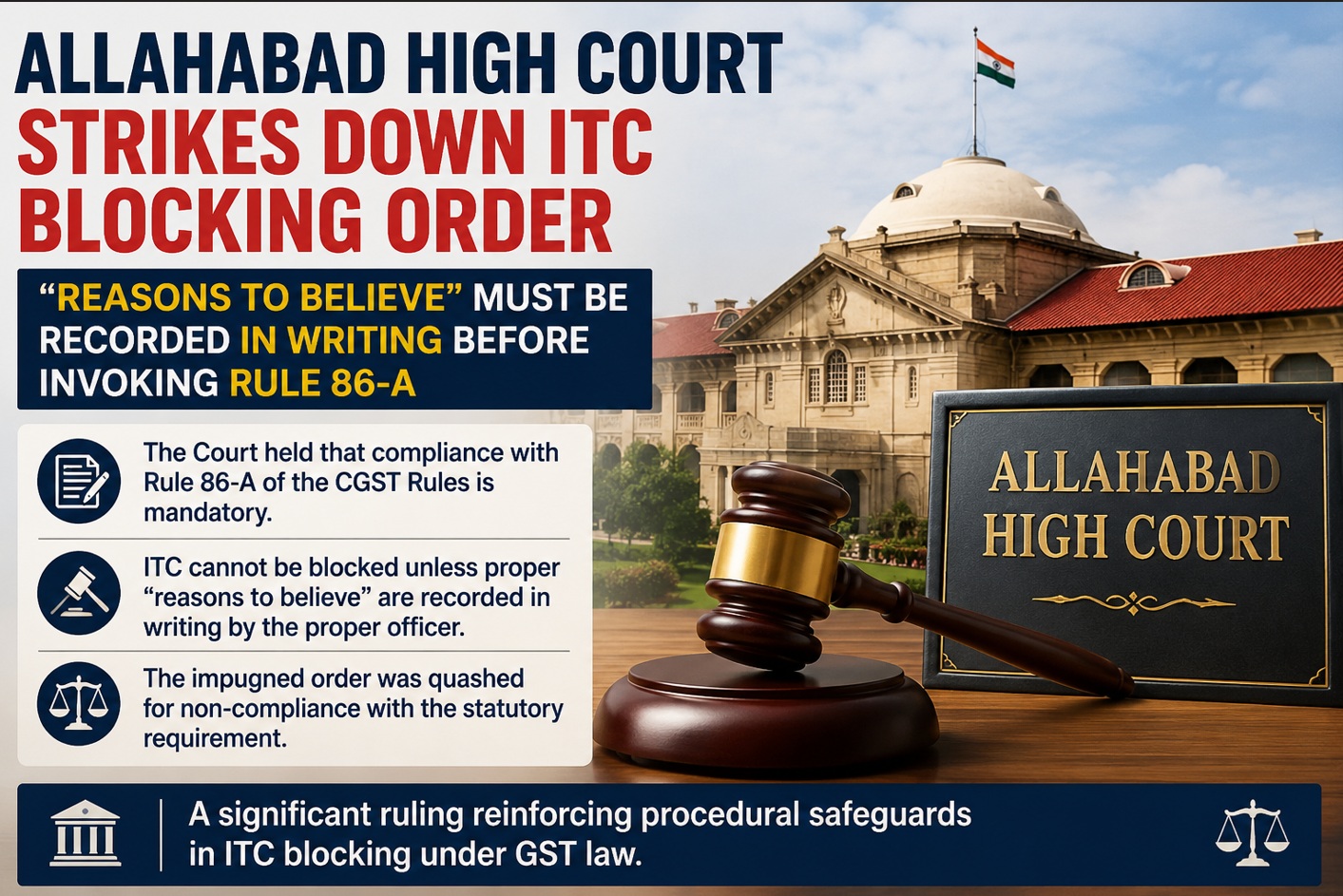
  • Allahabad High Court Strikes Down ITC Blocking Order: “Reasons to Believe” Must Be Recorded in Writing Before Invoking Rule 86-A

    Allahabad High Court Strikes Down ITC Blocking Order: “Reasons to Believe” Must Be Recorded in Writing Before Invoking Rule 86-A

    PRAYAGRAJ, May 26, 2026 — In a significant ruling reaffirming procedural safeguards for taxpayers, the Allahabad High Court has set aside an order blocking the Input Tax Credit (ITC) of a private dairy company after finding that the tax authorities failed to record “reasons to believe” in writing — a mandatory precondition under the GST framework.

    A division bench comprising Justice Saumitra Dayal Singh and Justice Vivek Saran quashed the order dated April 9, 2026, passed by the Joint Commissioner (Corporate-2), State Tax, which had blocked the ITC of M/s Mohan Milkfoods Private Limited in its Electronic Credit Ledger under Rule 86-A of the Uttar Pradesh Goods and Services Tax Rules, 2017.

    The petitioner, represented by Senior Advocate Rakesh Ranjan Agarwal along with counsel Nitin Kumar Kesarwani and Suyash Agarwal, contended that the essential precondition for exercising jurisdiction under Rule 86-A had not been fulfilled, as no “reason to believe” was recorded in writing before the extreme action of blocking ITC was taken.

    During the proceedings, the court directed the Standing Counsel for the revenue to produce clear written instructions confirming the existence of such recorded reasons. When the written instructions dated May 25, 2026, were produced, the court found that while several paragraphs offered reasoning to support the blocking order, the impugned order itself contained no recital of such reasons — it merely stated the conclusion that the petitioner had fraudulently availed ITC.

    Drawing on established constitutional jurisprudence, the court cited the Supreme Court’s landmark decision in Mohinder Singh Gill & Anr. vs. The Chief Election Commissioner, New Delhi & Ors. (1978), famously holding that “orders are not like old wine becoming better as they grow older” — an order must stand on its own strength and cannot be supplemented by subsequent affidavits or reasoning.

    The bench also placed strong reliance on a coordinate bench ruling in M/s Pilcon Infrastructure Pvt. Ltd. vs. State of U.P. & Anr. (2025), which had elaborated extensively on what constitutes a valid “reason to believe.” That ruling emphasised that there must be a rational basis for the belief, that the grounds must be germane to the formation of the belief, and that the belief must be held in good faith and not as a mere pretence.

    “It may not be forgotten, granting ITC and maintaining its chain is the soul of a successful GST regime,” the court had observed in Pilcon Infrastructure, a sentiment echoed by the present bench. “Any doubt or suspicion alone may not lead an action by the authorities to block the ITC of the assessee and disrupt the entire value addition chain.”

    The court declared the impugned order “jurisdictionally deficient” and set it aside, while granting liberty to the revenue to pass a fresh order strictly in accordance with law.

    The ruling underscores the judiciary’s consistent position that the requirement to record “reasons to believe” in writing is a non-negotiable, mandatory condition — even when the power is exercised ex-parte against the assessee.