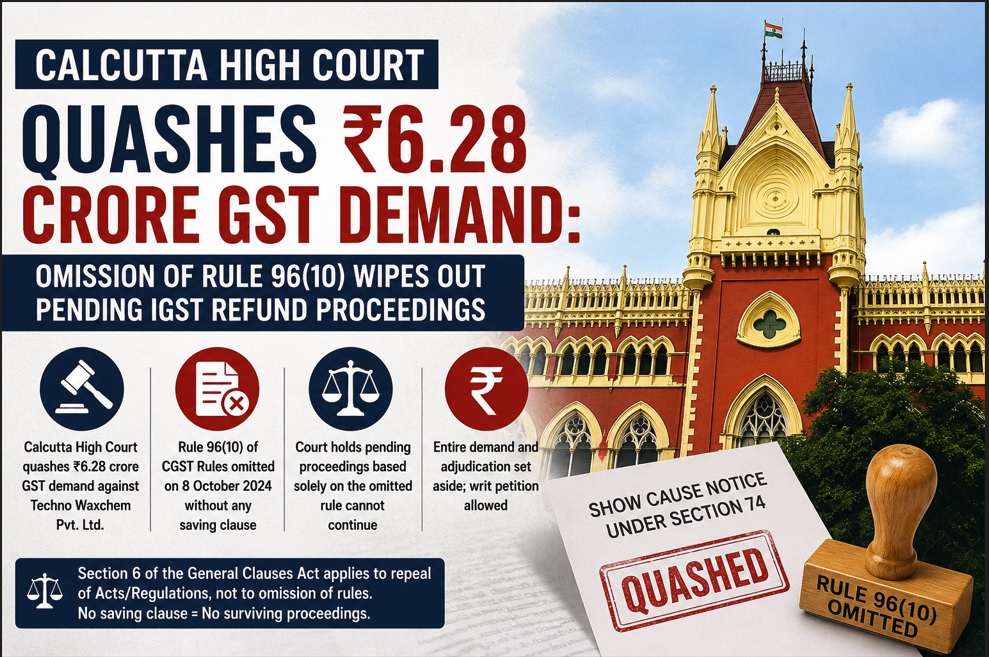
Kolkata, June 2026 – The Calcutta High Court has quashed a ₹6.28 crore tax demand against Techno Waxchem Private Limited, holding that the Government’s October 2024 decision to omit Rule 96(10) of the CGST Rules leaves no legal basis for continuing any pending enforcement proceedings under that provision. The ruling by Justice Raja Basu Chowdhury adds to a growing body of High Court jurisprudence that has effectively sounded the death knell for all outstanding show-cause notices, adjudication orders, and appeals rooted in the now-deleted anti-double-benefit restriction.
The Dispute
Techno Waxchem, a manufacturer and exporter of chemical products primarily used in the rubber industry — including modified formaldehyde resins, resorcinol blends, and related compounds — had, between October 2017 and March 2022, claimed and received IGST refunds totalling ₹6,28,27,407 on goods exported under the Advance Authorisation Scheme.
Under the Advance Authorisation framework, exporters are permitted duty-free import of inputs. The rub, according to the revenue authorities, was Rule 96(10) of the CGST Rules, 2017. That provision barred an exporter who had availed duty-free imports under specified Customs notifications from simultaneously claiming a refund of IGST paid on the exported finished goods. The logic was to prevent “encashment” of input tax credit accumulated on domestically procured goods against exports manufactured using duty-free imported inputs — a species of double benefit that the rule was designed to foreclose.
The Director General of GST Intelligence (DGGI) alleged that Techno Waxchem had done exactly that. A show-cause notice dated 27 September 2023 was issued under Section 74 of the CGST Act for the periods 2017–18 through 2021–22. The adjudicating authority confirmed the demand in an order-in-original dated 4 February 2025, directing recovery along with interest under Section 50 and penalty under Section 122(2)(b).
The Rule That Vanished
Between the issuance of the show-cause notice and the adjudication order, however, the legal landscape shifted fundamentally. In its 54th meeting, the GST Council accepted the Law Committee’s recommendation to do away with Rule 96(10), observing that the restriction had caused unnecessary complications without yielding any commensurate benefit. On 8 October 2024, the Central Government issued Notification No. 20/2024-Central Tax, which — at Serial No. 10 — simply stated: “In the said rules, in rule 96, sub-rule (10) shall be omitted.”
No saving clause was inserted. No transitional provision was made. No language preserved pending proceedings. The rule was simply taken off the statute book.
Techno Waxchem, during the personal hearing before the adjudicating authority, specifically drew attention to this development and argued that the demand could no longer survive. The Proper Officer, however, took the view that the omission was prospective — effective only from 8 October 2024 — and that since the refund was availed and the show-cause notice issued during the rule’s subsistence, the demand remained valid.
The High Court’s Reasoning
Justice Raja Basu Chowdhury disagreed. Drawing on two seminal Supreme Court decisions — Rayala Corporation (P) Ltd. v. Director of Enforcement (1969) and Kolhapur Canesugar Works Ltd. v. Union of India (2000) — the Court reaffirmed a proposition that, while well-settled in criminal and excise jurisprudence, is only now being tested in the GST context: Section 6 of the General Clauses Act, 1897, which saves proceedings initiated under a repealed enactment, applies only to the repeal of a Central Act or Regulation. It has no application to the omission of a rule.
The distinction is not merely semantic. As the Supreme Court held in Rayala Corporation:
“Section 6 only applies to repeals and not to omissions, and applies when the repeal is of a Central Act or Regulation and not of a rule.”
And in Kolhapur Canesugar Works, the Constitution Bench reaffirmed the principle, rejecting the Gujarat High Court’s attempt to distinguish Rayala Corporation. The rule, the Court held, takes its colour from the definition in the General Clauses Act — it is not a “statute,” and equating the two is impermissible.
The consequence is stark: when a rule is omitted without a saving clause, the rule is treated as having never existed. All pending proceedings — show-cause notices awaiting adjudication, orders under challenge before appellate authorities, even writ petitions contesting demands — stand ipso facto terminated.
A National Consensus Emerges
Justice Chowdhury’s ruling does not stand alone. The Calcutta High Court drew express support from three other High Courts that have addressed identical questions in recent months.
The Bombay High Court, in Hikal Limited v. Union of India (2025), held that following the omission of Rules 89(4B) and 96(10), and in the absence of saving clauses, “all pending proceedings — such as undisposed show cause notices, orders disposing of show cause notices issued after 08 October 2024, or even orders made before 08 October 2024 but not yet finalised due to appeals … are not preserved and will stand lapsed.”
The Gujarat High Court in Addwrap Packaging (P.) Ltd. v. Union of India (2025) arrived at the same conclusion.
Most recently, the Delhi High Court in Vinayak International Housewares Pvt. Ltd. undertook a comprehensive survey of the precedents and crystallised the position into four clear propositions: the GST Council itself acknowledged that Rule 96(10) caused unnecessary complications; the omission applies to all pending proceedings; anything short of a “transaction past and closed” is caught by the omission; and appeals, pending adjudications, and even show-cause notices all fall within the protective sweep of the deletion.
“Transactions Past and Closed”
The operative distinction, as the Bombay High Court framed it, is between proceedings that are alive and those that have attained finality. A demand confirmed by an order that has not been appealed — a “transaction past and closed” — may well stand. But a show-cause notice awaiting adjudication, an order under appeal, or a writ petition against an order — none of these constitutes a concluded transaction. For these, the omission of the underlying rule pulls the rug from under the entire proceeding.
Since Techno Waxchem’s writ petition was filed against the order-in-original dated 4 February 2025, the matter was very much alive. The Court had little difficulty concluding that “on the omission of Rule 96(10), the order dated 4th February, 2025 no longer survives.”
Implications for the Field
The judgment is significant beyond its immediate facts. Rule 96(10) had been one of the most heavily litigated provisions in the GST refund universe. Exporters across sectors — pharmaceuticals, chemicals, engineering goods, textiles — had been hit with demands running into hundreds of crores on the allegation that they had availed the IGST refund route while also holding Advance Authorisation licences or having procured inputs under specified exemption notifications.
The 54th GST Council meeting may have been motivated by administrative pragmatism — the rule, as the Council observed, created enormous compliance friction without meaningful revenue protection — but the legal effect of a simple omission, unaccompanied by a saving clause, appears to have been more far-reaching than perhaps anticipated. By operation of the principle laid down in Rayala Corporation and Kolhapur Canesugar, the omission has effectively wiped the slate clean.
Unless the revenue authorities persuade the Supreme Court to take a different view — and the consistent, multi-jurisdictional weight of High Court authority makes that an uphill task — thousands of pending IGST refund demands premised on Rule 96(10) now stand on legally unsustainable ground.
The Road Ahead
With four High Courts now speaking in one voice — Bombay, Gujarat, Delhi, and Calcutta — the question is whether the revenue will accept the settled position or attempt to carry the issue to the Supreme Court. The adjudicating authority, in its order, had noted pointedly that “the instant issue has not yet attained finality and the department has opportunity to appeal before Hon’ble Supreme Court against the aforementioned order of Hon’ble Kerala High Court.” That observation, however, concerned the constitutional validity of Rule 96(10) — a question rendered academic by the rule’s omission. The surviving question — the effect of omission without a saving clause — rests on Supreme Court decisions that are over five decades old and have never been doubted.
For exporters who have been fighting Rule 96(10) demands, the Calcutta High Court’s judgment is the latest — and one of the most lucidly reasoned — endorsements of a position that increasingly looks unassailable.