Tag: gst investigation

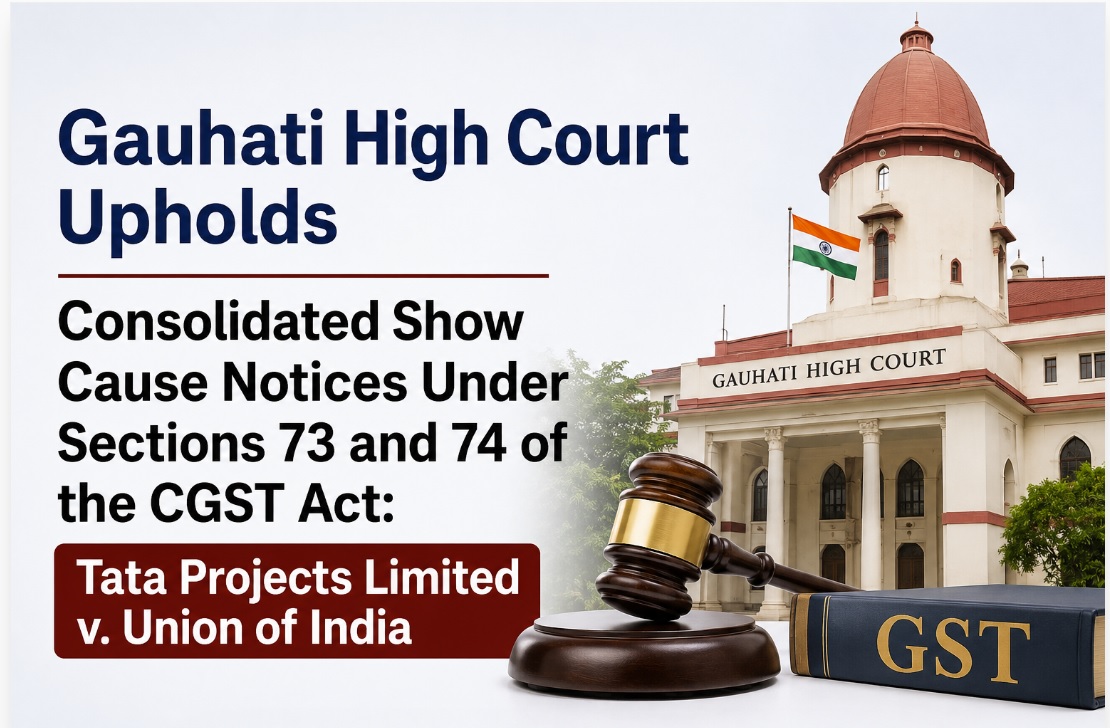
  • Gauhati High Court Upholds Consolidated Show Cause Notices Under Sections 73 and 74 of the CGST Act: Tata Projects Limited v. Union of India

    Gauhati High Court Upholds Consolidated Show Cause Notices Under Sections 73 and 74 of the CGST Act: Tata Projects Limited v. Union of India

    Gauhati High Court Upholds Consolidated Show Cause Notices Under Sections 73 and 74 of the CGST Act: Tata Projects Limited v. Union of India

    Court: Gauhati High Court | Bench: Justice Devashis Baruah | Case No.: WP(C)/2922/2025 (with WP(C)/20/2026 and WP(C)/1113/2026) | Date: June 8, 2026 | Citation: 2026:GAU-AS:8028


    Key Takeaways

    • There is no statutory bar under the CGST Act, 2017 against issuing a consolidated show cause notice under Section 73(1) or Section 74(1) covering multiple financial years, provided limitation under Sections 73(2)/74(2) is independently satisfied for each year.
    • Proceedings under Sections 73 and 74 are adversarial and adjudicatory in character, falling under Chapter XV (“Demand and Recovery”) — they are structurally distinct from “Assessment” under Chapter XII, and the financial-year-specific architecture of Chapter XII does not control or restrict the demand machinery.
    • Where a consolidated notice covers some financial years that are within limitation and others that are time-barred, the doctrine of severability applies: the notice survives for the years within time and fails only for those that are not.
    • The Court expressly disagreed with the Kerala High Court (Tharayil Medicals, Dhanlaxmi Bank) and the Madras High Court (Oriental Lotus, Titan Company), and aligned with the Delhi High Court (Ambika Traders, Mathur Polymers), the Allahabad High Court (S.A. Aromatics), and the Karnataka High Court Division Bench (Chimney Hills Education Society).

    What the Case Was About

    Three unrelated writ petitions — filed by Tata Projects Limited (a works contract services provider), Quantum Infratech (a residential construction firm), and Bitchem Asphalt Technologies Limited (a road-building materials supplier) — were heard together because they raised a single, common jurisdictional challenge. Each petitioner had been served a show cause notice under Section 74 (or Section 73, in Tata Projects’ case for one year) of the CGST Act that clubbed together demands pertaining to multiple financial years — ranging from 2017-18 through 2022-23 in the most expansive case. Each petitioner contended that the entire proceeding was without jurisdiction because the CGST Act requires year-specific show cause notices and does not permit consolidation.

    The stakes were significant. Tata Projects had already exhausted its first appeal, with the Commissioner (Appeals) confirming the demand. Quantum Infratech’s case originated in DGGI search operations, involved allegations of fraud under Section 74 read with Section 122(1A), and had penalties imposed on individual partners. Bitchem faced a demand of over ₹12.34 crore. In each case, if the jurisdictional challenge succeeded, the entire demand edifice would collapse without any adjudication on merits.

    What the Court Decided — and Why

    Justice Devashis Baruah, in a reserved judgment, ruled squarely against the petitioners on the jurisdictional question: there is no bar, explicit or implicit, in the CGST Act against issuance of a consolidated show cause notice or a consolidated adjudication order covering multiple financial years (para 70).

    The reasoning proceeds through several distinct analytical steps.

    The text of Sections 73(1) and 74(1) imposes no financial-year restriction. The Court observed that Sub-Section (1) of both provisions confers jurisdiction on the Proper Officer upon satisfaction of certain material facts — tax not paid, short paid, erroneously refunded, or ITC wrongly availed. Nothing in the language limits the notice to a single financial year. The only temporal constraint appears in Sub-Section (2), which requires the notice to be issued a specified period before the limitation deadline — but that constraint is about timing, not about the scope of years that can be covered (paras 48–49).

    Limitation runs independently per financial year, but that does not mandate separate notices. This is the heart of the judgment. The Court acknowledged that Sections 73(10) and 74(10) compute limitation by reference to the due date for filing annual returns “for the financial year to which” the default relates. But the Court drew a critical distinction: limitation governs whether a particular year’s demand can validly be raised at all, not whether it must be raised in a standalone proceeding. If a consolidated notice is issued on a date when limitation is still open for all the covered years, there is no infirmity (paras 53–55). The Court illustrated this with detailed worked examples and tabular computations for both three-year (Section 73) and five-year (Section 74) timelines.

    The doctrine of severability rescues partially time-barred consolidated notices. In an important practical holding, the Court addressed the scenario where a consolidated notice covers some years within limitation and some that are time-barred. Drawing an analogy to civil suits involving recurring causes of action (such as arrears of rent, where each rental period generates an independent cause of action), the Court held that the time-barred years can simply be severed — the notice and order survive for the years that are within time (para 59).

    Sections 73 and 74 are not “assessment” provisions — they are demand and adjudication provisions. The petitioners had argued that since the entire GST architecture (returns, annual returns, self-assessment) is financial-year-specific, Sections 73 and 74, being part of the “assessment” mechanism under Section 2(11), must also be year-specific. The Court rejected this by drawing a sharp structural distinction between Chapter XII (Assessment) and Chapter XV (Demand and Recovery). Assessment provisions — self-assessment under Section 59, scrutiny under Section 61, best judgment under Section 62 — are largely non-adversarial. Sections 73 and 74, by contrast, are adversarial and adjudicatory, requiring notice, reply, hearing, and a reasoned order. They also uniquely involve penalty and, in Section 74’s case, findings on fraud — matters that do not arise in assessment proceedings proper (paras 60–61).

    Sub-Sections (3) and (4) of both Sections 73 and 74 confirm the legislative design. The Court noted that these provisions allow the Proper Officer, after issuing a notice under Sub-Section (1) for “any period,” to serve a supplementary statement (Form DRC-02) covering “such periods other than those covered under Sub-Section (1).” The phrase “those covered under Sub-Section (1)” is deliberately pluralistic — it contemplates that the original notice itself may have covered multiple periods (paras 62–64).

    The insertion of Section 74A and Sub-Section (12) in Sections 73 and 74 does not help the petitioners. The petitioners pointed to the Finance Act, 2024 amendments (effective November 1, 2024) introducing Section 74A — which applies from FY 2024-25 onward and is expressly year-specific — as proof that the pre-amendment regime was also intended to be year-specific. The Court implicitly rejected this by treating the amendment as a prospective structural change, not a clarification of pre-existing law.

    How This Changes Practice

    This judgment is the most analytically detailed single-judge pronouncement on the consolidated-SCN question to date, and it lands on the side of a growing judicial consensus. With Delhi, Allahabad, Karnataka (Division Bench), and now Gauhati aligned on permissibility, and with the Bombay High Court’s contrary line (Milroc, Marfani Steel, Aasawa Brother) already referred to a larger bench in Rollmet LLP (2026 SCC OnLine Bom 2613), the practical balance has shifted decisively in the department’s favour.

    For practitioners, several operational implications follow. First, jurisdictional challenges to consolidated notices are now a diminishing-returns strategy in most High Courts. Counsel should assess whether the stronger defence lies on merits — limitation for specific years, factual defences on fraud or suppression, computation disputes — rather than on the consolidation point. Second, the severability holding at para 59 is a double-edged sword: it means that even if some years in a consolidated notice are demonstrably time-barred, the notice will not be quashed in its entirety. Counsel must raise limitation year-by-year during adjudication and cannot rely on a wholesale jurisdictional knock-out. Third, for assessees who have already received consolidated notices, the Court’s direction granting 30 days to file statutory appeals (with limitation condoned) provides a narrow but real window to get before the Tribunal or the Appellate Authority on merits.

    Relevant Provisions

    • Sections 73 and 74, CGST Act, 2017 — Determination of tax not paid or short paid (non-fraud and fraud cases respectively); Sub-Sections (1), (2), (3), (4), (9), (10) extensively analyzed
    • Section 74A, CGST Act — Determination of tax for FY 2024-25 onward (inserted by Finance Act, 2024 w.e.f. 01.11.2024)
    • Section 2(11), CGST Act — Definition of “assessment”
    • Sections 59–64, CGST Act — Chapter XII assessment provisions (self-assessment, provisional, scrutiny, best judgment, summary)
    • Section 75, CGST Act — General provisions relating to determination of tax
    • Rule 142(1)(a) and (b), CGST Rules, 2017 — Issuance of notice (DRC-01) and statement (DRC-02)
    • Sections 107, 108, 112, CGST Act — Appellate remedies
    • Article 14 and Article 141, Constitution of India

    What to Watch

    The consolidated-SCN question is now squarely headed for definitive resolution at two levels. The Bombay High Court’s larger bench reference in Rollmet LLP will be the most closely watched proceeding — if the larger bench disagrees with Delhi, Allahabad, Karnataka, and Gauhati, a genuine inter-High Court conflict crystallizes and a Supreme Court reference becomes almost inevitable. The SLP against Mathur Polymers was dismissed with the observation that the Supreme Court found “no good ground” to interfere, which the department treats as tantamount to approval under Kunhayammed principles — but whether that truly constitutes a declaration of law under Article 141, as the respondents argued here (para 31), remains contestable and will likely be tested. Practitioners should also monitor whether CBIC issues any clarificatory circular endorsing consolidated proceedings, which would give field formations explicit administrative cover. Finally, the interaction between this line of authority and the new Section 74A regime (which is expressly year-specific for FY 2024-25 onward) may itself generate fresh litigation on transitional cases straddling the old and new frameworks.
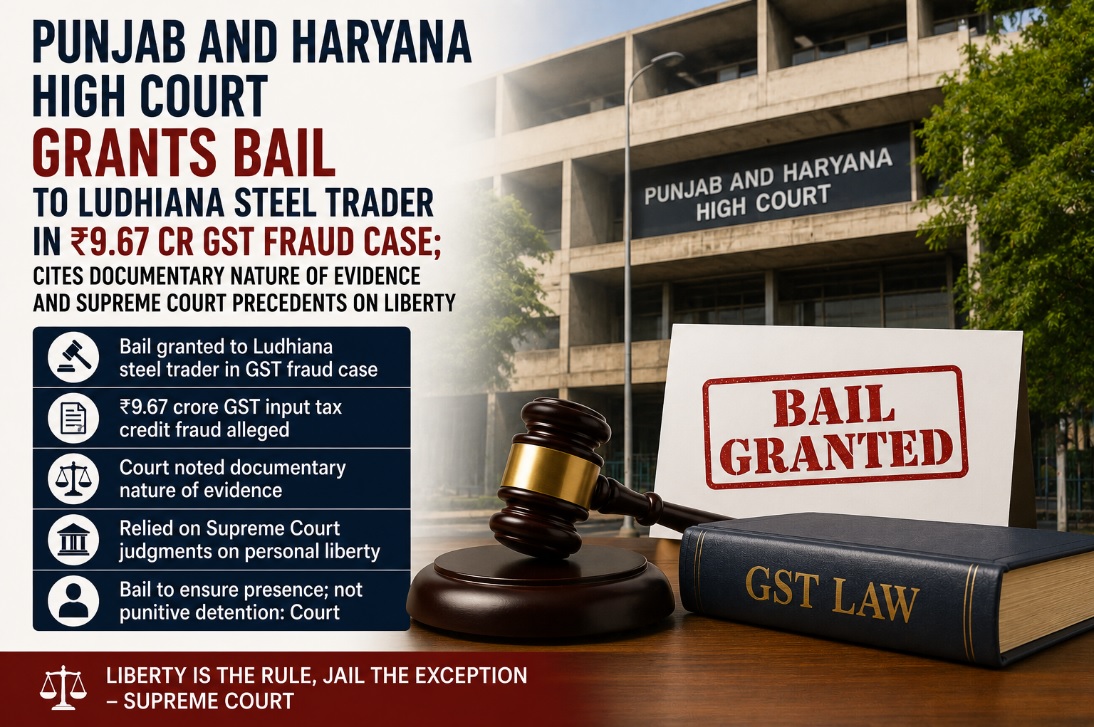
  • Punjab and Haryana High Court Grants Bail to Ludhiana Steel Trader in ₹9.67 Cr GST Fraud Case; Cites Documentary Nature of Evidence and Supreme Court Precedents on Liberty

    Punjab and Haryana High Court Grants Bail to Ludhiana Steel Trader in ₹9.67 Cr GST Fraud Case; Cites Documentary Nature of Evidence and Supreme Court Precedents on Liberty

    Court holds that a three-and-a-half month custody period, combined with the wholly documentary character of the evidence and the absence of any flight or tampering risk, tilts the scales firmly in favour of bail, irrespective of the gravity of the alleged offence.

    Punjab and Haryana High Court, Chandigarh | CHANDIGARH, June 2, 2026

    The Punjab and Haryana High Court has granted bail to Rohit Kumar Gupta, proprietor of M/s Maa Steel, Ludhiana, who was arrested on 12 February 2026 in connection with alleged irregularities in Input Tax Credit (ITC) claims totalling approximately ₹9.67 crore under the Central Goods and Services Tax Act, 2017.

    Hon’ble Mr. Justice Surya Partap Singh allowed the first bail petition, CRM-M-19525-2026, filed under Section 483 of the Bharatiya Nagarik Suraksha Sanhita (BNSS), 2023, holding that the cumulative effect of settled legal principles and the facts of the case overwhelmingly favoured the petitioner’s release on bail.

    Background and Allegations

    The petitioner is engaged in the business of trading iron and steel goods through his proprietorship concern, M/s Maa Steel, based in Ludhiana.

    According to the State Tax Department, scrutiny of E-Way Bill data for the period from 1 April 2024 to 27 January 2026 revealed systematic issuance and utilisation of invoices without actual movement or supply of goods. The authorities alleged that through these transactions, the petitioner fraudulently availed ineligible Input Tax Credit, causing a loss of approximately ₹9,66,64,194 to the State exchequer.

    Based on these allegations, the petitioner was arrested on 12 February 2026 and remained in judicial custody thereafter.

    The prosecution invoked Section 132 of the Punjab Goods and Services Tax Act/CGST Act, 2017, read with Section 69 of the CGST Act and Section 187 of the BNSS, 2023. The offences alleged against the petitioner carry a maximum punishment of seven years’ imprisonment.

    Petitioner’s Case

    Appearing for the petitioner, Mr. Gurkiran Singh contended that the allegations were baseless and unsupported by credible evidence.

    It was argued that M/s Maa Steel is a duly registered and functioning business concern and that all relevant documents, including GST invoices, E-Way Bills and purchase records, had already been supplied to the investigating authorities.

    The petitioner further pointed out that the department itself had previously sanctioned and processed refund claims after conducting due verification of records. According to the petitioner, this prior departmental verification contradicted the subsequent allegation that the transactions were fictitious.

    Counsel emphasised that the petitioner had fully cooperated with the investigation from the very beginning and that all material evidence was documentary in nature and already in the possession of the authorities.

    It was submitted that continued incarceration would serve no investigative purpose because:

    • All documents had been seized or examined;
    • No custodial interrogation was required;
    • The petitioner had cooperated throughout the investigation;
    • The trial was unlikely to conclude in the near future; and
    • The petitioner had already undergone more than three-and-a-half months of incarceration.

    The petitioner accordingly sought regular bail.

    State’s Opposition

    The State, represented by Deputy Advocate General Mr. I.P.S. Sabharwal, opposed the bail application.

    The prosecution argued that the allegations involved a serious economic offence resulting in substantial loss to the public exchequer and were supported by substantial documentary material.

    It was further submitted that although the petitioner had spent more than three-and-a-half months in custody, the investigation remained ongoing as a large volume of records still required scanning and processing.

    The State relied upon the Supreme Court’s decision in CBI v. V. Vijay Sai Reddy (2013) 7 SCC 452, which lays down the factors relevant to the grant of bail, including:

    • Nature and gravity of the accusation;
    • Severity of punishment upon conviction;
    • Likelihood of tampering with evidence;
    • Possibility of influencing witnesses; and
    • Larger public interest.

    Court’s Analysis

    Justice Surya Partap Singh undertook a detailed review of Supreme Court jurisprudence governing bail in economic offences before applying those principles to the facts of the present case.

    The Court identified seven factors favouring grant of bail.

    1. Length of Custody

    The petitioner had already undergone more than three-and-a-half months of incarceration.

    2. Maximum Punishment

    Even if the prosecution case were accepted in its entirety, the offences carry a maximum punishment of seven years.

    The Court observed that the Supreme Court has repeatedly granted bail in comparable GST-related prosecutions at relatively early stages of custody.

    3. Documentary Nature of Evidence

    The Court considered this to be the most significant factor.

    All evidence relied upon by the prosecution consisted of documentary and electronic records already collected and available with the department.

    Consequently, continued detention was unnecessary for the purposes of investigation.

    4. Delay in Trial

    The Court found no realistic possibility of the trial concluding in the immediate future.

    5. No Investigative Purpose Served

    Since the evidence had already been secured, continued incarceration would not advance the investigation.

    6. No Risk of Tampering

    Nothing on record suggested that the petitioner would tamper with evidence or influence witnesses if released on bail.

    7. No Flight Risk

    The Court also found no material indicating any possibility that the petitioner would abscond or evade trial.

    Reliance on Supreme Court Precedents

    The Court extensively relied upon recent Supreme Court decisions emphasising the primacy of personal liberty and the limited role of pre-trial detention.

    Referring to Dataram Singh v. State of Uttar Pradesh (2018), the Court reiterated:

    “The grant of bail is the general rule and putting a person in jail is an exception. A fundamental postulate of criminal jurisprudence is the presumption of innocence.”

    The Court also relied on Vineet Jain v. Union of India (2025 SCC OnLine SC 2331), where the Supreme Court expressed surprise that bail had been denied in a GST prosecution carrying a maximum sentence of five years despite the evidence being entirely documentary. Bail was ultimately granted after seven months of custody.

    Similarly, in Ratnambar Kaushik v. Union of India (2023) 2 SCC 621, the Supreme Court granted bail in a CGST evasion case after approximately four months of custody, observing that documentary and electronic evidence generally minimises the possibility of tampering.

    The Court further referred to Radhika Aggarwal v. Union of India (2025) 6 SCC 545, where the Supreme Court emphasised that arrest powers under the CGST Act must be exercised strictly in accordance with statutory safeguards and cannot be employed as a coercive mechanism for tax recovery.

    Particular reliance was also placed on Ashutosh Garg v. Union of India (SLP (Crl.) No. 8740 of 2024, decided on 26 July 2024), wherein the Supreme Court granted bail in a case involving alleged fake ITC transactions exceeding ₹1,032 crore through 294 firms after approximately nine months of custody.

    The High Court observed that if bail could be granted in a case involving allegations of such magnitude, the quantum involved in the present case could not, by itself, justify prolonged pre-trial detention.

    The Court also cited the landmark decision in Sanjay Chandra v. CBI (2012), observing:

    “Even if the offence is serious in terms of huge loss to the State exchequer, that, by itself, should not deter the Court from enlarging the appellant on bail, when there is no serious contention that the accused will interfere with the trial or tamper with evidence.”

    Reliance on Coordinate Bench Decisions

    Justice Surya Partap Singh also noted that several coordinate benches of the Punjab and Haryana High Court had recently granted bail in similar prosecutions under Section 132 of the GST laws.

    Among the decisions referred to were:

    • Atul Aggarwal v. State of Punjab (CRM-M-21915-2026);
    • Bhanuj Jindal v. DGGI (CRM-M-881-2026); and
    • Arvind Kumar v. DGGI (2025 NC PHHC 65125).

    In each of these cases, bail had been granted despite allegations of GST evasion after custody periods of approximately three months or less.

    Order

    Allowing the petition, the Court directed that the petitioner be released on regular bail upon furnishing appropriate personal bonds and surety bonds to the satisfaction of the Trial Court or Duty Magistrate concerned.

    The release was made subject to the following conditions:

    1. The petitioner shall not directly or indirectly induce, threaten or promise any person acquainted with the facts of the case to withhold information from the Court or investigating authorities;
    2. The petitioner shall furnish his residential address to the Court and promptly notify any subsequent change of address; and
    3. The petitioner shall not leave India without obtaining prior permission from the Trial Court.

    The Court clarified that the observations contained in the order were confined solely to adjudication of the bail application and would not influence the merits of the trial.

    Significance

    The judgment reinforces the increasingly consistent judicial approach that pre-trial incarceration in GST fraud prosecutions should remain an exception rather than the norm, particularly where the evidence is entirely documentary and already secured by the investigating authorities.

    The decision is especially noteworthy for its detailed reliance on the Supreme Court’s recent rulings in Vineet Jain and Radhika Aggarwal, which have significantly strengthened the protection of personal liberty in GST prosecutions and emphasised that the financial magnitude of an alleged tax fraud cannot, by itself, justify denial of bail.

    For taxpayers, professionals and enforcement agencies alike, the ruling serves as a reminder that economic offences, however serious, remain subject to the constitutional principles of presumption of innocence and personal liberty, and that continued custody must be justified by genuine investigative necessity rather than the mere size of the alleged tax demand.

    Case: Rohit Kumar Gupta v. State of Punjab through State Tax Officer
    Court: Punjab and Haryana High Court
    Case No.: CRM-M-19525-2026 (O&M)
    Decision Date: 2 June 2026
    Judge: Hon’ble Mr. Justice Surya Partap Singh