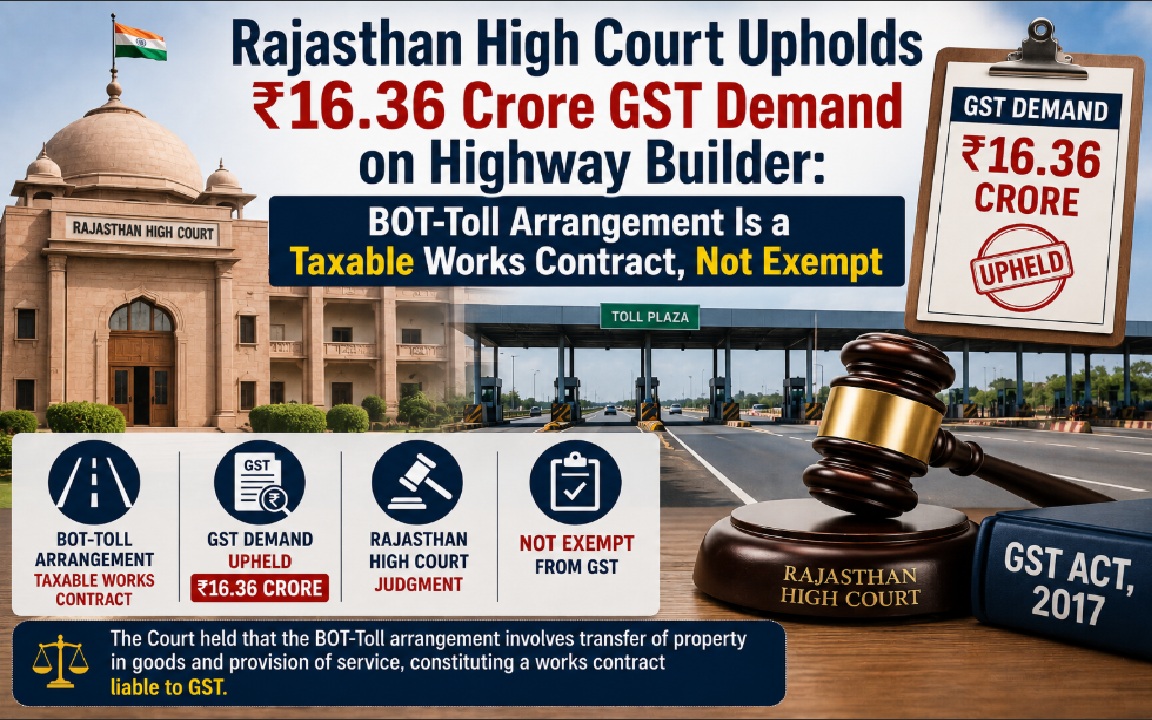
JODHPUR, May 22, 2026 — In a ruling of significant consequence for the infrastructure sector, the Rajasthan High Court has upheld a GST demand of ₹16.36 crore against a highway concessionaire, holding that the construction and maintenance of a national highway on a Build-Operate-Transfer (BOT-Toll) basis constitutes a taxable “works contract” and that the right to collect toll in return for such construction is a form of “barter” falling squarely within the definition of “supply” under the GST framework.
A division bench comprising Justice Arun Monga and Justice Sandeep Shah dismissed the writ petition filed by CG Tollway Ltd., which had challenged an order dated December 14, 2023, passed by the Deputy Commissioner, State Tax, Bhilwara, as well as the appellate order dated May 9, 2025, that affirmed the demand.
The Factual Background
CG Tollway Ltd. entered into a concession agreement with the National Highways Authority of India (NHAI) on December 9, 2016, for the six-laning of the Kishangarh-Udaipur-Ahmedabad section of NH-79 on a Design, Build, Finance, Operate, and Transfer (DBFOT) basis. The construction work was sub-contracted to IRB Infrastructure Developers Limited, while the petitioner retained the right to collect toll from road users.
An internal audit flagged that the petitioner had not paid GST amounting to Rs. 16,36,20,418/-. Despite the petitioner’s objections, the Deputy Commissioner confirmed the demand along with penalty at 10% and interest. The Appellate Authority, Ajmer, dismissed the statutory appeal on May 9, 2025.
The Petitioner’s Case
Senior counsel appearing for CG Tollway, led by Mr. Bharat Raichandani, advanced a multi-pronged challenge. The principal contention was that no “service” was provided to NHAI and therefore there was no “supply” attracting GST. The petitioner argued that the only consideration it received — the right to collect toll — was exempt from GST under Entry 23 of Notification No. 12/2017-Central Tax (Rate) dated June 28, 2017, which exempts “service by way of access to a road or a bridge on payment of toll charges.”
The petitioner also contended that the sub-contractor (IRB Infrastructure Developers Limited) had already paid GST on the same construction activity, making the demand an impermissible instance of double taxation. Reliance was placed on the Supreme Court’s decision in State of Andhra Pradesh vs. Larsen & Toubro Ltd. (2008), which had held under the VAT regime that the State cannot collect tax from both the contractor and the sub-contractor for the same transaction. In addition, the petitioner pointed out that identical audit objections had been dropped by GST authorities in Karnataka and Gujarat in the case of its sister concerns, and that parity demanded the same outcome in Rajasthan.
The Revenue’s Stand
The State, represented by Additional Advocate General Mahaveer Bishnoi and counsel Harshvardhan Singh, raised a preliminary objection regarding the availability of an alternative remedy before the GST Appellate Tribunal under Section 112 of the CGST Act. However, the revenue candidly admitted that the Tribunal was not yet functional — a concession the Court accepted in deciding to hear the matter on merits rather than leaving the petitioner remediless.
On substance, the revenue argued that the arrangement between NHAI and the concessionaire was a classic case of “barter”: the petitioner constructed and maintained the road and, in return, received the exclusive right to collect toll for the duration of the concession period—plus leave and licence rights over the site. The definition of “supply” under Section 7 of the CGST Act expressly includes “barter,” and “consideration” under Section 2(31) includes payment “in money or otherwise.”
Crucially, the revenue submitted that the construction of roads falls under Heading 9954 (general construction services of highways) and not under Heading 9967 (supporting services in transport), which is the heading under which the toll exemption operates. The revenue relied on Circular No. 150/06/2021-GST dated June 17, 2021, issued pursuant to the 43rd GST Council meeting, which clarified that “Entry 23A does not cover construction of road services (falling under heading 9954), even if deferred payment is made by way of instalments (annuities).”
The Court’s Analysis
Delivering the judgment, the bench undertook an exhaustive examination of the statutory provisions and the concession agreement.
On “Supply” and “Barter.” The Court found that the terms of the concession agreement — particularly the grant of exclusive leave and licence rights, the right to collect toll, and the obligation to pay a substantial premium (Rs. 228.60 crore, escalating annually by 3%) — made it clear that the transaction was a works contract falling within Section 2(119) and amounted to “supply” under Section 7. “In barter for undertaking the construction and maintenance of the road, the concessionaire has been conferred certain exclusive rights,” the Court held, “thus all the ingredients of ‘barter’ are clearly available.”
On the Exemption Claim. The Court rejected the petitioner’s argument that toll collection was exempt. A comparative analysis of the notification and the 2021 circular revealed that construction of roads falls under Heading 9954, not Heading 9967. The exemption under Entry 23 is confined to services by way of access to a road or bridge on payment of toll — not to the construction of the road itself. “The toll is being collected as a barter for the work contract undertaken by the petitioner,” the Court observed, adding that besides toll collection, the petitioner was also paying a significant premium to NHAI under the agreement.
Citing the Supreme Court’s Constitution Bench decision in Commissioner of Customs vs. Dilip Kumar & Co. (2018) and the recent ruling in Commissioner (CGST) vs. Safari Retreats Pvt. Ltd. (2025), the bench reiterated that exemption notifications must be interpreted strictly and any ambiguity must be resolved in favour of the Revenue — not the assessee.
On Double Taxation. The Court distinguished the Larsen & Toubro case, noting that it was decided under the VAT regime, which taxed goods at the point of incorporation into works. GST, by contrast, is a destination-based tax levied on the supply of both goods and services. Further, there were two distinct contracts — one between NHAI and the petitioner, and another between the petitioner and the sub-contractor — with no privity of contract between NHAI and the sub-contractor. “Both contracts are distinct and cannot be treated as overlapping,” the Court held.
On Parity with Karnataka and Gujarat. The Court examined the audit reports from the two States and found that the issues involved were entirely different. The Karnataka proceedings concerned ineligible ITC disclosures in Form GSTR-9, while the Gujarat matter pertained to VAT liability under the composition scheme. Neither addressed the question of whether a BOT-Toll arrangement constitutes a taxable works contract under GST. “There can be no concept of negative equality,” the Court stated.
On the Telangana High Court Precedent. The bench expressly agreed with the reasoning of the Telangana High Court in GMR Pochanpalli Expressways Limited vs. Additional Director, DGGI (2024), which had upheld the validity of the very same 2021 circular in an identical BOT context.
Conclusion
Finding that both the Deputy Commissioner’s order and the Appellate Authority’s decision were “well-reasoned” and fully consistent with the statutory framework and the terms of the concession agreement, the Court dismissed the writ petition and affirmed the demand of Rs. 16,36,20,418/- along with penalty and interest. No order as to costs was made.
The judgment is likely to have wide ramifications for infrastructure developers operating under BOT-Toll models across the country, clarifying that the consideration flowing from such arrangements — whether in the form of toll collection rights or deferred annuity payments — constitutes a taxable supply of works contract services and is not shielded by the toll exemption under Entry 23 of the GST rate notification.