Tag: GST Demand

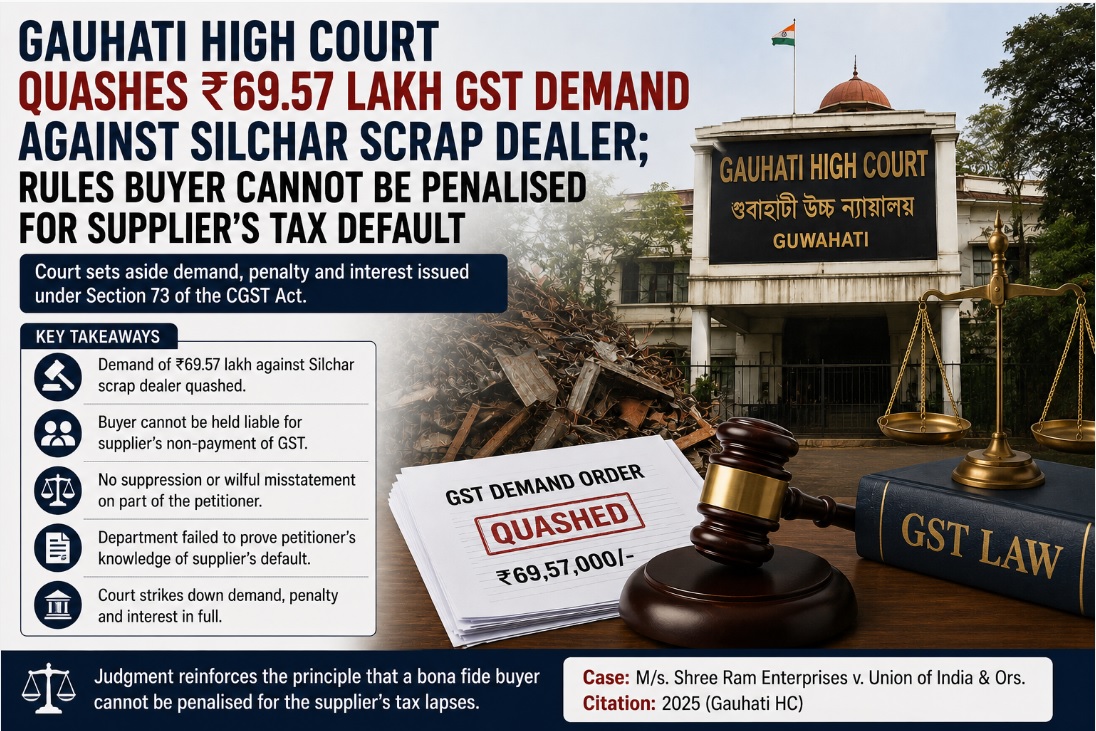
  • Gauhati High Court Quashes ₹69.57 Lakh GST Demand Against Silchar Scrap Dealer; Rules Buyer Cannot Be Penalised for Supplier’s Tax Default

    Gauhati High Court Quashes ₹69.57 Lakh GST Demand Against Silchar Scrap Dealer; Rules Buyer Cannot Be Penalised for Supplier’s Tax Default

    Court reaffirms that a bona fide purchasing dealer who has duly paid GST to a registered seller cannot be denied input tax credit merely because the seller failed to remit the tax to the government.

    Gauhati High Court | GUWAHATI

    In a significant ruling for trading and manufacturing businesses, the Gauhati High Court has set aside a demand order of ₹69,56,794 raised against Sri Gurucharan Kangsa Banik, proprietor of M/s Sree Guru Metals, Silchar. The demand comprised IGST of ₹50.19 lakh, CGST of ₹9.69 lakh, and SGST of ₹9.69 lakh, along with an equivalent penalty.

    Hon’ble Mr. Justice Kardak Ete held that a purchasing dealer who acts in good faith and pays GST to a registered supplier cannot be penalised if the supplier subsequently fails to deposit the tax with the government.

    The Court followed the Division Bench judgment in National Plasto Moulding v. State of Assam & Ors. [2024] 129 GSTR 544 (Gauhati), which in turn relied upon the Delhi High Court’s decision in On Quest Merchandising India Pvt. Ltd. v. Government of NCT of Delhi [2018] 56 GSTR 177 (Delhi). Counsel appearing for both the petitioner and the Revenue accepted that the issue was covered by these decisions.

    Facts of the Case

    M/s Sree Guru Metals is engaged in the business of procurement and sale of scrap and waste batteries.

    During the financial years 2017-18 and 2018-19, the proprietorship purchased goods from suppliers located in Kolkata and paid the applicable GST along with the purchase consideration through banking channels. The transactions were supported by valid tax invoices.

    Following the introduction of the GST regime in July 2017, the business encountered certain compliance-related issues, including discrepancies between GSTR-1 and GSTR-3B arising from data-entry errors relating to reporting of output tax liability and input tax credit.

    Pursuant to a summons issued by the Directorate General of GST Intelligence (DGGI), Guwahati Zonal Unit, the petitioner appeared before the authorities on 5 April 2019 and furnished all relevant records, including GST returns and purchase invoices.

    A search conducted at the business premises on 9 July 2019 did not result in recovery of any incriminating material.

    The Demand and the Challenge

    Despite the petitioner’s cooperation, a Show Cause Notice dated 26 August 2022 was issued alleging wrongful availment of ITC amounting to ₹69.56 lakh under Section 16(2)(a) and Section 16(2)(b) of the CGST Act on the ground that the underlying goods had not actually been received.

    Thereafter, an Order-in-Original dated 28 March 2024 was passed confirming the demand together with interest under Section 50 and an equivalent penalty under Section 74(1) read with Section 122 of the CGST Act.

    The petitioner challenged the order on several grounds.

    It was contended that no effective opportunity of hearing had been granted, as notices were manually served after the dates fixed for hearing and were not uploaded on the GST portal. It was also argued that Form GST DRC-07 had not been issued prior to passing the order.

    On merits, the petitioner submitted that all statutory conditions prescribed under Section 16(2) had been fulfilled. The goods had been received, genuine tax invoices had been issued, and payment including GST had been made through banking channels.

    According to the petitioner, the sole basis for denial of ITC was the alleged failure of the suppliers to deposit the tax collected from the petitioner, a circumstance entirely beyond the purchaser’s control.

    The petitioner further raised a limitation challenge, contending that a part of the disputed period was governed by Section 73 of the CGST Act and that the statutory limitation for proceedings under that provision had already expired. Consequently, invocation of Section 74 was stated to be impermissible.

    An additional objection was raised against the clubbing of multiple assessment years into a single adjudication order.

    Court’s Reasoning

    The Court held that the controversy stood squarely covered by the Division Bench judgment in National Plasto Moulding, which had adopted the reasoning of the Delhi High Court in On Quest Merchandising.

    The Division Bench had held that where a purchasing dealer bona fide enters into transactions with a validly registered supplier, pays the tax component, and otherwise complies with the statutory requirements, denial of ITC merely because the selling dealer fails to deposit the tax with the government is impermissible.

    The Court referred to the following observation in National Plasto Moulding:

    “A purchasing dealer cannot be punished for the act of a selling dealer who has failed to deposit the tax collected by it.”

    The Court also noted that the Delhi High Court in On Quest Merchandising had read down Section 9(2)(g) of the Delhi VAT Act—the provision analogous to Sections 16(2)(c) and 16(2)(d) of the CGST Act—to exclude bona fide purchasing dealers from its scope.

    The Delhi High Court had reasoned that a literal interpretation would impose an impossible burden on a purchaser and could render the provision vulnerable to challenge under Article 14 of the Constitution.

    The Court further noted that the Special Leave Petition filed against the Delhi High Court’s judgment had been dismissed by the Supreme Court, while preserving liberty for the authorities to proceed in cases where the transactions were not bona fide.

    Accepting that the legal position stood settled, the Gauhati High Court set aside the impugned Order-in-Original.

    At the same time, the Court preserved the department’s right to proceed against the petitioner if material subsequently emerges showing that the transactions were not genuine or were entered into in collusion with the suppliers.

    Significance

    The decision adds to the growing body of judicial authority protecting bona fide purchasers from adverse consequences arising solely from a supplier’s failure to discharge tax liability.

    The ruling reiterates that where a purchaser has acted in good faith, obtained valid tax invoices, received the goods, and paid the consideration including GST, denial of ITC cannot be justified merely because the supplier defaults in remitting tax to the government.

    The Court, however, recognised the distinction between genuine transactions and collusive arrangements. Where the department is able to establish that transactions were not bona fide or lacked commercial substance, it remains open to the authorities to invoke the statutory provisions and deny the benefit of ITC.

    Citation: Sri Gurucharan Kangsa Banik v. Union of India & Ors. — Gauhati High Court, Writ Petition (arising from Order-in-Original No. 37/GST/AC/SIL/2023-24 dated 28.03.2024).
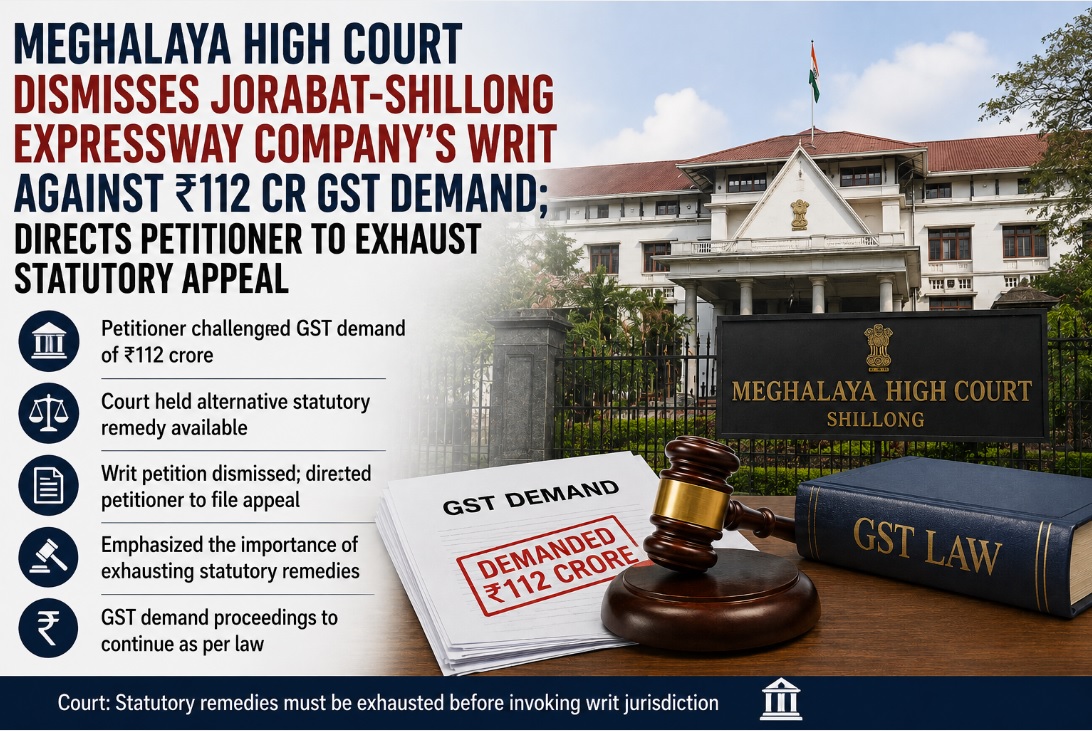
  • Meghalaya High Court Dismisses Jorabat-Shillong Expressway Company’s Writ Against ₹112 Cr GST Demand; Directs Petitioner to Exhaust Statutory Appeal

    Meghalaya High Court Dismisses Jorabat-Shillong Expressway Company’s Writ Against ₹112 Cr GST Demand; Directs Petitioner to Exhaust Statutory Appeal

    Division Bench holds that classification of BOT annuity receipts—whether taxable construction services or exempt road-access services—raises mixed questions of law and fact unsuitable for writ adjudication, and finds no patent jurisdictional defect or violation of natural justice that would warrant bypassing the appellate remedy under Section 107 of the CGST Act.

    Gauhati High Court, Shillong Bench (Meghalaya) | SHILLONG, June 2, 2026

    The Meghalaya Bench of the Gauhati High Court has dismissed a writ petition filed by M/s Jorabat Shillong Expressway Limited (JSEL) challenging a GST demand of ₹112,39,64,394 (comprising CGST and SGST) raised on annuity receipts of ₹864,12,69,958 received from the National Highways Authority of India (NHAI) for the period July 2017 to December 2022.

    The Division Bench of Hon’ble Mr. Justice H.S. Thangkhiew and Hon’ble Mr. Justice B. Bhattacharjee declined to exercise writ jurisdiction under Article 226 of the Constitution, holding that the petitioner had an efficacious alternate remedy by way of a statutory appeal before the appellate authority under Section 107 of the CGST Act, 2017.

    The Court, however, granted liberty to the petitioner to file the appeal within four weeks and directed the appellate authority to consider the same on its own merits, uninfluenced by any observations made in the judgment.

    Background: The BOT Annuity Project

    JSEL was incorporated as a Special Purpose Vehicle (SPV) by a consortium of IL&FS Transportation Networks Limited and Ramky Infrastructure pursuant to a Letter of Acceptance issued by NHAI on 20 May 2010.

    The company entered into a Concession Agreement dated 16 July 2010 for a BOT (Annuity) project covering approximately 61.98 kilometres of the Jorabat–Shillong Section of National Highway No. 40 spanning the States of Assam and Meghalaya.

    Under the BOT (Annuity) model—a Public Private Partnership structure widely used in highway development—the concessionaire finances and constructs the highway, operates and maintains it for a specified concession period, and eventually transfers it back to the government.

    Importantly, the right to collect toll remains with NHAI and not with the concessionaire. Instead, the concessionaire recovers its investment through half-yearly annuity payments made by NHAI after commencement of commercial operations. Under JSEL’s concession agreement, the concession period extends until 2031.

    The Demand and Its Basis

    The dispute originated when GST Intelligence authorities issued a Show Cause Notice dated 30 September 2023 alleging that JSEL had failed to discharge GST on annuity payments received for road construction activities.

    The Department classified the services under SAC 9954 (works contract services taxable at 12% to 18%) rather than SAC 9967 (services by way of access to a road or bridge exempt under Entry 23A of the relevant exemption notification).

    An initial demand of approximately ₹130.57 crore, along with interest and penalty, was proposed.

    JSEL initially challenged the Show Cause Notice before the High Court on the ground that the proceedings were premature. That writ petition was dismissed. Thereafter, a Special Leave Petition filed before the Supreme Court was disposed of on 5 February 2024 with directions requiring the authorities to properly consider the petitioner’s submissions.

    Following a personal hearing held on 19 March 2024, the Additional Commissioner, CGST, Shillong passed an Order-in-Original dated 18 April 2024 confirming a reduced demand of ₹112.39 crore together with applicable interest and penalty.

    The present writ petition challenged both the Show Cause Notice and the Order-in-Original.

    Petitioner’s Grounds of Challenge

    Senior Advocate Mr. S. Ghosh advanced multiple grounds of challenge on behalf of JSEL.

    The central contention was that the entire consideration, including annuity receipts received under the BOT arrangement, was exempt under Entry 23A of the exemption notification dated 28 June 2017, as amended on 13 October 2017, which exempts:

    “Service by way of access to a road or a bridge on payment of annuity.”

    According to the petitioner, the Department had artificially bifurcated an integrated BOT service into separate construction and access components when, in substance, the concessionaire was providing a composite and indivisible service.

    The petitioner also mounted a constitutional challenge to CBIC Circular No. 150/06/2021-GST dated 17 June 2021, which clarified that Entry 23A does not exempt GST on annuity paid for construction of roads.

    It was argued that the Circular effectively overrides a statutory exemption notification, contrary to Section 11(3) of the CGST Act.

    Reliance was placed upon the decision of the Karnataka High Court in M/s DPJ Bidar-Chincholi (Annuity) Road Project Pvt. Ltd. v. Union of India, reported in (2024) 122 GSTR 48, wherein the same Circular was struck down and annuity receipts were held exempt.

    Jurisdictional objections were also raised against:

    • The Additional Director, DGGI, who issued the Show Cause Notice; and
    • The Additional Commissioner, CGST, Shillong, who passed the adjudication order.

    The petitioner contended that neither officer qualified as a “Proper Officer” under Section 2(91) of the CGST Act for initiating and adjudicating proceedings under Section 74.

    Further, it was argued that Section 74, which applies to cases involving fraud, suppression, or wilful misstatement, was inapplicable because the dispute involved only interpretation of law and not any attempt to evade tax.

    Additional grounds included:

    • Taxability of services rendered under pre-GST contracts;
    • Incorrect inclusion of certain exempt receipts;
    • Alleged computational errors in the demand; and
    • Inclusion of interest earned on term deposits, which was claimed to be exempt.

    The petitioner submitted:

    “The case hinges on a pure question of law—whether annuity receipts under BOT road projects are exempt—supported by statutory notifications, judicial precedent, and settled principles on interpretation of exemptions.”

    Revenue’s Defence

    The Union respondents, represented by learned DSGI Dr. N. Mozika, defended both the Show Cause Notice and the Order-in-Original.

    According to the Revenue, JSEL was engaged in a composite supply consisting of:

    • Design;
    • Financing;
    • Construction;
    • Operation; and
    • Maintenance.

    The principal supply, according to the Department, was construction of roads, which is taxable as a works contract service.

    Since the right to collect toll never vested in JSEL, the concessionaire could not claim that it was providing road-access services falling under Entry 23A.

    On jurisdiction, the Revenue relied on Notification No. 14/2017-Central Tax dated 1 July 2017, which conferred powers upon DGGI officers as Central Tax officers.

    The Revenue also relied upon Notification No. 2/2022-Central Tax dated 11 March 2022, which inserted Paragraph 3A and vested Additional Commissioners with adjudication powers in respect of Show Cause Notices issued by DGGI.

    On the issue of pre-GST contracts, reliance was placed on Section 142(10) of the CGST Act and Section 13 dealing with time of supply of continuous services.

    The Revenue further contended that the Karnataka High Court’s decision in DPJ Bidar-Chincholi had not attained finality as appeals were pending.

    The State of Meghalaya, represented by learned Government Advocate Mr. N. Syngkon, argued that Entry 23A was intended to apply only where a concessionaire provides access to a road in lieu of toll collection and receives annuity as compensation.

    Since JSEL never possessed toll collection rights, the principal supply remained construction, making the entire composite supply taxable under Section 8 of the CGST Act.

    Court’s Analysis

    The Division Bench first noted that the legal position concerning GST liability on BOT annuity receipts remains unsettled and is presently the subject of divergent judicial views and pending appeals.

    Against that background, the Court examined the maintainability of the writ petition.

    Challenge to Jurisdiction Rejected

    The Court rejected the petitioner’s challenge regarding the competence of the officers involved.

    It held that the Additional Director, DGGI was a valid Proper Officer by virtue of Notification No. 14/2017, which conferred powers on DGGI officers corresponding to their rank.

    Similarly, the Additional Commissioner, CGST, Shillong possessed adjudicatory authority under Notification No. 2/2022.

    The Court observed:

    “Mere disagreement regarding the interpretation of the scope of powers conferred under statutory notifications cannot by itself convert an issue into a jurisdictional defect warranting interference under Article 226.”

    The Court relied upon the decision of the Allahabad High Court in RC Infra Digital Solution v. Union of India as well as the Supreme Court’s decision in Union of India v. Azadi Bachao Andolan (2004) 10 SCC 1.

    Mixed Questions of Law and Fact

    The Court further held that the controversy involved several intertwined issues requiring detailed factual examination, including:

    • Classification under SAC 9954 or SAC 9967;
    • Applicability of Entry 23A;
    • Characterisation of BOT annuity payments;
    • Interpretation of concession agreements; and
    • Determination of principal supply under the composite supply provisions.

    These issues, according to the Court, constituted mixed questions of law and fact and were therefore unsuitable for adjudication in writ jurisdiction at the first instance.

    Alternate Remedy Cannot Be Bypassed

    The petitioner argued that the appellate remedy under Section 107 would be illusory because appellate authorities are bound by CBIC Circulars issued under Section 168 of the CGST Act.

    The Court rejected this contention.

    It held that while circulars may bind departmental officers, they do not constitute law and do not bind courts.

    The Court observed that acceptance of the petitioner’s argument would effectively permit taxpayers to bypass the statutory appellate framework whenever a departmental circular is involved.

    Approving the principle laid down by the Allahabad High Court, the Bench noted:

    “Though orders or instructions issued by the Board may be binding upon departmental authorities, they do not bind courts and it is needless to cite cases on the point.”

    The Court also noted that the petitioner had fully participated in the adjudication proceedings pursuant to the directions of the Supreme Court, filed detailed replies, attended personal hearings, and presented extensive submissions.

    Whether the conclusions reached by the adjudicating authority were correct or incorrect was a matter appropriately falling within the domain of the appellate authority.

    Outcome

    Finding no exceptional circumstance warranting interference under Article 226, the Court dismissed the writ petition.

    The Court held that none of the recognised exceptions to the rule of alternate remedy were attracted, namely:

    • Lack of jurisdiction;
    • Violation of principles of natural justice; or
    • Infringement of fundamental rights incapable of redress through the statutory mechanism.

    However, the Court granted JSEL liberty to file an appeal under Section 107 of the CGST Act within four weeks from the date of the judgment.

    The appellate authority was directed to decide the appeal independently and strictly on its own merits, without being influenced by any observations made in the writ proceedings.

    Significance

    The judgment reinforces the well-established principle that writ jurisdiction should not ordinarily be invoked where an effective statutory appellate remedy exists.

    The ruling is particularly significant for infrastructure concessionaires operating under BOT (Annuity) models because it indicates that disputes concerning the GST treatment of annuity receipts should generally be pursued through the appellate hierarchy rather than through direct writ proceedings.

    The decision also highlights that the controversy surrounding taxation of BOT annuity receipts remains unresolved. Although the Karnataka High Court in DPJ Bidar-Chincholi held such annuity receipts to be exempt, the Meghalaya Bench noted that the issue remains subject to pending appellate proceedings and cannot yet be regarded as conclusively settled.

    Case: M/s Jorabat Shillong Expressway Limited v. Union of India & Others
    Court: Meghalaya Bench of the Gauhati High Court
    Case No.: WP(C) No. 245 of 2024
    Decision Date: 2 June 2026

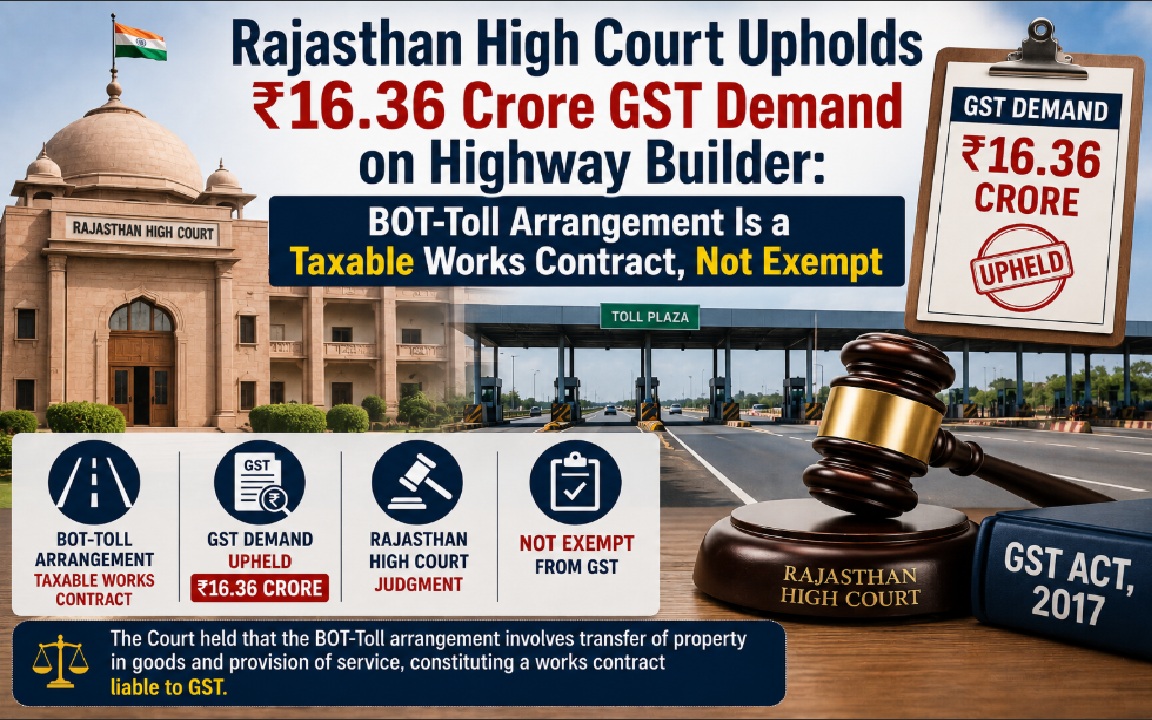
  • Rajasthan High Court Upholds ₹16.36 Crore GST Demand on Highway Builder: BOT-Toll Arrangement Is a Taxable Works Contract, Not Exempt

    Rajasthan High Court Upholds ₹16.36 Crore GST Demand on Highway Builder: BOT-Toll Arrangement Is a Taxable Works Contract, Not Exempt

    JODHPUR, May 22, 2026 — In a ruling of significant consequence for the infrastructure sector, the Rajasthan High Court has upheld a GST demand of ₹16.36 crore against a highway concessionaire, holding that the construction and maintenance of a national highway on a Build-Operate-Transfer (BOT-Toll) basis constitutes a taxable “works contract” and that the right to collect toll in return for such construction is a form of “barter” falling squarely within the definition of “supply” under the GST framework.

    A division bench comprising Justice Arun Monga and Justice Sandeep Shah dismissed the writ petition filed by CG Tollway Ltd., which had challenged an order dated December 14, 2023, passed by the Deputy Commissioner, State Tax, Bhilwara, as well as the appellate order dated May 9, 2025, that affirmed the demand.

    The Factual Background

    CG Tollway Ltd. entered into a concession agreement with the National Highways Authority of India (NHAI) on December 9, 2016, for the six-laning of the Kishangarh-Udaipur-Ahmedabad section of NH-79 on a Design, Build, Finance, Operate, and Transfer (DBFOT) basis. The construction work was sub-contracted to IRB Infrastructure Developers Limited, while the petitioner retained the right to collect toll from road users.

    An internal audit flagged that the petitioner had not paid GST amounting to Rs. 16,36,20,418/-. Despite the petitioner’s objections, the Deputy Commissioner confirmed the demand along with penalty at 10% and interest. The Appellate Authority, Ajmer, dismissed the statutory appeal on May 9, 2025.

    The Petitioner’s Case

    Senior counsel appearing for CG Tollway, led by Mr. Bharat Raichandani, advanced a multi-pronged challenge. The principal contention was that no “service” was provided to NHAI and therefore there was no “supply” attracting GST. The petitioner argued that the only consideration it received — the right to collect toll — was exempt from GST under Entry 23 of Notification No. 12/2017-Central Tax (Rate) dated June 28, 2017, which exempts “service by way of access to a road or a bridge on payment of toll charges.”

    The petitioner also contended that the sub-contractor (IRB Infrastructure Developers Limited) had already paid GST on the same construction activity, making the demand an impermissible instance of double taxation. Reliance was placed on the Supreme Court’s decision in State of Andhra Pradesh vs. Larsen & Toubro Ltd. (2008), which had held under the VAT regime that the State cannot collect tax from both the contractor and the sub-contractor for the same transaction. In addition, the petitioner pointed out that identical audit objections had been dropped by GST authorities in Karnataka and Gujarat in the case of its sister concerns, and that parity demanded the same outcome in Rajasthan.

    The Revenue’s Stand

    The State, represented by Additional Advocate General Mahaveer Bishnoi and counsel Harshvardhan Singh, raised a preliminary objection regarding the availability of an alternative remedy before the GST Appellate Tribunal under Section 112 of the CGST Act. However, the revenue candidly admitted that the Tribunal was not yet functional — a concession the Court accepted in deciding to hear the matter on merits rather than leaving the petitioner remediless.

    On substance, the revenue argued that the arrangement between NHAI and the concessionaire was a classic case of “barter”: the petitioner constructed and maintained the road and, in return, received the exclusive right to collect toll for the duration of the concession period—plus leave and licence rights over the site. The definition of “supply” under Section 7 of the CGST Act expressly includes “barter,” and “consideration” under Section 2(31) includes payment “in money or otherwise.”

    Crucially, the revenue submitted that the construction of roads falls under Heading 9954 (general construction services of highways) and not under Heading 9967 (supporting services in transport), which is the heading under which the toll exemption operates. The revenue relied on Circular No. 150/06/2021-GST dated June 17, 2021, issued pursuant to the 43rd GST Council meeting, which clarified that “Entry 23A does not cover construction of road services (falling under heading 9954), even if deferred payment is made by way of instalments (annuities).”

    The Court’s Analysis

    Delivering the judgment, the bench undertook an exhaustive examination of the statutory provisions and the concession agreement.

    On “Supply” and “Barter.” The Court found that the terms of the concession agreement — particularly the grant of exclusive leave and licence rights, the right to collect toll, and the obligation to pay a substantial premium (Rs. 228.60 crore, escalating annually by 3%) — made it clear that the transaction was a works contract falling within Section 2(119) and amounted to “supply” under Section 7. “In barter for undertaking the construction and maintenance of the road, the concessionaire has been conferred certain exclusive rights,” the Court held, “thus all the ingredients of ‘barter’ are clearly available.”

    On the Exemption Claim. The Court rejected the petitioner’s argument that toll collection was exempt. A comparative analysis of the notification and the 2021 circular revealed that construction of roads falls under Heading 9954, not Heading 9967. The exemption under Entry 23 is confined to services by way of access to a road or bridge on payment of toll — not to the construction of the road itself. “The toll is being collected as a barter for the work contract undertaken by the petitioner,” the Court observed, adding that besides toll collection, the petitioner was also paying a significant premium to NHAI under the agreement.

    Citing the Supreme Court’s Constitution Bench decision in Commissioner of Customs vs. Dilip Kumar & Co. (2018) and the recent ruling in Commissioner (CGST) vs. Safari Retreats Pvt. Ltd. (2025), the bench reiterated that exemption notifications must be interpreted strictly and any ambiguity must be resolved in favour of the Revenue — not the assessee.

    On Double Taxation. The Court distinguished the Larsen & Toubro case, noting that it was decided under the VAT regime, which taxed goods at the point of incorporation into works. GST, by contrast, is a destination-based tax levied on the supply of both goods and services. Further, there were two distinct contracts — one between NHAI and the petitioner, and another between the petitioner and the sub-contractor — with no privity of contract between NHAI and the sub-contractor. “Both contracts are distinct and cannot be treated as overlapping,” the Court held.

    On Parity with Karnataka and Gujarat. The Court examined the audit reports from the two States and found that the issues involved were entirely different. The Karnataka proceedings concerned ineligible ITC disclosures in Form GSTR-9, while the Gujarat matter pertained to VAT liability under the composition scheme. Neither addressed the question of whether a BOT-Toll arrangement constitutes a taxable works contract under GST. “There can be no concept of negative equality,” the Court stated.

    On the Telangana High Court Precedent. The bench expressly agreed with the reasoning of the Telangana High Court in GMR Pochanpalli Expressways Limited vs. Additional Director, DGGI (2024), which had upheld the validity of the very same 2021 circular in an identical BOT context.

    Conclusion

    Finding that both the Deputy Commissioner’s order and the Appellate Authority’s decision were “well-reasoned” and fully consistent with the statutory framework and the terms of the concession agreement, the Court dismissed the writ petition and affirmed the demand of Rs. 16,36,20,418/- along with penalty and interest. No order as to costs was made.

    The judgment is likely to have wide ramifications for infrastructure developers operating under BOT-Toll models across the country, clarifying that the consideration flowing from such arrangements — whether in the form of toll collection rights or deferred annuity payments — constitutes a taxable supply of works contract services and is not shielded by the toll exemption under Entry 23 of the GST rate notification.

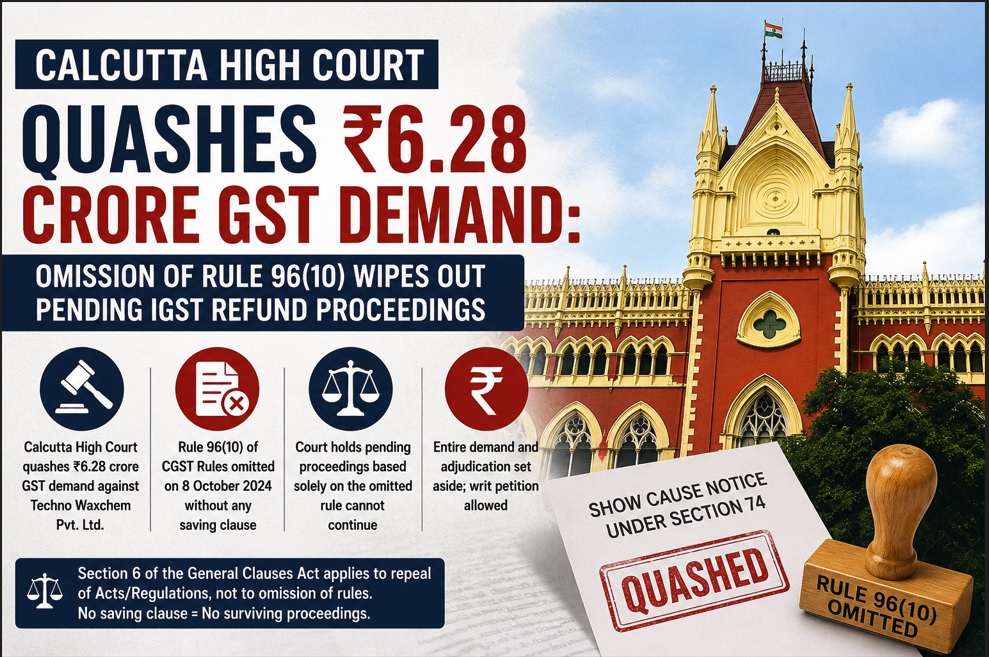
  • Calcutta HC Quashes ₹6.28 Crore GST Demand: Omission of Rule 96(10) Wipes Out Pending IGST Refund Proceedings

    Calcutta HC Quashes ₹6.28 Crore GST Demand: Omission of Rule 96(10) Wipes Out Pending IGST Refund Proceedings

    Kolkata, June 2026 – The Calcutta High Court has quashed a ₹6.28 crore tax demand against Techno Waxchem Private Limited, holding that the Government’s October 2024 decision to omit Rule 96(10) of the CGST Rules leaves no legal basis for continuing any pending enforcement proceedings under that provision. The ruling by Justice Raja Basu Chowdhury adds to a growing body of High Court jurisprudence that has effectively sounded the death knell for all outstanding show-cause notices, adjudication orders, and appeals rooted in the now-deleted anti-double-benefit restriction.


    The Dispute

    Techno Waxchem, a manufacturer and exporter of chemical products primarily used in the rubber industry — including modified formaldehyde resins, resorcinol blends, and related compounds — had, between October 2017 and March 2022, claimed and received IGST refunds totalling ₹6,28,27,407 on goods exported under the Advance Authorisation Scheme.

    Under the Advance Authorisation framework, exporters are permitted duty-free import of inputs. The rub, according to the revenue authorities, was Rule 96(10) of the CGST Rules, 2017. That provision barred an exporter who had availed duty-free imports under specified Customs notifications from simultaneously claiming a refund of IGST paid on the exported finished goods. The logic was to prevent “encashment” of input tax credit accumulated on domestically procured goods against exports manufactured using duty-free imported inputs — a species of double benefit that the rule was designed to foreclose.

    The Director General of GST Intelligence (DGGI) alleged that Techno Waxchem had done exactly that. A show-cause notice dated 27 September 2023 was issued under Section 74 of the CGST Act for the periods 2017–18 through 2021–22. The adjudicating authority confirmed the demand in an order-in-original dated 4 February 2025, directing recovery along with interest under Section 50 and penalty under Section 122(2)(b).


    The Rule That Vanished

    Between the issuance of the show-cause notice and the adjudication order, however, the legal landscape shifted fundamentally. In its 54th meeting, the GST Council accepted the Law Committee’s recommendation to do away with Rule 96(10), observing that the restriction had caused unnecessary complications without yielding any commensurate benefit. On 8 October 2024, the Central Government issued Notification No. 20/2024-Central Tax, which — at Serial No. 10 — simply stated: “In the said rules, in rule 96, sub-rule (10) shall be omitted.”

    No saving clause was inserted. No transitional provision was made. No language preserved pending proceedings. The rule was simply taken off the statute book.

    Techno Waxchem, during the personal hearing before the adjudicating authority, specifically drew attention to this development and argued that the demand could no longer survive. The Proper Officer, however, took the view that the omission was prospective — effective only from 8 October 2024 — and that since the refund was availed and the show-cause notice issued during the rule’s subsistence, the demand remained valid.


    The High Court’s Reasoning

    Justice Raja Basu Chowdhury disagreed. Drawing on two seminal Supreme Court decisions — Rayala Corporation (P) Ltd. v. Director of Enforcement (1969) and Kolhapur Canesugar Works Ltd. v. Union of India (2000) — the Court reaffirmed a proposition that, while well-settled in criminal and excise jurisprudence, is only now being tested in the GST context: Section 6 of the General Clauses Act, 1897, which saves proceedings initiated under a repealed enactment, applies only to the repeal of a Central Act or Regulation. It has no application to the omission of a rule.

    The distinction is not merely semantic. As the Supreme Court held in Rayala Corporation:

    “Section 6 only applies to repeals and not to omissions, and applies when the repeal is of a Central Act or Regulation and not of a rule.”

    And in Kolhapur Canesugar Works, the Constitution Bench reaffirmed the principle, rejecting the Gujarat High Court’s attempt to distinguish Rayala Corporation. The rule, the Court held, takes its colour from the definition in the General Clauses Act — it is not a “statute,” and equating the two is impermissible.

    The consequence is stark: when a rule is omitted without a saving clause, the rule is treated as having never existed. All pending proceedings — show-cause notices awaiting adjudication, orders under challenge before appellate authorities, even writ petitions contesting demands — stand ipso facto terminated.


    A National Consensus Emerges

    Justice Chowdhury’s ruling does not stand alone. The Calcutta High Court drew express support from three other High Courts that have addressed identical questions in recent months.

    The Bombay High Court, in Hikal Limited v. Union of India (2025), held that following the omission of Rules 89(4B) and 96(10), and in the absence of saving clauses, “all pending proceedings — such as undisposed show cause notices, orders disposing of show cause notices issued after 08 October 2024, or even orders made before 08 October 2024 but not yet finalised due to appeals … are not preserved and will stand lapsed.”

    The Gujarat High Court in Addwrap Packaging (P.) Ltd. v. Union of India (2025) arrived at the same conclusion.

    Most recently, the Delhi High Court in Vinayak International Housewares Pvt. Ltd. undertook a comprehensive survey of the precedents and crystallised the position into four clear propositions: the GST Council itself acknowledged that Rule 96(10) caused unnecessary complications; the omission applies to all pending proceedings; anything short of a “transaction past and closed” is caught by the omission; and appeals, pending adjudications, and even show-cause notices all fall within the protective sweep of the deletion.


    “Transactions Past and Closed”

    The operative distinction, as the Bombay High Court framed it, is between proceedings that are alive and those that have attained finality. A demand confirmed by an order that has not been appealed — a “transaction past and closed” — may well stand. But a show-cause notice awaiting adjudication, an order under appeal, or a writ petition against an order — none of these constitutes a concluded transaction. For these, the omission of the underlying rule pulls the rug from under the entire proceeding.

    Since Techno Waxchem’s writ petition was filed against the order-in-original dated 4 February 2025, the matter was very much alive. The Court had little difficulty concluding that “on the omission of Rule 96(10), the order dated 4th February, 2025 no longer survives.”


    Implications for the Field

    The judgment is significant beyond its immediate facts. Rule 96(10) had been one of the most heavily litigated provisions in the GST refund universe. Exporters across sectors — pharmaceuticals, chemicals, engineering goods, textiles — had been hit with demands running into hundreds of crores on the allegation that they had availed the IGST refund route while also holding Advance Authorisation licences or having procured inputs under specified exemption notifications.

    The 54th GST Council meeting may have been motivated by administrative pragmatism — the rule, as the Council observed, created enormous compliance friction without meaningful revenue protection — but the legal effect of a simple omission, unaccompanied by a saving clause, appears to have been more far-reaching than perhaps anticipated. By operation of the principle laid down in Rayala Corporation and Kolhapur Canesugar, the omission has effectively wiped the slate clean.

    Unless the revenue authorities persuade the Supreme Court to take a different view — and the consistent, multi-jurisdictional weight of High Court authority makes that an uphill task — thousands of pending IGST refund demands premised on Rule 96(10) now stand on legally unsustainable ground.


    The Road Ahead

    With four High Courts now speaking in one voice — Bombay, Gujarat, Delhi, and Calcutta — the question is whether the revenue will accept the settled position or attempt to carry the issue to the Supreme Court. The adjudicating authority, in its order, had noted pointedly that “the instant issue has not yet attained finality and the department has opportunity to appeal before Hon’ble Supreme Court against the aforementioned order of Hon’ble Kerala High Court.” That observation, however, concerned the constitutional validity of Rule 96(10) — a question rendered academic by the rule’s omission. The surviving question — the effect of omission without a saving clause — rests on Supreme Court decisions that are over five decades old and have never been doubted.

    For exporters who have been fighting Rule 96(10) demands, the Calcutta High Court’s judgment is the latest — and one of the most lucidly reasoned — endorsements of a position that increasingly looks unassailable.