Division Bench holds that classification of BOT annuity receipts—whether taxable construction services or exempt road-access services—raises mixed questions of law and fact unsuitable for writ adjudication, and finds no patent jurisdictional defect or violation of natural justice that would warrant bypassing the appellate remedy under Section 107 of the CGST Act.
Gauhati High Court, Shillong Bench (Meghalaya) | SHILLONG, June 2, 2026
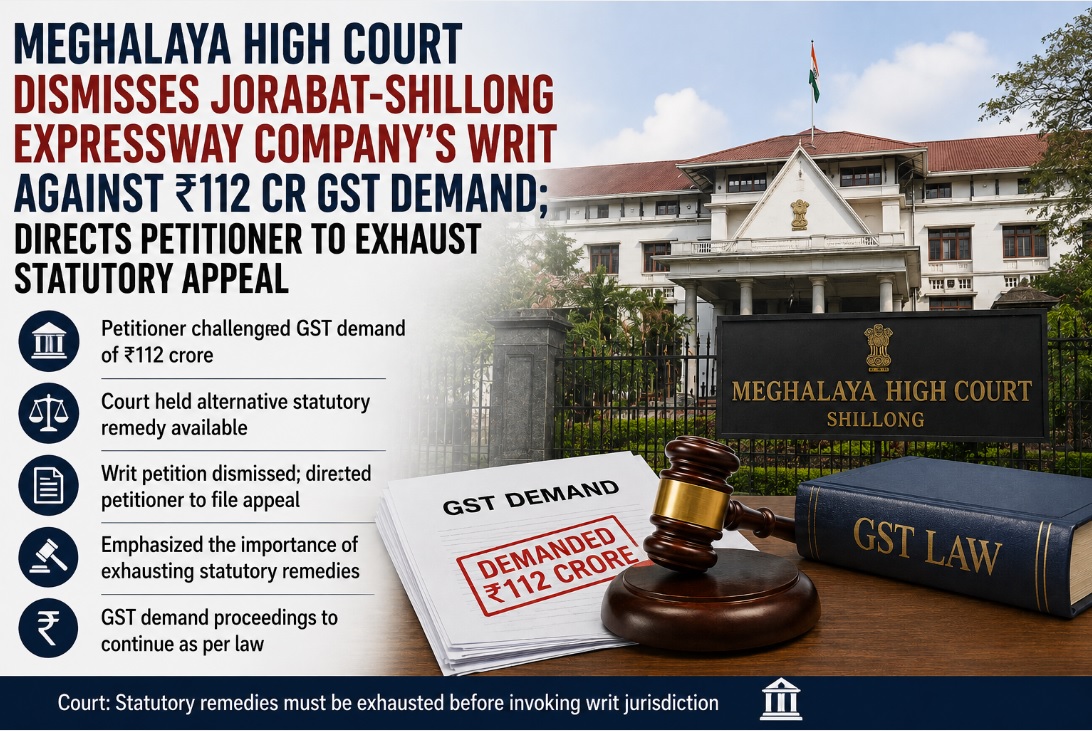
The Meghalaya Bench of the Gauhati High Court has dismissed a writ petition filed by M/s Jorabat Shillong Expressway Limited (JSEL) challenging a GST demand of ₹112,39,64,394 (comprising CGST and SGST) raised on annuity receipts of ₹864,12,69,958 received from the National Highways Authority of India (NHAI) for the period July 2017 to December 2022.
The Division Bench of Hon’ble Mr. Justice H.S. Thangkhiew and Hon’ble Mr. Justice B. Bhattacharjee declined to exercise writ jurisdiction under Article 226 of the Constitution, holding that the petitioner had an efficacious alternate remedy by way of a statutory appeal before the appellate authority under Section 107 of the CGST Act, 2017.
The Court, however, granted liberty to the petitioner to file the appeal within four weeks and directed the appellate authority to consider the same on its own merits, uninfluenced by any observations made in the judgment.
Background: The BOT Annuity Project
JSEL was incorporated as a Special Purpose Vehicle (SPV) by a consortium of IL&FS Transportation Networks Limited and Ramky Infrastructure pursuant to a Letter of Acceptance issued by NHAI on 20 May 2010.
The company entered into a Concession Agreement dated 16 July 2010 for a BOT (Annuity) project covering approximately 61.98 kilometres of the Jorabat–Shillong Section of National Highway No. 40 spanning the States of Assam and Meghalaya.
Under the BOT (Annuity) model—a Public Private Partnership structure widely used in highway development—the concessionaire finances and constructs the highway, operates and maintains it for a specified concession period, and eventually transfers it back to the government.
Importantly, the right to collect toll remains with NHAI and not with the concessionaire. Instead, the concessionaire recovers its investment through half-yearly annuity payments made by NHAI after commencement of commercial operations. Under JSEL’s concession agreement, the concession period extends until 2031.
The Demand and Its Basis
The dispute originated when GST Intelligence authorities issued a Show Cause Notice dated 30 September 2023 alleging that JSEL had failed to discharge GST on annuity payments received for road construction activities.
The Department classified the services under SAC 9954 (works contract services taxable at 12% to 18%) rather than SAC 9967 (services by way of access to a road or bridge exempt under Entry 23A of the relevant exemption notification).
An initial demand of approximately ₹130.57 crore, along with interest and penalty, was proposed.
JSEL initially challenged the Show Cause Notice before the High Court on the ground that the proceedings were premature. That writ petition was dismissed. Thereafter, a Special Leave Petition filed before the Supreme Court was disposed of on 5 February 2024 with directions requiring the authorities to properly consider the petitioner’s submissions.
Following a personal hearing held on 19 March 2024, the Additional Commissioner, CGST, Shillong passed an Order-in-Original dated 18 April 2024 confirming a reduced demand of ₹112.39 crore together with applicable interest and penalty.
The present writ petition challenged both the Show Cause Notice and the Order-in-Original.
Petitioner’s Grounds of Challenge
Senior Advocate Mr. S. Ghosh advanced multiple grounds of challenge on behalf of JSEL.
The central contention was that the entire consideration, including annuity receipts received under the BOT arrangement, was exempt under Entry 23A of the exemption notification dated 28 June 2017, as amended on 13 October 2017, which exempts:
“Service by way of access to a road or a bridge on payment of annuity.”
According to the petitioner, the Department had artificially bifurcated an integrated BOT service into separate construction and access components when, in substance, the concessionaire was providing a composite and indivisible service.
The petitioner also mounted a constitutional challenge to CBIC Circular No. 150/06/2021-GST dated 17 June 2021, which clarified that Entry 23A does not exempt GST on annuity paid for construction of roads.
It was argued that the Circular effectively overrides a statutory exemption notification, contrary to Section 11(3) of the CGST Act.
Reliance was placed upon the decision of the Karnataka High Court in M/s DPJ Bidar-Chincholi (Annuity) Road Project Pvt. Ltd. v. Union of India, reported in (2024) 122 GSTR 48, wherein the same Circular was struck down and annuity receipts were held exempt.
Jurisdictional objections were also raised against:
- The Additional Director, DGGI, who issued the Show Cause Notice; and
- The Additional Commissioner, CGST, Shillong, who passed the adjudication order.
The petitioner contended that neither officer qualified as a “Proper Officer” under Section 2(91) of the CGST Act for initiating and adjudicating proceedings under Section 74.
Further, it was argued that Section 74, which applies to cases involving fraud, suppression, or wilful misstatement, was inapplicable because the dispute involved only interpretation of law and not any attempt to evade tax.
Additional grounds included:
- Taxability of services rendered under pre-GST contracts;
- Incorrect inclusion of certain exempt receipts;
- Alleged computational errors in the demand; and
- Inclusion of interest earned on term deposits, which was claimed to be exempt.
The petitioner submitted:
“The case hinges on a pure question of law—whether annuity receipts under BOT road projects are exempt—supported by statutory notifications, judicial precedent, and settled principles on interpretation of exemptions.”
Revenue’s Defence
The Union respondents, represented by learned DSGI Dr. N. Mozika, defended both the Show Cause Notice and the Order-in-Original.
According to the Revenue, JSEL was engaged in a composite supply consisting of:
- Design;
- Financing;
- Construction;
- Operation; and
- Maintenance.
The principal supply, according to the Department, was construction of roads, which is taxable as a works contract service.
Since the right to collect toll never vested in JSEL, the concessionaire could not claim that it was providing road-access services falling under Entry 23A.
On jurisdiction, the Revenue relied on Notification No. 14/2017-Central Tax dated 1 July 2017, which conferred powers upon DGGI officers as Central Tax officers.
The Revenue also relied upon Notification No. 2/2022-Central Tax dated 11 March 2022, which inserted Paragraph 3A and vested Additional Commissioners with adjudication powers in respect of Show Cause Notices issued by DGGI.
On the issue of pre-GST contracts, reliance was placed on Section 142(10) of the CGST Act and Section 13 dealing with time of supply of continuous services.
The Revenue further contended that the Karnataka High Court’s decision in DPJ Bidar-Chincholi had not attained finality as appeals were pending.
The State of Meghalaya, represented by learned Government Advocate Mr. N. Syngkon, argued that Entry 23A was intended to apply only where a concessionaire provides access to a road in lieu of toll collection and receives annuity as compensation.
Since JSEL never possessed toll collection rights, the principal supply remained construction, making the entire composite supply taxable under Section 8 of the CGST Act.
Court’s Analysis
The Division Bench first noted that the legal position concerning GST liability on BOT annuity receipts remains unsettled and is presently the subject of divergent judicial views and pending appeals.
Against that background, the Court examined the maintainability of the writ petition.
Challenge to Jurisdiction Rejected
The Court rejected the petitioner’s challenge regarding the competence of the officers involved.
It held that the Additional Director, DGGI was a valid Proper Officer by virtue of Notification No. 14/2017, which conferred powers on DGGI officers corresponding to their rank.
Similarly, the Additional Commissioner, CGST, Shillong possessed adjudicatory authority under Notification No. 2/2022.
The Court observed:
“Mere disagreement regarding the interpretation of the scope of powers conferred under statutory notifications cannot by itself convert an issue into a jurisdictional defect warranting interference under Article 226.”
The Court relied upon the decision of the Allahabad High Court in RC Infra Digital Solution v. Union of India as well as the Supreme Court’s decision in Union of India v. Azadi Bachao Andolan (2004) 10 SCC 1.
Mixed Questions of Law and Fact
The Court further held that the controversy involved several intertwined issues requiring detailed factual examination, including:
- Classification under SAC 9954 or SAC 9967;
- Applicability of Entry 23A;
- Characterisation of BOT annuity payments;
- Interpretation of concession agreements; and
- Determination of principal supply under the composite supply provisions.
These issues, according to the Court, constituted mixed questions of law and fact and were therefore unsuitable for adjudication in writ jurisdiction at the first instance.
Alternate Remedy Cannot Be Bypassed
The petitioner argued that the appellate remedy under Section 107 would be illusory because appellate authorities are bound by CBIC Circulars issued under Section 168 of the CGST Act.
The Court rejected this contention.
It held that while circulars may bind departmental officers, they do not constitute law and do not bind courts.
The Court observed that acceptance of the petitioner’s argument would effectively permit taxpayers to bypass the statutory appellate framework whenever a departmental circular is involved.
Approving the principle laid down by the Allahabad High Court, the Bench noted:
“Though orders or instructions issued by the Board may be binding upon departmental authorities, they do not bind courts and it is needless to cite cases on the point.”
The Court also noted that the petitioner had fully participated in the adjudication proceedings pursuant to the directions of the Supreme Court, filed detailed replies, attended personal hearings, and presented extensive submissions.
Whether the conclusions reached by the adjudicating authority were correct or incorrect was a matter appropriately falling within the domain of the appellate authority.
Outcome
Finding no exceptional circumstance warranting interference under Article 226, the Court dismissed the writ petition.
The Court held that none of the recognised exceptions to the rule of alternate remedy were attracted, namely:
- Lack of jurisdiction;
- Violation of principles of natural justice; or
- Infringement of fundamental rights incapable of redress through the statutory mechanism.
However, the Court granted JSEL liberty to file an appeal under Section 107 of the CGST Act within four weeks from the date of the judgment.
The appellate authority was directed to decide the appeal independently and strictly on its own merits, without being influenced by any observations made in the writ proceedings.
Significance
The judgment reinforces the well-established principle that writ jurisdiction should not ordinarily be invoked where an effective statutory appellate remedy exists.
The ruling is particularly significant for infrastructure concessionaires operating under BOT (Annuity) models because it indicates that disputes concerning the GST treatment of annuity receipts should generally be pursued through the appellate hierarchy rather than through direct writ proceedings.
The decision also highlights that the controversy surrounding taxation of BOT annuity receipts remains unresolved. Although the Karnataka High Court in DPJ Bidar-Chincholi held such annuity receipts to be exempt, the Meghalaya Bench noted that the issue remains subject to pending appellate proceedings and cannot yet be regarded as conclusively settled.
Case: M/s Jorabat Shillong Expressway Limited v. Union of India & Others
Court: Meghalaya Bench of the Gauhati High Court
Case No.: WP(C) No. 245 of 2024
Decision Date: 2 June 2026