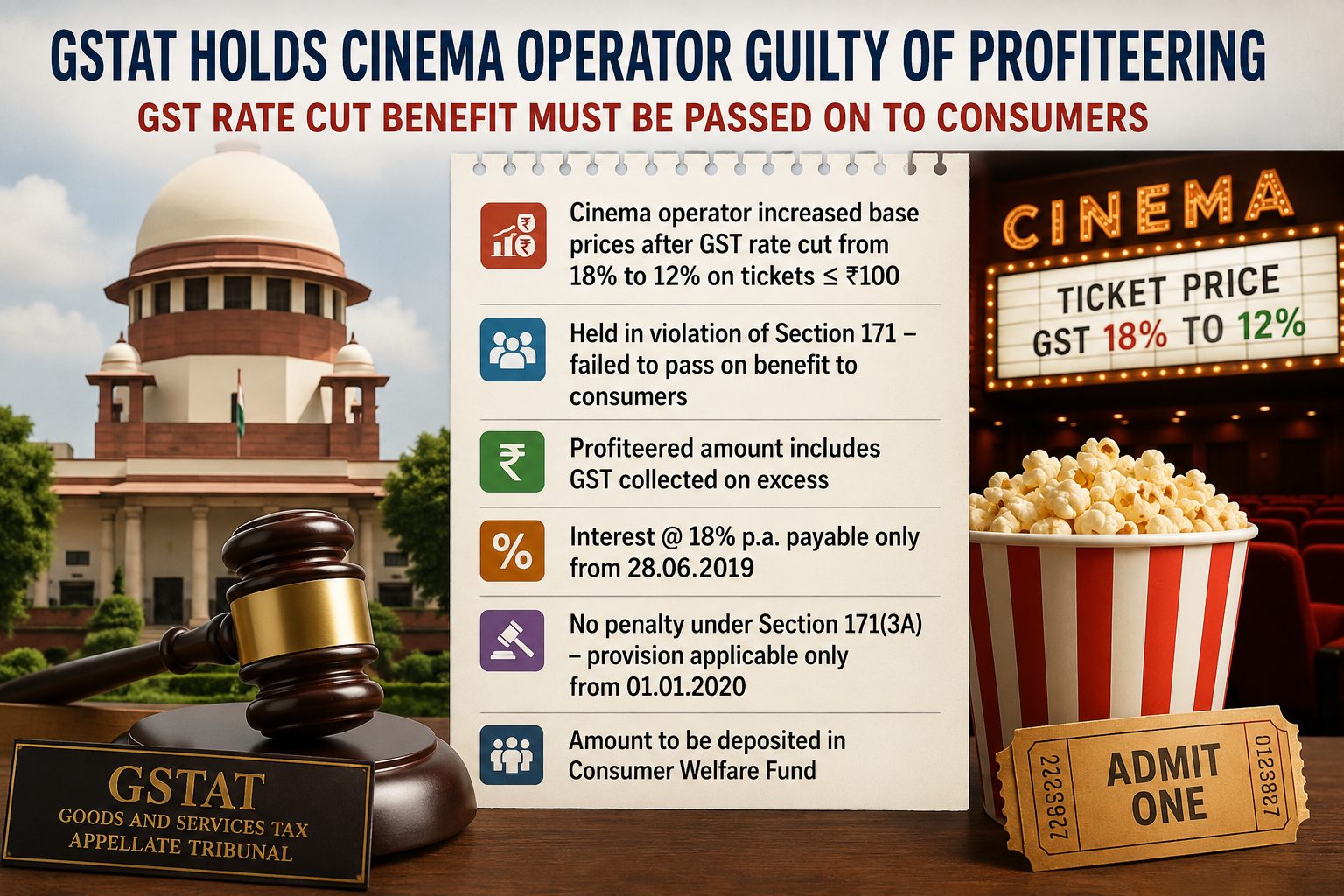
The GST Appellate Tribunal (GSTAT) has passed an ex parte order against M/s ASR Cinemas LLP, holding the multiplex operator guilty of profiteering to the tune of ₹9,67,589 by failing to pass on the benefit of a GST rate cut on cinema admission tickets to consumers. The Tribunal, in a strongly worded order, directed the Respondent to deposit the profiteered amount in the Central and State Consumer Welfare Funds along with interest at 18% per annum.
The Backdrop: GST Rate Cut and the Obligation to Pass It On
The Central Government, acting on the recommendation of the GST Council, reduced the GST rate on cinema admission tickets priced at ₹100 or below — from 18% to 12% — with effect from 1 January 2019, vide Notification No. 27/2018-Central Tax (Rate) dated 31 December 2018.
Under Section 171(1) of the CGST Act, 2017, every supplier is statutorily obligated to pass on any reduction in tax rate to the end consumer by way of a commensurate reduction in prices. The provision was conceived as a legislative anti-profiteering shield, ensuring that tax cuts announced by the Government actually reach the public rather than being pocketed by businesses.
What ASR Cinemas Did
According to the investigation report submitted by the Director General of Anti-Profiteering (DGAP) on 30 April 2024, ASR Cinemas did precisely the opposite of what the law required. Instead of lowering the effective selling price to reflect the 6% GST reduction, the multiplex increased its base ticket prices across all categories — Platinum, Gold Class, and Silver Class — thereby maintaining the identical cum-tax selling price that prevailed before the rate cut.
The DGAP’s analysis, covering the period 1 January 2019 to 30 September 2019, revealed an average base price increase of approximately 5.37% across ticket categories. The following table from the DGAP report illustrates the pattern:
| Ticket Category | Pre-Cut Price (incl. 18% GST) | Post-Cut Price Charged (incl. 12% GST) | What Should Have Been Charged |
|---|---|---|---|
| Platinum (70mm) | ₹100 | ₹100 | ₹94.92 |
| Platinum (35mm) | ₹90 | ₹90 | ₹85.42 |
| Gold Class (70mm) | ₹70 | ₹70 | ₹66.44 |
| Silver Class (70mm) | ₹30 | ₹30 | ₹28.47 |
The total profiteered amount was computed at ₹9,67,589, comprising a base profiteering of ₹8,63,919 plus GST of ₹1,03,670 collected on that excess realization.
The Respondent’s Defence — and the Tribunal’s Rejection
ASR Cinemas sought to justify its pricing by invoking an order dated 8 February 2019 passed by the Hon’ble High Court of Telangana in W.P. No. 2482 of 2019, which permitted theatres to collect their proposed fares pending adjudication of pricing disputes by Government-appointed committees.
The Tribunal rejected this argument outright. Citing the Telangana High Court’s own ruling in Sudarshan Theatre 35MM v. Union of India (W.P. Nos. 4760 and 5351 of 2021), the Tribunal held that any liberty granted under the State’s cinema regulatory framework is conditional and cannot override the statutory mandate of Section 171 of the CGST Act. The High Court had itself observed:
“A plain reading of the said provision of law clearly indicates that the said provision has been introduced to ensure that the supplier of goods and services should not make profit from the reduction of the tax rate under the GST law.”
The Tribunal further noted that ASR Cinemas had placed no material on record to demonstrate compliance with the conditions attached to the High Court’s order, even assuming the order applied to it.
Ex Parte Proceedings: A Pattern of Non-Cooperation
The proceedings before the Tribunal were marked by the Respondent’s persistent non-participation. Despite notices served through multiple modes — email, speed post, and through the jurisdictional Commissionerate — and despite confirmed service of notice (including an acknowledgment dated 13 February 2026 from a Partner of the Respondent company), ASR Cinemas neither appeared for any of the five hearings (held between December 2025 and May 2026) nor filed any written submissions.
The Tribunal, satisfied that principles of natural justice had been complied with, proceeded to adjudicate the matter ex parte under Order IX Rule 6 and Order XVII Rule 2 of the Code of Civil Procedure, 1908.
Interest: 18% — But Only Prospectively
The Tribunal ordered interest at 18% per annum on the profiteered amount under Rule 133(3)(c) of the CGST Rules, 2017. However, relying on the coordinate Bench decision in DGAP v. Proctor & Gamble Group (2025), it held that the interest provision — inserted vide Notification No. 31/2019-Central Tax dated 28 June 2019 — operates only prospectively. Accordingly, interest runs from 28 June 2019 and not from the commencement of the profiteering period (1 January 2019).
Penalty: No Retrospective Application
On the question of penalty under Section 171(3A) — which prescribes a penalty of 10% of the profiteered amount — the Tribunal declined to impose it. The penal provision was brought into force only on 1 January 2020, whereas the entire period of profiteering in this case (1 January 2019 to 30 September 2019) predated its enforcement. Applying the settled principle that penal provisions operate prospectively unless made expressly retrospective, the Tribunal held that penalty was not leviable.
The Directions
The Tribunal issued the following directives:
- Deposit of ₹9,67,589 — 50% in the Central Consumer Welfare Fund and 50% in the State Consumer Welfare Fund, Telangana (since the individual recipients are not identifiable);
- Interest at 18% per annum from 28 June 2019 till the date of actual deposit;
- The amounts to be deposited within 60 days of the order;
- The jurisdictional CGST/SGST Commissioner to ensure compliance and submit a report within three months.
Commentary: A Signal to the Entertainment Sector
This order reinforces a principle that has been consistently applied by GST adjudicatory bodies: regulatory pricing powers under State law do not exempt a supplier from anti-profiteering obligations under the CGST Act. The two operate in parallel, and a High Court order permitting collection of “proposed fares” is not a license to absorb a GST rate cut.
For the cinema exhibition industry — where ticket pricing is often governed by State-level regulatory mechanisms — the ruling serves as a clear warning that the anti-profiteering provisions cut across regulatory silos. The obligation to pass on tax benefits is absolute, non-delegable, and enforceable irrespective of the pricing regime that governs the underlying service.
The matter now shifts to the jurisdictional Commissionerate for enforcement. Whether ASR Cinemas will challenge the order before a higher forum remains to be seen.
– DG Anti Profiteering, Director General… vs. ASR Cinema LLP, 2026-juristway.com-1361-GSTAT(New Delhi)-GST