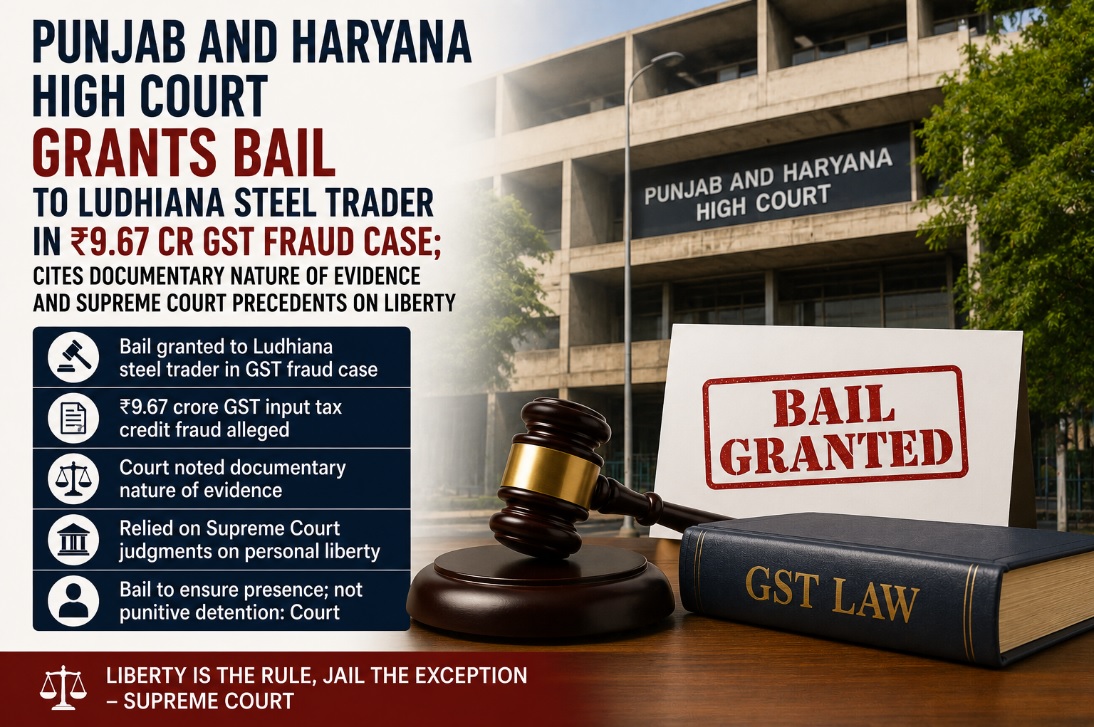
Court holds that a three-and-a-half month custody period, combined with the wholly documentary character of the evidence and the absence of any flight or tampering risk, tilts the scales firmly in favour of bail, irrespective of the gravity of the alleged offence.
Punjab and Haryana High Court, Chandigarh | CHANDIGARH, June 2, 2026
The Punjab and Haryana High Court has granted bail to Rohit Kumar Gupta, proprietor of M/s Maa Steel, Ludhiana, who was arrested on 12 February 2026 in connection with alleged irregularities in Input Tax Credit (ITC) claims totalling approximately ₹9.67 crore under the Central Goods and Services Tax Act, 2017.
Hon’ble Mr. Justice Surya Partap Singh allowed the first bail petition, CRM-M-19525-2026, filed under Section 483 of the Bharatiya Nagarik Suraksha Sanhita (BNSS), 2023, holding that the cumulative effect of settled legal principles and the facts of the case overwhelmingly favoured the petitioner’s release on bail.
Background and Allegations
The petitioner is engaged in the business of trading iron and steel goods through his proprietorship concern, M/s Maa Steel, based in Ludhiana.
According to the State Tax Department, scrutiny of E-Way Bill data for the period from 1 April 2024 to 27 January 2026 revealed systematic issuance and utilisation of invoices without actual movement or supply of goods. The authorities alleged that through these transactions, the petitioner fraudulently availed ineligible Input Tax Credit, causing a loss of approximately ₹9,66,64,194 to the State exchequer.
Based on these allegations, the petitioner was arrested on 12 February 2026 and remained in judicial custody thereafter.
The prosecution invoked Section 132 of the Punjab Goods and Services Tax Act/CGST Act, 2017, read with Section 69 of the CGST Act and Section 187 of the BNSS, 2023. The offences alleged against the petitioner carry a maximum punishment of seven years’ imprisonment.
Petitioner’s Case
Appearing for the petitioner, Mr. Gurkiran Singh contended that the allegations were baseless and unsupported by credible evidence.
It was argued that M/s Maa Steel is a duly registered and functioning business concern and that all relevant documents, including GST invoices, E-Way Bills and purchase records, had already been supplied to the investigating authorities.
The petitioner further pointed out that the department itself had previously sanctioned and processed refund claims after conducting due verification of records. According to the petitioner, this prior departmental verification contradicted the subsequent allegation that the transactions were fictitious.
Counsel emphasised that the petitioner had fully cooperated with the investigation from the very beginning and that all material evidence was documentary in nature and already in the possession of the authorities.
It was submitted that continued incarceration would serve no investigative purpose because:
- All documents had been seized or examined;
- No custodial interrogation was required;
- The petitioner had cooperated throughout the investigation;
- The trial was unlikely to conclude in the near future; and
- The petitioner had already undergone more than three-and-a-half months of incarceration.
The petitioner accordingly sought regular bail.
State’s Opposition
The State, represented by Deputy Advocate General Mr. I.P.S. Sabharwal, opposed the bail application.
The prosecution argued that the allegations involved a serious economic offence resulting in substantial loss to the public exchequer and were supported by substantial documentary material.
It was further submitted that although the petitioner had spent more than three-and-a-half months in custody, the investigation remained ongoing as a large volume of records still required scanning and processing.
The State relied upon the Supreme Court’s decision in CBI v. V. Vijay Sai Reddy (2013) 7 SCC 452, which lays down the factors relevant to the grant of bail, including:
- Nature and gravity of the accusation;
- Severity of punishment upon conviction;
- Likelihood of tampering with evidence;
- Possibility of influencing witnesses; and
- Larger public interest.
Court’s Analysis
Justice Surya Partap Singh undertook a detailed review of Supreme Court jurisprudence governing bail in economic offences before applying those principles to the facts of the present case.
The Court identified seven factors favouring grant of bail.
1. Length of Custody
The petitioner had already undergone more than three-and-a-half months of incarceration.
2. Maximum Punishment
Even if the prosecution case were accepted in its entirety, the offences carry a maximum punishment of seven years.
The Court observed that the Supreme Court has repeatedly granted bail in comparable GST-related prosecutions at relatively early stages of custody.
3. Documentary Nature of Evidence
The Court considered this to be the most significant factor.
All evidence relied upon by the prosecution consisted of documentary and electronic records already collected and available with the department.
Consequently, continued detention was unnecessary for the purposes of investigation.
4. Delay in Trial
The Court found no realistic possibility of the trial concluding in the immediate future.
5. No Investigative Purpose Served
Since the evidence had already been secured, continued incarceration would not advance the investigation.
6. No Risk of Tampering
Nothing on record suggested that the petitioner would tamper with evidence or influence witnesses if released on bail.
7. No Flight Risk
The Court also found no material indicating any possibility that the petitioner would abscond or evade trial.
Reliance on Supreme Court Precedents
The Court extensively relied upon recent Supreme Court decisions emphasising the primacy of personal liberty and the limited role of pre-trial detention.
Referring to Dataram Singh v. State of Uttar Pradesh (2018), the Court reiterated:
“The grant of bail is the general rule and putting a person in jail is an exception. A fundamental postulate of criminal jurisprudence is the presumption of innocence.”
The Court also relied on Vineet Jain v. Union of India (2025 SCC OnLine SC 2331), where the Supreme Court expressed surprise that bail had been denied in a GST prosecution carrying a maximum sentence of five years despite the evidence being entirely documentary. Bail was ultimately granted after seven months of custody.
Similarly, in Ratnambar Kaushik v. Union of India (2023) 2 SCC 621, the Supreme Court granted bail in a CGST evasion case after approximately four months of custody, observing that documentary and electronic evidence generally minimises the possibility of tampering.
The Court further referred to Radhika Aggarwal v. Union of India (2025) 6 SCC 545, where the Supreme Court emphasised that arrest powers under the CGST Act must be exercised strictly in accordance with statutory safeguards and cannot be employed as a coercive mechanism for tax recovery.
Particular reliance was also placed on Ashutosh Garg v. Union of India (SLP (Crl.) No. 8740 of 2024, decided on 26 July 2024), wherein the Supreme Court granted bail in a case involving alleged fake ITC transactions exceeding ₹1,032 crore through 294 firms after approximately nine months of custody.
The High Court observed that if bail could be granted in a case involving allegations of such magnitude, the quantum involved in the present case could not, by itself, justify prolonged pre-trial detention.
The Court also cited the landmark decision in Sanjay Chandra v. CBI (2012), observing:
“Even if the offence is serious in terms of huge loss to the State exchequer, that, by itself, should not deter the Court from enlarging the appellant on bail, when there is no serious contention that the accused will interfere with the trial or tamper with evidence.”
Reliance on Coordinate Bench Decisions
Justice Surya Partap Singh also noted that several coordinate benches of the Punjab and Haryana High Court had recently granted bail in similar prosecutions under Section 132 of the GST laws.
Among the decisions referred to were:
- Atul Aggarwal v. State of Punjab (CRM-M-21915-2026);
- Bhanuj Jindal v. DGGI (CRM-M-881-2026); and
- Arvind Kumar v. DGGI (2025 NC PHHC 65125).
In each of these cases, bail had been granted despite allegations of GST evasion after custody periods of approximately three months or less.
Order
Allowing the petition, the Court directed that the petitioner be released on regular bail upon furnishing appropriate personal bonds and surety bonds to the satisfaction of the Trial Court or Duty Magistrate concerned.
The release was made subject to the following conditions:
- The petitioner shall not directly or indirectly induce, threaten or promise any person acquainted with the facts of the case to withhold information from the Court or investigating authorities;
- The petitioner shall furnish his residential address to the Court and promptly notify any subsequent change of address; and
- The petitioner shall not leave India without obtaining prior permission from the Trial Court.
The Court clarified that the observations contained in the order were confined solely to adjudication of the bail application and would not influence the merits of the trial.
Significance
The judgment reinforces the increasingly consistent judicial approach that pre-trial incarceration in GST fraud prosecutions should remain an exception rather than the norm, particularly where the evidence is entirely documentary and already secured by the investigating authorities.
The decision is especially noteworthy for its detailed reliance on the Supreme Court’s recent rulings in Vineet Jain and Radhika Aggarwal, which have significantly strengthened the protection of personal liberty in GST prosecutions and emphasised that the financial magnitude of an alleged tax fraud cannot, by itself, justify denial of bail.
For taxpayers, professionals and enforcement agencies alike, the ruling serves as a reminder that economic offences, however serious, remain subject to the constitutional principles of presumption of innocence and personal liberty, and that continued custody must be justified by genuine investigative necessity rather than the mere size of the alleged tax demand.
Case: Rohit Kumar Gupta v. State of Punjab through State Tax Officer
Court: Punjab and Haryana High Court
Case No.: CRM-M-19525-2026 (O&M)
Decision Date: 2 June 2026
Judge: Hon’ble Mr. Justice Surya Partap Singh