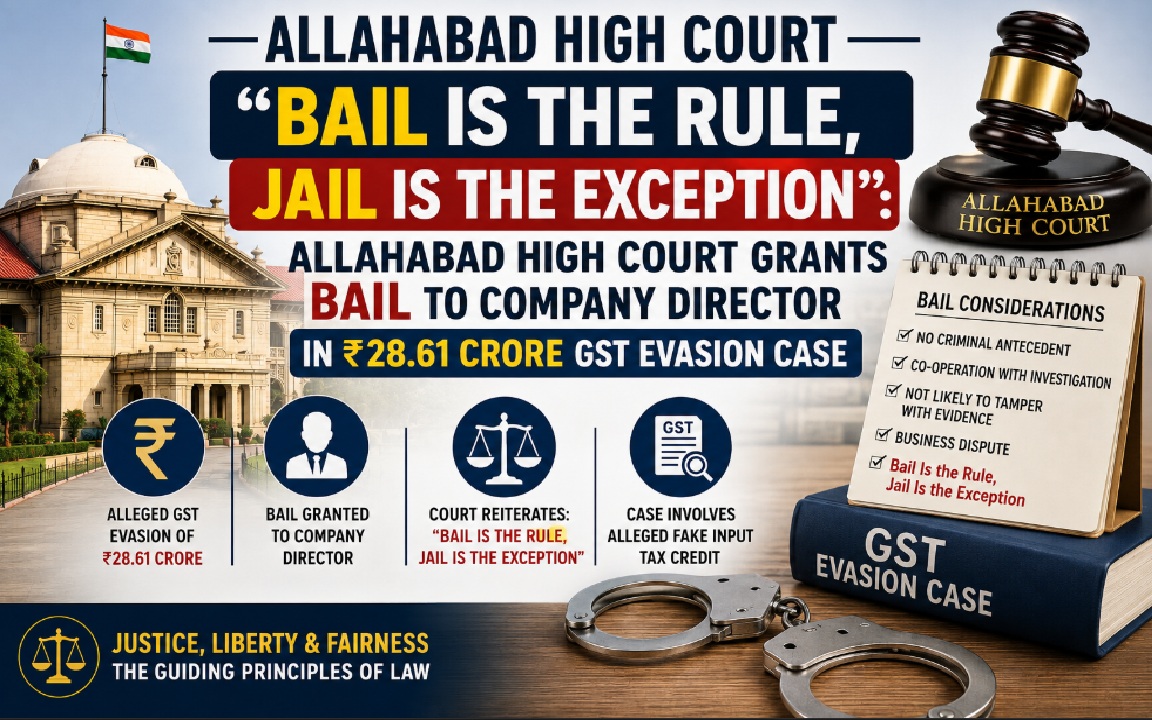
PRAYAGRAJ, May 25, 2026 — Reaffirming the well-settled principle that pre-conviction detention is not meant to be punitive, the Allahabad High Court has granted bail to Dhruv Seth, a director of an online gaming company accused of evading GST to the tune of ₹28.61 crore, holding that the prosecution had failed to demonstrate any exceptional circumstances warranting continued incarceration.
Justice Vikram D. Chauhan, sitting singly, allowed the bail application (No. 14325 of 2026) filed by Seth, who had been in custody since March 15, 2026, in connection with Case Crime No. GEXCOM/AE/INV/GST/1555/2026-AE-P/o-COOMR-CGST-AGRA-A under Sections 132(1)(A), 132(1)(F), and 132(1)(i) of the Central Goods and Services Tax Act, 2017.
The prosecution’s case alleged that the company, M/s Pymplay Advance Gaming Tech (OPC) Pvt. Ltd., was involved in online money gaming and had failed to issue invoices, resulting in a tax evasion of ₹28,61,45,695. The payments received by the aggregator were allegedly transferred into different accounts to facilitate the evasion.
However, the applicant’s counsel, Mahima Singh and Sudhanshu Kumar, argued that the co-accused Sachet Goyal had, in his statement recorded during investigation, specifically stated that Seth had merely provided his documents for the establishment of the company and directorship as a friend, and that the directors were not in direct contact with the handlers — all work was handled by Goyal himself.
The court noted that the maximum punishment under Section 132 of the CGST Act is five years, that the offences are triable by a Magistrate, that the investigation was complete and a complaint had already been filed, and that even if trial were to commence in the near future, it would not conclude within a year.
Citing a string of Supreme Court authorities, including Sanjay Chandra vs. CBI (2012), Satyendra Kumar Antil vs. CBI (2022), Ratnambar Kaushik vs. Union of India (2023), and Manish Sisodia vs. Enforcement Directorate (2024), the court observed that “bail is a rule and jail is an exception” — a principle that has been repeatedly emphasised by the apex court.
The court also placed significant reliance on two recent Supreme Court orders in GST-related bail matters: Atul Mehra vs. Union of India (January 2026), where bail was granted after eight months of detention, and Vineet Jain vs. Union of India (April 2025), where the Supreme Court had expressed surprise that the accused had been denied bail at all levels in a case where the maximum sentence was five years and the prosecution was based on documentary evidence.
“We are surprised to note that in a case like this, the appellant has been denied the benefit of bail at all levels, including the High Court and ultimately, he was forced to approach this Court,” the Supreme Court had remarked in Vineet Jain, adding that “these are the cases where in normal course, before the Trial Courts, the accused should get bail unless there are some extraordinary circumstances.”
The court imposed standard conditions on Seth’s release, including that he shall not tamper with evidence, shall appear before the trial court on all dates, shall not leave India without prior permission, and shall not commit a similar offence while on bail.