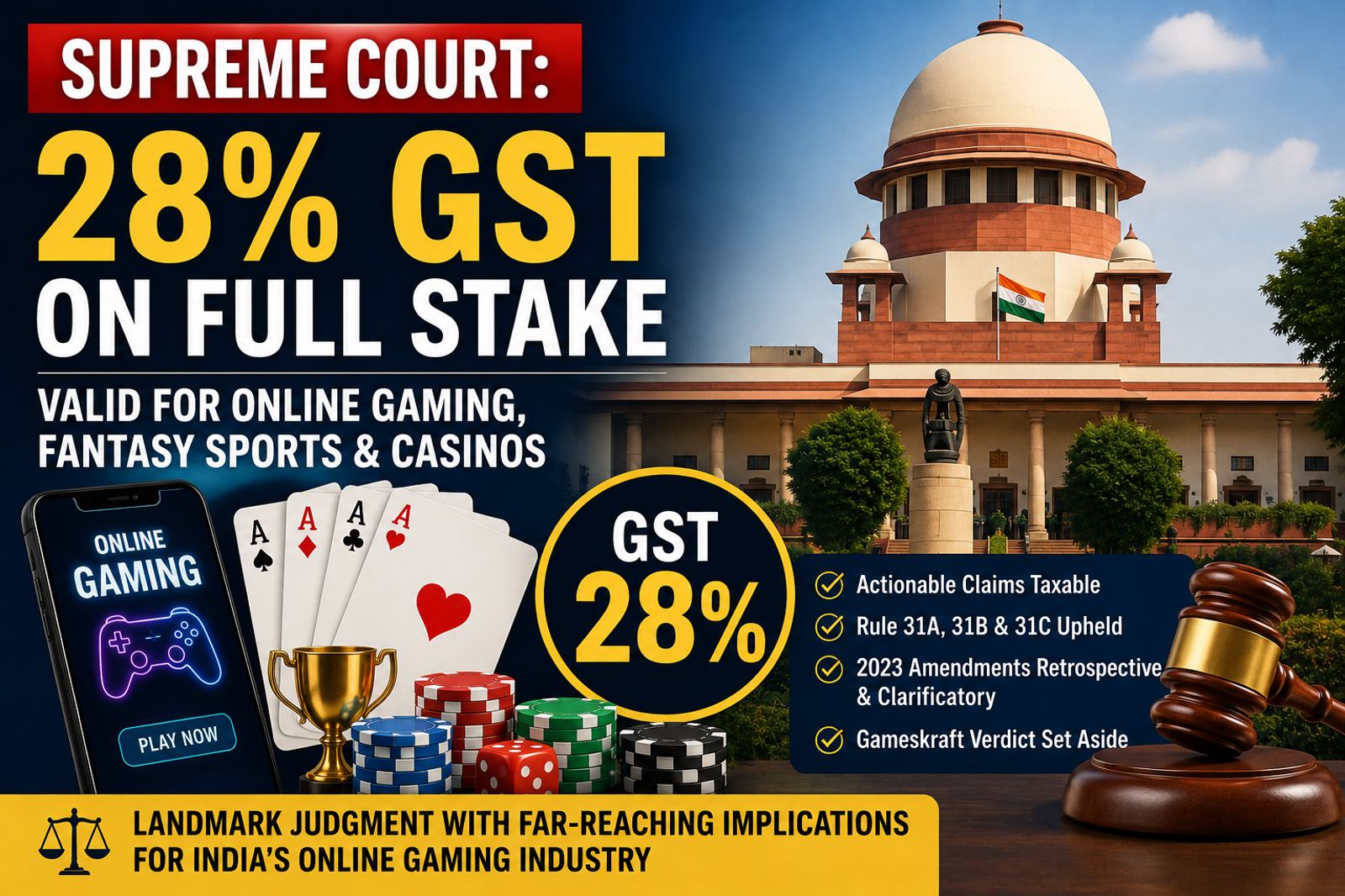
In a sweeping constitutional verdict, a two-judge bench holds that all forms of online staking — regardless of skill or chance — constitute “betting and gambling” for GST purposes, and that the entire amount wagered, not just platform fees, is the taxable value.
Justices J.B. Pardiwala and R. Mahadevan, sitting as a two-judge bench, dismissed a clutch of writ petitions and transferred cases filed by major operators including GamesKraft Technologies, Dream11, Games24x7, Head Digital Works, and casino operators. The bench simultaneously set aside a May 2023 Karnataka High Court order that had quashed show cause notices against GamesKraft, restoring the notices and directing adjudication within tight timelines.
The Central Legal Question
At the heart of the litigation was a deceptively simple question: when a player deposits ₹100 into an online rummy, fantasy cricket, or casino app, should GST attach to the entire ₹100 (the gross betting value approach) or only to the ₹5–₹10 the platform retains as commission (the gross gaming revenue approach)? The difference is enormous — roughly 10 to 20 times the tax liability.
The gaming companies argued that their platforms merely provide a technology service, that players transact with each other, and that classifying games involving skill — such as rummy, poker, or fantasy sports — as “betting and gambling” is constitutionally impermissible. They also challenged the 2023 amendments to the CGST Act and new valuation Rules 31B (online gaming) and 31C (casinos) as imposing a fresh levy retrospectively, in violation of fundamental rights.
“The essential element of betting and gambling lies in staking money or money’s worth upon uncertain outcomes. The character of betting and gambling does not depend exclusively upon whether the underlying activity is a game of skill or a game of chance.”
— Supreme Court of India, paragraph 84(i)
Skill vs. Chance: A New Legal Framework
The Court made a sharp doctrinal departure from prior High Court rulings that had protected fantasy sports and card games as “games of skill.” The bench held that the skill-versus-chance distinction — relevant under State gaming statutes and for Article 19(1)(g) trade rights — is simply irrelevant for the purpose of GST taxation.
What matters for GST, the Court explained, is whether money is staked upon an uncertain outcome. Once a player places real money at risk — regardless of how much skill is involved — the transaction assumes the character of “betting and gambling” under the GST framework. A wager on a chess game, the judgment observed, remains a wager.
The bench also clarified that earlier Supreme Court dismissals of Special Leave Petitions in the Gurdeep Singh Sachar, Varun Gumber, and Avinash Mehrotra matters — which had implied fantasy sports were settled as games of skill — did not constitute binding declarations of law under Article 141 of the Constitution, having been made without speaking orders or comprehensive adjudication on the GST question.
Key Holdings of the Court
- Skill is irrelevant to GST liability. Online gaming, fantasy sports, and casino activities all constitute “betting and gambling” for GST purposes once money is staked upon uncertain outcomes, regardless of the degree of skill involved.
- Full stake is taxable, not just the platform fee. The amount deposited by a player for participation in gameplay constitutes “consideration” under Section 2(31) CGST Act. There is no statutory basis to deduct prize pools, winnings, or payouts while computing taxable value.
- Online gaming companies are suppliers, not mere intermediaries. They create and operate the entire commercial ecosystem; players do not independently transact with each other.
- Actionable claims validly arise from staking. Contingent beneficial interests in pooled stake funds constitute actionable claims under the Transfer of Property Act, and their supply is taxable under the GST framework.
- 2023 CGST amendments are retrospective. The CGST (Amendment) Act, 2023 and Rules 31B and 31C are clarificatory in nature and operate retrospectively — the industry cannot argue these created a fresh levy applying only from October 2023 onwards.
- Rules 31A, 31B, and 31C are constitutionally valid. These valuation rules are intra vires the CGST Act and bear a rational nexus with the taxable event.
- Casino valuation to be redetermined under Rule 31C. While the broad challenge by casino operators fails, actual tax computation must be reconsidered using Rule 31C (total chips/tokens purchased), replacing the Department’s earlier “House Advantage Method.”
The Actionable Claims Analysis
A substantial portion of the 413-page judgment is devoted to establishing that online gaming transactions generate actionable claims — a legal category of goods under the Transfer of Property Act, 1882, and therefore taxable as goods under GST. An actionable claim requires a beneficial interest in movable property, outside the claimant’s possession, and recognisable by civil courts.
The Court held all three ingredients are satisfied: pooled stake funds form present movable property; players relinquish control over funds once committed to gameplay under the platform’s contractual terms; and the organised gaming framework creates legally cognisable rights and obligations between players and the platform, even if direct enforcement between players inter se may be barred by Section 30 of the Contract Act. The voidness of the wager per se does not obliterate the proprietary interest for tax purposes.
The Court also invoked the doctrine of approbation and reprobation: the Federation of Fantasy Sports had itself successfully argued, in earlier service tax proceedings, that fantasy sports involve supply of actionable claims — thereby avoiding service tax. That position cannot now be reversed to escape GST liability.
What Happens Next — Sector by Sector
Online gaming & fantasy sports
GST payable at 28% on the full deposit amount under Rule 31B. Pending show cause notices revived; operators must reply within 8 weeks; authorities to adjudicate within 12 weeks thereafter.
Casinos
GST on total chips or tokens purchased (Rule 31C), not on net earnings retained. Actual tax quantum to be recomputed by adjudicating authorities; factual objections kept open.
GamesKraft & Karnataka HC
Karnataka HC order quashing show cause notices is set aside. Notices restored. GamesKraft to file reply; authority to pass fresh orders on the facts in accordance with this judgment.
Bombay HC / Criminal Appeal
Bombay HC ruling that fantasy sports fall outside GST betting provisions is set aside to that extent. Criminal appeal by the Union allowed; proceedings may be revived in line with the new judgment.
Law and the Digital Economy
The bench closed with a broader observation about the relationship between technology and law. Noting that India stands at an “unprecedented technological transformation driven by artificial intelligence, digital platforms, fintech ecosystems, and blockchain infrastructures,” the Court emphasised that technological innovation cannot operate in a constitutional vacuum insulated from regulation, taxation, and public accountability.
The judgment — running to over 400 pages and authored jointly by Justices Pardiwala and Mahadevan — is expected to trigger fresh GST demands running into tens of thousands of crores against the online gaming industry, which until the 2023 amendments had largely been paying GST at 18 percent on commission income alone. All interim stays granted by various courts in connected matters stand vacated. There is no order as to costs.
Disclaimer: This article is a journalistic summary of the judgment in 2026 INSC 595 (GamesKraft vs. DGGI). It does not constitute legal advice. Readers are advised to consult the full text of the judgment and qualified legal counsel before acting on any information contained herein.