Category: High Court

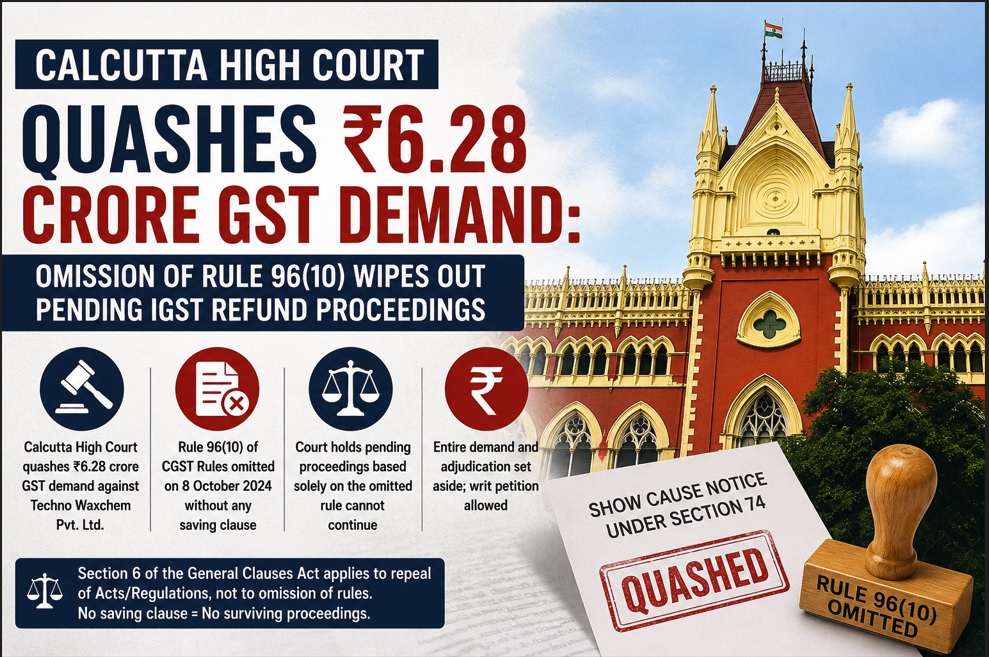
  • Calcutta HC Quashes ₹6.28 Crore GST Demand: Omission of Rule 96(10) Wipes Out Pending IGST Refund Proceedings

    Calcutta HC Quashes ₹6.28 Crore GST Demand: Omission of Rule 96(10) Wipes Out Pending IGST Refund Proceedings

    Kolkata, June 2026 – The Calcutta High Court has quashed a ₹6.28 crore tax demand against Techno Waxchem Private Limited, holding that the Government’s October 2024 decision to omit Rule 96(10) of the CGST Rules leaves no legal basis for continuing any pending enforcement proceedings under that provision. The ruling by Justice Raja Basu Chowdhury adds to a growing body of High Court jurisprudence that has effectively sounded the death knell for all outstanding show-cause notices, adjudication orders, and appeals rooted in the now-deleted anti-double-benefit restriction.


    The Dispute

    Techno Waxchem, a manufacturer and exporter of chemical products primarily used in the rubber industry — including modified formaldehyde resins, resorcinol blends, and related compounds — had, between October 2017 and March 2022, claimed and received IGST refunds totalling ₹6,28,27,407 on goods exported under the Advance Authorisation Scheme.

    Under the Advance Authorisation framework, exporters are permitted duty-free import of inputs. The rub, according to the revenue authorities, was Rule 96(10) of the CGST Rules, 2017. That provision barred an exporter who had availed duty-free imports under specified Customs notifications from simultaneously claiming a refund of IGST paid on the exported finished goods. The logic was to prevent “encashment” of input tax credit accumulated on domestically procured goods against exports manufactured using duty-free imported inputs — a species of double benefit that the rule was designed to foreclose.

    The Director General of GST Intelligence (DGGI) alleged that Techno Waxchem had done exactly that. A show-cause notice dated 27 September 2023 was issued under Section 74 of the CGST Act for the periods 2017–18 through 2021–22. The adjudicating authority confirmed the demand in an order-in-original dated 4 February 2025, directing recovery along with interest under Section 50 and penalty under Section 122(2)(b).


    The Rule That Vanished

    Between the issuance of the show-cause notice and the adjudication order, however, the legal landscape shifted fundamentally. In its 54th meeting, the GST Council accepted the Law Committee’s recommendation to do away with Rule 96(10), observing that the restriction had caused unnecessary complications without yielding any commensurate benefit. On 8 October 2024, the Central Government issued Notification No. 20/2024-Central Tax, which — at Serial No. 10 — simply stated: “In the said rules, in rule 96, sub-rule (10) shall be omitted.”

    No saving clause was inserted. No transitional provision was made. No language preserved pending proceedings. The rule was simply taken off the statute book.

    Techno Waxchem, during the personal hearing before the adjudicating authority, specifically drew attention to this development and argued that the demand could no longer survive. The Proper Officer, however, took the view that the omission was prospective — effective only from 8 October 2024 — and that since the refund was availed and the show-cause notice issued during the rule’s subsistence, the demand remained valid.


    The High Court’s Reasoning

    Justice Raja Basu Chowdhury disagreed. Drawing on two seminal Supreme Court decisions — Rayala Corporation (P) Ltd. v. Director of Enforcement (1969) and Kolhapur Canesugar Works Ltd. v. Union of India (2000) — the Court reaffirmed a proposition that, while well-settled in criminal and excise jurisprudence, is only now being tested in the GST context: Section 6 of the General Clauses Act, 1897, which saves proceedings initiated under a repealed enactment, applies only to the repeal of a Central Act or Regulation. It has no application to the omission of a rule.

    The distinction is not merely semantic. As the Supreme Court held in Rayala Corporation:

    “Section 6 only applies to repeals and not to omissions, and applies when the repeal is of a Central Act or Regulation and not of a rule.”

    And in Kolhapur Canesugar Works, the Constitution Bench reaffirmed the principle, rejecting the Gujarat High Court’s attempt to distinguish Rayala Corporation. The rule, the Court held, takes its colour from the definition in the General Clauses Act — it is not a “statute,” and equating the two is impermissible.

    The consequence is stark: when a rule is omitted without a saving clause, the rule is treated as having never existed. All pending proceedings — show-cause notices awaiting adjudication, orders under challenge before appellate authorities, even writ petitions contesting demands — stand ipso facto terminated.


    A National Consensus Emerges

    Justice Chowdhury’s ruling does not stand alone. The Calcutta High Court drew express support from three other High Courts that have addressed identical questions in recent months.

    The Bombay High Court, in Hikal Limited v. Union of India (2025), held that following the omission of Rules 89(4B) and 96(10), and in the absence of saving clauses, “all pending proceedings — such as undisposed show cause notices, orders disposing of show cause notices issued after 08 October 2024, or even orders made before 08 October 2024 but not yet finalised due to appeals … are not preserved and will stand lapsed.”

    The Gujarat High Court in Addwrap Packaging (P.) Ltd. v. Union of India (2025) arrived at the same conclusion.

    Most recently, the Delhi High Court in Vinayak International Housewares Pvt. Ltd. undertook a comprehensive survey of the precedents and crystallised the position into four clear propositions: the GST Council itself acknowledged that Rule 96(10) caused unnecessary complications; the omission applies to all pending proceedings; anything short of a “transaction past and closed” is caught by the omission; and appeals, pending adjudications, and even show-cause notices all fall within the protective sweep of the deletion.


    “Transactions Past and Closed”

    The operative distinction, as the Bombay High Court framed it, is between proceedings that are alive and those that have attained finality. A demand confirmed by an order that has not been appealed — a “transaction past and closed” — may well stand. But a show-cause notice awaiting adjudication, an order under appeal, or a writ petition against an order — none of these constitutes a concluded transaction. For these, the omission of the underlying rule pulls the rug from under the entire proceeding.

    Since Techno Waxchem’s writ petition was filed against the order-in-original dated 4 February 2025, the matter was very much alive. The Court had little difficulty concluding that “on the omission of Rule 96(10), the order dated 4th February, 2025 no longer survives.”


    Implications for the Field

    The judgment is significant beyond its immediate facts. Rule 96(10) had been one of the most heavily litigated provisions in the GST refund universe. Exporters across sectors — pharmaceuticals, chemicals, engineering goods, textiles — had been hit with demands running into hundreds of crores on the allegation that they had availed the IGST refund route while also holding Advance Authorisation licences or having procured inputs under specified exemption notifications.

    The 54th GST Council meeting may have been motivated by administrative pragmatism — the rule, as the Council observed, created enormous compliance friction without meaningful revenue protection — but the legal effect of a simple omission, unaccompanied by a saving clause, appears to have been more far-reaching than perhaps anticipated. By operation of the principle laid down in Rayala Corporation and Kolhapur Canesugar, the omission has effectively wiped the slate clean.

    Unless the revenue authorities persuade the Supreme Court to take a different view — and the consistent, multi-jurisdictional weight of High Court authority makes that an uphill task — thousands of pending IGST refund demands premised on Rule 96(10) now stand on legally unsustainable ground.


    The Road Ahead

    With four High Courts now speaking in one voice — Bombay, Gujarat, Delhi, and Calcutta — the question is whether the revenue will accept the settled position or attempt to carry the issue to the Supreme Court. The adjudicating authority, in its order, had noted pointedly that “the instant issue has not yet attained finality and the department has opportunity to appeal before Hon’ble Supreme Court against the aforementioned order of Hon’ble Kerala High Court.” That observation, however, concerned the constitutional validity of Rule 96(10) — a question rendered academic by the rule’s omission. The surviving question — the effect of omission without a saving clause — rests on Supreme Court decisions that are over five decades old and have never been doubted.

    For exporters who have been fighting Rule 96(10) demands, the Calcutta High Court’s judgment is the latest — and one of the most lucidly reasoned — endorsements of a position that increasingly looks unassailable.
  • No “Right to Visibility” on AI Platforms: Calcutta High Court Dismisses IndiaMart’s Plea Against ChatGPT

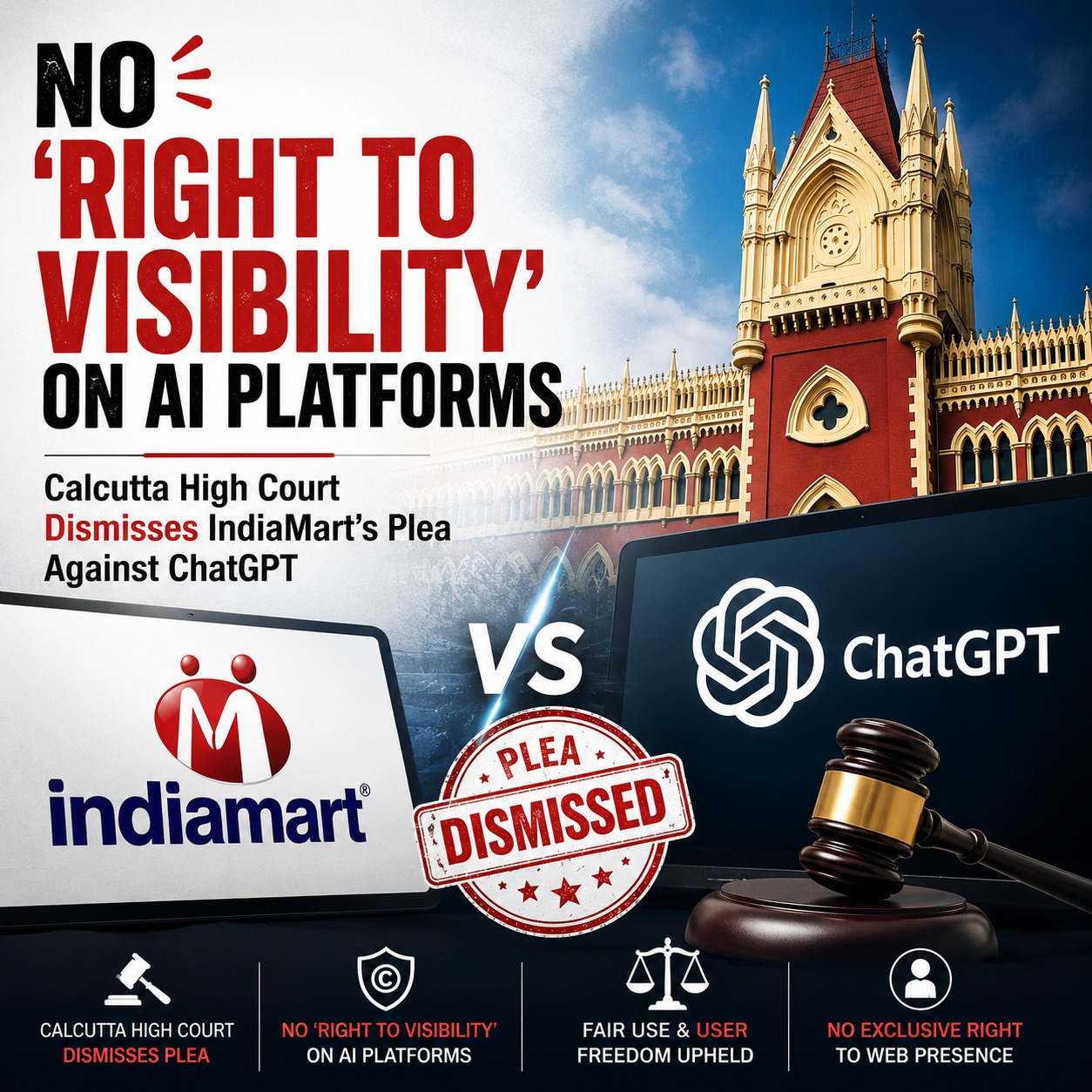
    No “Right to Visibility” on AI Platforms: Calcutta High Court Dismisses IndiaMart’s Plea Against ChatGPT

    IndiaMart Inter Mesh Limited v. Open AI Inc. & Ors. | IP-COM/57/2025 | Calcutta High Court | Justice Ravi Krishan Kapur | May 20, 2026


    Kolkata, May 2026 — In a landmark ruling at the intersection of artificial intelligence, intellectual property, and digital commerce, the Calcutta High Court has dismissed an application for interim relief filed by IndiaMart Inter Mesh Limited — one of India’s largest B2B e-commerce platforms — against Open AI Inc., the company behind the globally popular generative AI tool ChatGPT. Justice Ravi Krishan Kapur held that IndiaMart had failed to demonstrate any legally recognisable right that had been infringed, and that no private enterprise can be compelled to promote or display another party’s business on its platform merely because it is commercially convenient to that party.


    The Dispute — Selective Exclusion or Legitimate Business Decision?

    IndiaMart’s grievance was specific and pointed: when users queried ChatGPT for products available on IndiaMart, the AI tool would bypass IndiaMart’s platform links and instead provide direct links to individual sellers’ websites — while simultaneously providing full platform-level links for competing B2B platforms such as DHGate, Pinduoduo, Shopee, and Taobao. IndiaMart alleged that this constituted deliberate and intentional exclusion of its platform, causing significant loss of user traffic and business revenue. The petitioner characterised this as disparagement, dilution of its registered trademarks, unfair trade practice, and a violation of its fundamental rights under Articles 14, 19, and 21 of the Constitution of India.

    The reason for this exclusion, as it emerged during the proceedings, was that IndiaMart’s name appears on the United States Trade Representative’s (USTR) Review of Notorious Markets List 2024 — a list that Open AI had relied upon as an internal policy basis for restricting IndiaMart’s visibility on ChatGPT. IndiaMart contested this, arguing that the USTR List is a foreign document with no statutory force in India, and that blind reliance on it to discriminate against an Indian platform was impermissible — particularly when other platforms on the same USTR List continued to receive full visibility on ChatGPT.


    The Court’s Ruling — No Legal Right, No Cause of Action

    Justice Kapur dismissed the application on multiple grounds, each of which carries significant implications for the evolving law around AI platforms in India.

    On the most fundamental question, the Court held that IndiaMart had no legally enforceable “right to visibility” on ChatGPT — whether arising from contract, statute, or constitutional law. The loss complained of was pure economic loss — a potential reduction in user traffic translating into a potential loss of profit. Such loss, the Court held, does not by itself give rise to a cause of action. Quoting the Delhi High Court’s ruling in Google LLC v. DRS Logistics (P) Ltd. (2023), Justice Kapur observed: “No third party can compel a service provider to use its service in a manner to reflect its link or for its benefit.” Open AI’s decision to rely on the USTR List was characterised as an internal policy and business decision — one that courts cannot be called upon to second-guess in the absence of a demonstrated legal wrong.

    On the intellectual property claims, the Court was equally unsparing. It found no case of trademark disparagement, as disparagement requires publication of a false statement — and silence or omission cannot constitute disparagement. On trademark dilution under Section 29(4) of the Trade Marks Act, 1999, the Court held that mere referential use of the IndiaMart name does not satisfy the requirement of “use in the course of trade.” On copyright, the Court noted that no specific infringement of any copyrighted work had been pleaded or identified with particulars — arguments made from the Bar were entirely dehors the pleadings.


    The AI Classification Question — Originator or Intermediary?

    Perhaps the most intellectually significant portion of the judgment addresses a question that no Indian court has squarely confronted before: is ChatGPT an “intermediary” or an “originator” under the Information Technology Act, 2000?

    The distinction matters enormously. An intermediary enjoys conditional immunity — “safe harbour” — under Section 79 of the IT Act from liability for third-party content, provided it observes due diligence. An originator, by contrast, is the source of the electronic message and bears primary responsibility for it. IndiaMart had argued that ChatGPT is an intermediary and is therefore bound by the non-discrimination obligation under Rule 3(1)(n) of the IT Rules, 2021. Open AI countered that ChatGPT is an originator — it generates new content rather than merely transmitting existing content.

    Justice Kapur acknowledged that this is a “complicated and vexed question of both law and fact” that can only be finally determined after technical and expert evidence is led at trial. However, for the purposes of the interim application, the Court offered a considered prima facie view: ChatGPT, by virtue of its generative qualities — its ability to synthesise, curate, and produce entirely new content in response to user prompts, going well beyond the function of a search engine or a passive conduit — prima facie falls within the definition of an “originator” rather than an “intermediary.” The Court noted that unlike a search engine, which merely crawls and ranks existing web content, a Large Language Model applies independent algorithms to vast datasets and generates direct, synthesised responses. It can write poems, prepare research projects, generate images — functions that require going beyond existing electronic records and creating new content.

    The Court was careful to flag the deeper legislative gap: the IT Act was drafted in 2000, long before generative AI existed. Its definitions of “intermediary” and “originator” were conceived in a world where only humans or legal entities could originate messages. Generative AI does not fit neatly into either category, and the Court expressly called for legislative intervention — not merely government advisories — to create a distinct liability framework for AI platforms that recognises and distributes liability across developers and users in proportion to their control over the system.


    Balance of Convenience — Against IndiaMart

    Even on the question of balance of convenience, the Court found against IndiaMart. Any interim order directing ChatGPT to display IndiaMart’s links would, in effect, be compelling specific performance of a positive obligation — requiring continuous judicial supervision and being virtually impossible to monitor. The Court also noted a significant factual circumstance: at an earlier point in time, IndiaMart itself had blocked ChatGPT from crawling its website — a fact that considerably undermined its claim of irreparable injury from reduced visibility.


    The Ripple Effect — Does This Judgment Unsettle GST on AI Services Too?

    The judgment’s implications do not stop at the doors of the IP court. A pointed observation buried within it — that ChatGPT is not a search engine but a generator of entirely new content — quietly opens a significant question in Indian tax law: does ChatGPT, and generative AI more broadly, qualify as an Online Information Database Access and Retrieval (OIDAR) service under the GST framework?

    The question matters because under GST, foreign OIDAR service providers are required to register in India and pay GST on their B2C transactions — i.e., services supplied directly to individual consumers who are not registered businesses. Platforms like ChatGPT and Claude have, by default, been treated as OIDAR services and have been expected to comply with this obligation. But the Calcutta High Court’s characterisation of ChatGPT as a creator rather than a retriever puts that assumption under strain.

    The word “OIDAR” is not merely a label — it carries a precise definitional meaning. It refers to services involving access to or retrieval of information or a database. Both “access” and “retrieval” presuppose something pre-existing — a stored record, a queryable database, an archived piece of content waiting to be fetched. That is precisely what a search engine like Google does: it crawls, indexes, and retrieves pre-existing web content in response to a query. But that is not what a Large Language Model does. A generative AI does not retrieve your answer from a database — it synthesises it, token by token, in real time, producing a response that did not exist before you asked the question.

    The Finance Act 2023 did broaden the OIDAR definition by removing the earlier requirement of “minimal human intervention” — an amendment that was widely understood to bring more digital services within the GST net. But crucially, it left the words “access” and “retrieval” untouched. The definitional gap, therefore, remains very much alive.

    If a well-advised taxpayer were to press this argument in a tax dispute, the consequences could be considerable. For B2B transactions, the impact is limited — registered Indian businesses are already required to pay GST on reverse charge, regardless of the OIDAR classification. But for B2C transactions, the stakes are higher: if generative AI services fall outside the OIDAR definition, the obligation on foreign AI providers to register in India and collect GST from individual users may simply not apply. That would represent a significant revenue collection gap — and, more troublingly, a structural arbitrage against Indian digital service providers who are fully subject to GST on equivalent services.

    The deeper issue is one of conceptual architecture. OIDAR was designed for a retrieval economy — search engines, streaming platforms, database downloads. Generative AI is a creation economy. The law was built for a world where digital services delivered pre-existing content; it has not yet reckoned with a world where the service itself is the act of creation. The Calcutta High Court has, perhaps inadvertently, handed tax practitioners a powerful new argument. Interesting times lie ahead.


    Why This Judgment Matters

    This is the first Indian High Court ruling to substantively engage with the legal status of a generative AI platform under the IT Act framework, and its implications extend well beyond the parties before the Court. Three takeaways stand out for businesses, technologists, and policymakers alike.

    First, there is no “right to algorithmic visibility.” Businesses cannot claim a legal entitlement to appear in the results generated by an AI platform — or any private digital platform — merely because their exclusion causes them economic harm. The law of pure economic loss does not recognise such a claim in the absence of a specific legal duty owed by the defendant to the claimant.

    Second, the USTR List, while not a legally binding document in India, can inform the internal policies of private platforms operating in India. Courts will not ordinarily interfere with such internal policy decisions in the absence of a demonstrated violation of a substantive legal right.

    Third, and most significantly, India urgently needs a legislative framework for AI liability — and, as this judgment now suggests, AI taxation. The IT Act’s binary of “intermediary” and “originator” is ill-equipped to handle generative AI, and the GST framework’s OIDAR definition may be equally unprepared. Until Parliament acts on both fronts, courts and tribunals will be left to navigate this terrain case by case — a process that is neither efficient nor conducive to legal certainty for an industry growing at extraordinary speed.

    The suit itself has been directed to proceed to an expeditious final hearing, where these questions — particularly the intermediary/originator classification — will be decided conclusively on the basis of technical and expert evidence.

    With courtesy to Mr. Manish Sachdeva.